 DecodedCars
2025 Toyota Tundra
Trims, performance, features, fuel economy, safety and known problems — with the pros and cons against similar 2025 models.
- Class
- Standard Pickup Trucks 2WD
- Body styles
- Crewmax Hybrid L/Box, Crewmax Hydrid M/Box, Crewmax L/Box 4WD, Crewmax M/Box 4WD
- Engines
- 3.4L 6-cyl turbo
- Horsepower
- 389 hp
- Transmission
- 10-speed automatic
- Drivetrain
- Rear-Wheel Drive, Part-time 4-Wheel Drive
- Seats
- 5
- Fuel
- Hybrid, Regular Gasoline
- MPG (best)
- 22 combined · 20 city / 24 hwy
- Length
- 233.5–252.8 in
- Curb weight
- 5,291–6,096 lb
- NHTSA rating
- ★★★★★
- Recalls
- 5 campaigns
Pros & cons
What's good
- Hybrid version availableOffered as a hybrid as well as gas.
- AWD / 4WD available
- 5-star NHTSA safety ratingTop overall score in federal crash tests.
- Lots of standard safety tech5 of 5 key driver aids standard on the versions we checked.
Watch out for
- 5 recallsMore than similar models (about 0). Confirm repairs with the VIN.
Calculated from EPA, NHTSA and vPIC data — not a review. How we calculate this →
Overview
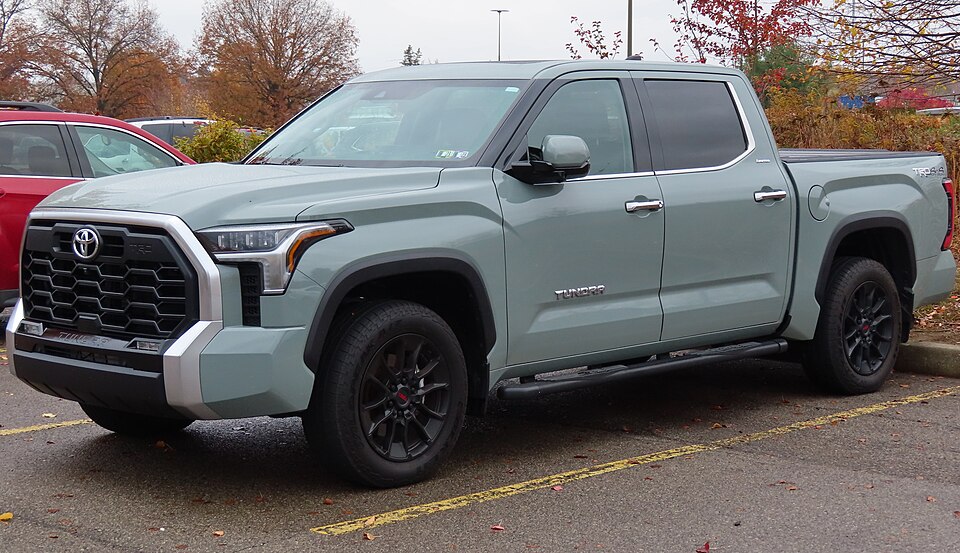
The 2025 Toyota Tundra is a standard pickup truck offered with a 3.4L 6-cyl turbo engine, including a hybrid version and rear-wheel drive and part-time 4-wheel drive.
It measures about 246 inches long and 80 inches wide on a 158-inch wheelbase, with a curb weight of roughly 6,096 lb (Crewmax Hybrid L/Box).
EPA rates its most efficient version at 22 MPG combined (20 city / 24 highway), 7% better than the 2025 standard pickup truck average of 20.5 MPG, for an estimated $3,050 a year in fuel.
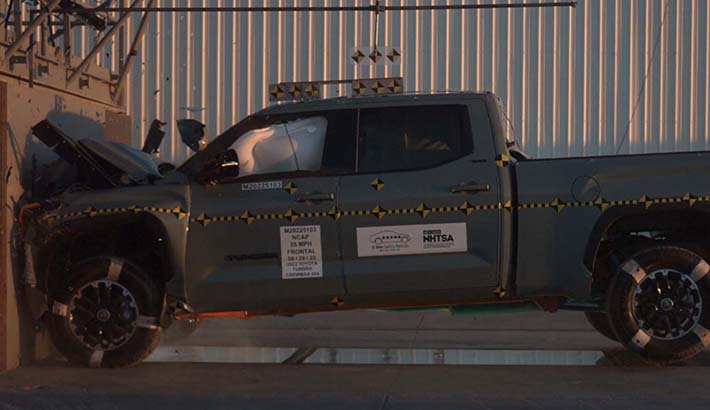
In NHTSA crash testing it earned the top 5-star overall rating.
It has 5 recall campaigns on file and owners have filed 142 complaints with NHTSA since 2015, most often about the engine.
What changed for 2025
- Lightest version 198 lb heavier
Compared with 2024; trim, feature and price changes aren't covered. See the 2024 Tundra →
Trims, performance & features
Trims
Safety & driver-assist features
Built in: San Antonio, Texas
NHTSA vPIC, as reported by the manufacturer for 5 2025 Tundra configurations; may not list every trim. How we calculate this →
Dimensions & weight
| Body | Length | Width | Height | Wheelbase | Track F / R | Curb weight | Weight F/R |
|---|---|---|---|---|---|---|---|
| Crewmax Hybrid L/Box | 245.7 in | 79.9 in | 78 in | 157.9 in | 68.9 / 68.9 in | 6,096 lb | |
| Crewmax Hydrid M/Box | 233.5 in | 79.9 in | 78 in | 145.7 in | 68.9 / 68.9 in | 6,008 lb | |
| Crewmax L/Box 4WD | 245.7 in | 79.9 in | 78 in | 157.9 in | 68.9 / 68.9 in | 5,622 lb | |
| Crewmax M/Box 4WD | 233.5 in | 79.9 in | 78 in | 145.7 in | 68.9 / 68.9 in | 5,390 lb | |
| Double Cab L/Box 2WD | 252.8 in | 79.9 in | 76 in | 164.6 in | 68.9 / 68.9 in | 5,291 lb | |
| Double Cab L/Box 4WD | 252.8 in | 79.9 in | 78 in | 164.6 in | 68.9 / 68.9 in | 5,567 lb |
Transport Canada CVS (Open Government Licence – Canada), Canadian-market figures.
Will it fit your garage? Check with your measurements →Engines, MPG & running costs
| Version | Engine | Transmission | Drive | City / Hwy / Comb | vs. class | Fuel / yr | CO₂ g/mi |
|---|---|---|---|---|---|---|---|
| Tundra 2WD Hybrid | 3.4L 6-cyl turbo | Automatic (S10) | Rear-Wheel Drive | 20 / 24 / 22 | +7% | $3,050 | 409 |
| Tundra 2WD | 3.4L 6-cyl turbo | Automatic (S10) | Rear-Wheel Drive | 18 / 23 / 20 | -2% | $3,350 | 450 |
| Tundra 2WD | 3.4L 6-cyl turbo | Automatic (S10) | Rear-Wheel Drive | 18 / 23 / 20 | -2% | $3,350 | 442 |
| Tundra 4WD Hybrid | 3.4L 6-cyl turbo | Automatic (S10) | Part-time 4-Wheel Drive | 19 / 22 / 20 | +10% | $3,350 | 439 |
| Tundra 4WD | 3.4L 6-cyl turbo | Automatic (S10) | Part-time 4-Wheel Drive | 17 / 22 / 19 | +4% | $3,550 | 460 |
| Tundra 4WD | 3.4L 6-cyl turbo | Automatic (S10) | Part-time 4-Wheel Drive | 17 / 22 / 19 | +4% | $3,550 | 468 |
| Tundra 4WD PRO Hybrid | 3.4L 6-cyl turbo | Automatic (S10) | Part-time 4-Wheel Drive | 18 / 20 / 19 | +4% | $3,550 | 461 |
EPA estimates; "vs. class" is combined MPG against the 2025 EPA class average. How we calculate this →
Safety ratings & technology
| Version | Overall | Frontal | Driver / passenger | Side | Side pole | Rollover | Rollover risk |
|---|---|---|---|---|---|---|---|
| 2025 Toyota TUNDRA PU/CC 4WD | ★★★★★ | ★★★★★ | 5★ / 5★ | ★★★★★ | ★★★★★ | ★★★★★ | 18.5% |
| 2025 Toyota TUNDRA PU/CC RWD | ★★★★★ | ★★★★★ | 5★ / 5★ | ★★★★★ | ★★★★★ | ★★★★★ | 19.8% |
| 2025 Toyota TUNDRA PU/EC 4WD | Not rated | Not rated | –★ / –★ | Not rated | Not rated | ★★★★★ | 18.5% |
| 2025 Toyota TUNDRA PU/EC RWD | Not rated | Not rated | –★ / –★ | Not rated | Not rated | ★★★★★ | 19.8% |

Similar 2025 standard pickup trucks
| Model | Best MPG / range | NHTSA overall | Recalls |
|---|---|---|---|
| 2025 Toyota Tundra (this car) | 22 MPG | ★★★★★ | 5 |
| 2025 Ford F-150 | 23 MPG | Not rated | 16 |
| 2025 GMC Sierra | 26 MPG | Not rated | 4 |
Recalls (5)
Equipment › Other › Labels · Sep 2, 2026
NHTSA campaign 26V571000 · 135 vehicles
- Problem
- Toyota Motor Engineering & Manufacturing (Toyota) is recalling certain 2024 Toyota Tacoma Hybrid, 2025 Tundra Hybrid, Tundra, 2026 RAV4 Hybrid, 4Runner i-Force Max Hybrid, and 4Runner vehicles. The load carrying capacity modification label may display inaccurate added weight values. As such, these vehicles fail to comply with the requirements of Federal Motor Vehicle Safety Standard number 110, "Tire Selection and Rims."
- Risk
- A vehicle with an incorrect maximum capacity weight value may be overloaded, increasing the risk of a crash.
- Fix
- Dealers will replace the load carrying capacity modification label, free of charge. Owner notification letters are expected to be mailed October 18, 2026. Owners may contact Toyota's customer service at 1-800-331-4331. Toyota's number for this recall is 26TA18.
Equipment › Other › Labels · Mar 24, 2026
NHTSA campaign 26V179000 · 8,230 vehicles
- Problem
- Toyota Motor Engineering & Manufacturing (Toyota) is recalling certain 2024-2025 Toyota Tundra, Tacoma Hybrid, Tacoma, RAV4 Hybrid, Land Cruiser Hybrid, Lexus GX550, 2024-2026 Tundra Hybrid, 2025 Sequoia Hybrid, Crown Signia, Grand Highlander, Lexus TX500 Hybrid, Lexus NX350 Hybrid, 2025-2026 Grand Highlander Hybrid, and Lexus TX350 vehicles. The load carrying capacity modification label may display inaccurate added weight values. As such, these vehicles fail to comply with the requirements of Federal Motor Vehicle Safety Standard number 110, "Tire Selection and Rims."
- Risk
- A vehicle with an incorrect maximum capacity weight value may be overloaded, which can increase the risk of a crash.
- Fix
- Dealers will replace the load carrying capacity modification label, free of charge. Owner letters were mailed May 26, 2026. Owners may contact Toyota's customer service at 1-800-331-4331. Toyota's numbers for this recall are 26LB04, 26LA04, 26TB07, and 26TA07.
Back Over Prevention › Software · Jan 23, 2026
NHTSA campaign 26V038000 · 161,268 vehicles
- Problem
- Toyota Motor Engineering & Manufacturing (Toyota) is recalling certain 2024-2025 Toyota Tundra and Tundra Hybrid vehicles equipped with a Panoramic View Monitor (PVM) system. The rearview camera image may not display when the vehicle is placed in reverse. As such, these vehicles fail to comply with the requirements of Federal Motor Vehicle Safety Standard (FMVSS) number 111, "Rear Visibility."
- Risk
- A rearview camera image that does not display reduces the driver's view behind the vehicle, increasing the risk of a crash.
- Fix
- Dealers will update the parking assist ECU software, free of charge. Owner notification letters were mailed March 23, 2026. Owners may contact Toyota's customer service at 1-800-331-4331. Toyota's numbers for this recall are 26TB02 and 26TA02.
Back Over Prevention › Software · Oct 1, 2025
NHTSA campaign 25V657000 · 393,838 vehicles
- Problem
- Toyota Motor Engineering & Manufacturing (Toyota) is recalling certain 2022-2025 Tundra, Tundra Hybrid, and 2023-2025 Sequoia Hybrid vehicles. A software error may cause the rearview image not to display when the vehicle is placed in reverse. As such, these vehicles fail to comply with the requirements of Federal Motor Vehicle Safety Standard (FMVSS) number 111, "Rear Visibility."
- Risk
- A rearview image that does not display reduces the driver's view behind the vehicle, increasing the risk of a crash.
- Fix
- Dealers will update the multimedia display software, free of charge. Owner notification letters were mailed November 19, 2025. Owners may contact Toyota's customer service at 1-800-331-4331. Toyota's numbers for this recall are 25TB10 and 25TA10.
Exterior Lighting › Back Up Lights · May 15, 2025
NHTSA campaign 25V322000 · 443,444 vehicles
- Problem
- Toyota Motor Engineering & Manufacturing (Toyota) is recalling certain 2022-2025 Toyota Tundra and Tundra Hybrid vehicles. Moisture may enter the reverse light assemblies and cause a light failure.
- Risk
- Reverse light failure may reduce visibility, and not alert pedestrians and other drivers that the vehicle is backing up, increasing the risk of a crash.
- Fix
- Dealers will replace both reverse light assemblies and repair the wire harnesses as necessary, free of charge. Owner letters were mailed May 23, 2026. This is a phased recall. Owners may contact Toyota's customer service at 1-800-331-4331.Toyota's numbers for this recall are 24TB06 and 24TA06.
Not every 2025 Toyota Tundra is affected — only a VIN check confirms your car.
Owner-reported problems
Unverified owner reports; best-sellers collect more.
Used 2025 Toyota Tundra buyer's checklist
- Run the VIN at nhtsa.gov/recalls. 5 recalls this year — ask for proof of repairs.
- Engine — 47 owner reports. Cold-start the engine, listen for knocking, and watch for warning lights or hesitation on acceleration.
- Power Train — 37 owner reports. Test-drive through all gears, including reverse; note slipping, harsh or delayed shifts.
- Fuel/Propulsion System — 26 owner reports. Smell for fuel around the car and in the cabin, check that it starts easily when warm, and look at the oil dipstick for a fuel smell or rising level.
- Mileage to watch. Owners typically reported problems around 4,605 miles; ask what was repaired near that point.
- Hybrid system. Check for hybrid-system warning lights and ask whether the high-voltage battery has been replaced or is still under warranty.
- Before you pay: service records, a history report and an independent inspection.
Generated by DecodedCars from NHTSA recalls and owner complaints for the 2025 Toyota Tundra. Not a substitute for a professional inspection.
Other Tundra years
Compare all years →| Year | MPG (best) | Length | Overall | Recalls | Complaints |
|---|---|---|---|---|---|
| 2026 Tundra | 22 | 245.7 in | Not rated | 2 | 37 |
| 2024 Tundra | 22 | 245.7 in | ★★★★★ | 10 | 353 |
| 2023 Tundra | 22 | 245.7 in | ★★★★★ | 13 | 414 |
| 2022 Tundra | 22 | 245.7 in | ★★★★★ | 13 | 434 |
| 2021 Tundra | 15 | 226 in | ★★★★★ | 2 | 24 |
| 2020 Tundra | 15 | 226 in | ★★★★★ | 4 | 47 |
| 2019 Tundra | 16 | 226 in | ★★★★★ | 9 | 74 |
| 2018 Tundra | 16 | 226 in | ★★★★★ | 8 | 100 |
| 2017 Tundra | 16 | 226 in | ★★★★★ | 5 | 78 |
| 2016 Tundra | 17 | 226 in | Not rated | 5 | 120 |
| 2015 Tundra | 17 | 226 in | Not rated | 4 | 51 |
| 2014 Tundra | 17 | 226 in | Not rated | 4 | 78 |
Sources: EPA, NHTSA, Transport Canada, Wikimedia Commons. Not affiliated with NHTSA, the EPA or Toyota. How we calculate this →