 DecodedCars
Ford Ranger 2011
Versiones, desempeño, equipamiento, consumo, seguridad y problemas conocidos, con sus ventajas y desventajas frente a modelos similares 2011.
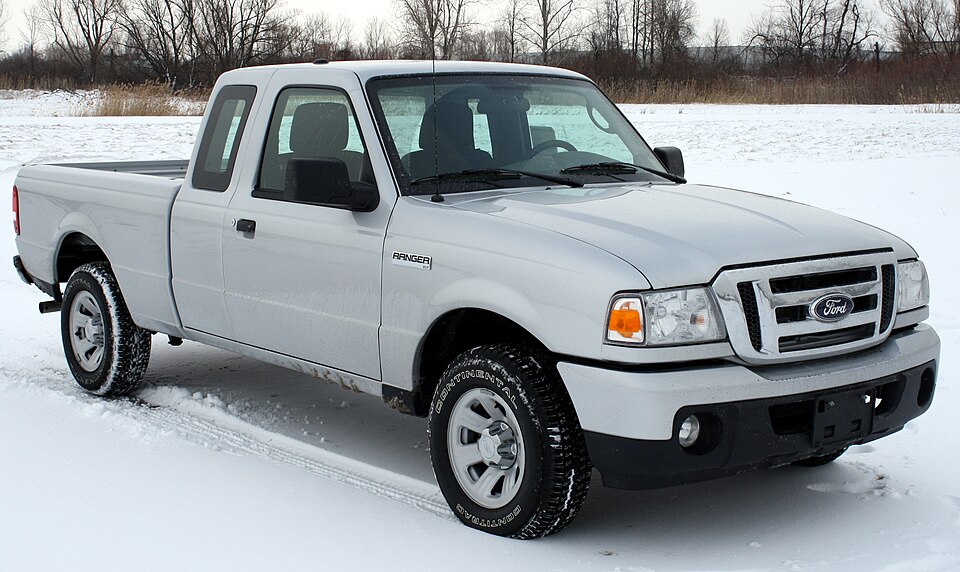
- Clase
- Pickup pequeña (2WD)
- Carrocerías
- Reg Cab Styleside S/Box, Super Cab Styleside S/Box Sport/Xlt 4x, Super Cab Styleside S/Box Xl/Sport 4x2
- Motores
- 2.3L 4 cil., 4.0L 6 cil.
- Tracción
- Tracción trasera, Tracción 4x4
- Combustible
- Gasolina regular
- MPG (mejor)
- 24 combinadas · 22 ciudad / 27 carretera
- Largo
- 187.4–201.6 in
- Peso en vacío
- 3,069–3,600 lb
- Calificación NHTSA
- Sin calificar
- Retiros
- 5 campañas
Ventajas y desventajas
Lo bueno
- Excelente consumo de combustibleHasta 24 MPG combinadas: un 26 % mejor que el promedio de su clase (pickup pequeña, 2011: 19.1 MPG).
- Tracción total / 4x4 disponible
A tener en cuenta
- Retiro con aviso de "no conducir"Verifica que la reparación del retiro esté hecha antes de comprarlo o manejarlo.
Calculado con datos de la EPA, la NHTSA y vPIC; no es una reseña. Cómo lo calculamos →
Resumen
El Ford Ranger 2011 es una pickup pequeña disponible con 2 motores (2.3L 4 cil. y 4.0L 6 cil.), con tracción trasera y tracción 4x4.
Mide unas 187 pulgadas de largo y 69 de ancho, con una distancia entre ejes de 112 pulgadas, y pesa alrededor de 3,069 lb (Reg Cab Styleside S/Box).
La EPA califica su versión más eficiente con 24 MPG combinadas (22 en ciudad / 27 en carretera), un 26 % mejor que el promedio de su clase (pickup pequeña, 2011: 19.1 MPG), con un gasto estimado de $2,800 al año en combustible.
La NHTSA no ha publicado una calificación general de 5 estrellas para este año modelo.
Tiene 5 campañas de retiro registradas y los propietarios han presentado 223 quejas ante la NHTSA desde 2015, sobre todo por problemas de bolsas de aire.
Novedades del 2011
Sin cambios en motores, versiones, tracción, tamaño, consumo EPA ni calificación NHTSA respecto al Ranger 2010: un año sin cambios según los datos.
Comparado con 2010; no incluye cambios de versiones, equipamiento ni precio. Ver el Ranger 2010 →
Dimensiones y peso
| Carrocería | Largo | Ancho | Alto | Distancia entre ejes | Vía del. / tras. | Peso en vacío | Peso del./tras. |
|---|---|---|---|---|---|---|---|
| Reg Cab Styleside S/Box | 187.4 in | 69.3 in | 63.8 in | 111.8 in | 58.7 / 57.5 in | 3,069 lb | 60/40 |
| Super Cab Styleside S/Box Sport/Xlt 4x | 201.6 in | 69.3 in | 67.7 in | 125.6 in | 58.7 / 57.5 in | 3,600 lb | 60/40 |
| Super Cab Styleside S/Box Xl/Sport 4x2 | 201.6 in | 69.3 in | 65 in | 125.6 in | 58.7 / 57.5 in | 3,234 lb | 60/40 |
Transport Canada CVS (Open Government Licence – Canada), medidas del mercado canadiense.
¿Cabe en tu garaje? Compruébalo con tus medidas →Motores, consumo y costo de uso
| Versión | Motor | Transmisión | Tracción | Ciudad / Carr. / Comb. | vs. su clase | Combustible / año | CO₂ g/mi |
|---|---|---|---|---|---|---|---|
| Ranger 2WD | 2.3L 4 cil. | Manual 5-spd | Tracción trasera | 22 / 27 / 24 | +26% | $2,800 | 370 |
| Ranger 2WD | 2.3L 4 cil. | Automática 5-spd | Tracción trasera | 19 / 23 / 20 | +5% | $3,350 | 444 |
| Ranger 2WD | 4.0L 6 cil. | Manual 5-spd | Tracción trasera | 16 / 21 / 18 | -6% | $3,700 | 494 |
| Ranger 2WD | 4.0L 6 cil. | Automática 5-spd | Tracción trasera | 15 / 20 / 17 | -11% | $3,950 | 523 |
| Ranger 4WD | 4.0L 6 cil. | Manual 5-spd | Tracción 4x4 | 15 / 19 / 17 | -4% | $3,950 | 523 |
| Ranger 4WD | 4.0L 6 cil. | Automática 5-spd | Tracción 4x4 | 15 / 18 / 16 | -10% | $4,200 | 555 |
Estimaciones de la EPA; "vs. su clase" compara las MPG combinadas con el promedio 2011 de su clase EPA. Cómo lo calculamos →
Calificaciones de seguridad y tecnología
La NHTSA no ha publicado calificaciones de 5 estrellas para el Ford Ranger 2011.
Pickup pequeña similares 2011
| Modelo | Mejor MPG / autonomía | General NHTSA | Retiros |
|---|---|---|---|
| Ford Ranger 2011 (este auto) | 24 MPG | Sin calificar | 5 |
| Suzuki Equator 2011 | 21 MPG | Sin calificar | 1 |
Retiros (5)
Texto oficial de la NHTSA (en inglés).
Bolsas de aire › Frontal › Driver Side › Inflator Module · 10 mar 2021
Campaña NHTSA 21V158000 · 2,602,668 vehículos
- Problema
- Ford Motor Company (Ford) is recalling certain 2007-2011 Ranger, 2006-2012 Fusion, Lincoln Zephyr, Lincoln MKZ, 2006-2011 Mercury Milan, 2007-2010 Ford Edge, and Lincoln MKX vehicles. The driver's side air bag inflator may explode due to propellant degradation occurring after long-term exposure to high absolute humidity, high temperatures, and high temperature cycling.
- Riesgo
- An inflator explosion may result in sharp metal fragments striking the driver or other occupants, resulting in serious injury or death.
- Solución
- Ford will notify owners, and dealers will replace the driver-side airbag inflator or module with an alternate one, free of charge. Owner notification letters were mailed on April 9, 2021 for the passenger side, and November 14, 2022 for the driver side. Owners may contact Ford customer service at 1-866-436-7332. Ford's number for this recall is 21S12.
Bolsas de aire › Frontal › Passenger Side › Inflator Module · 16 feb 2021
Campaña NHTSA 21V081000 · 1,067 vehículos
- Problema
- Ford Motor Company (Ford) is recalling certain 2005-2014 Mustang, 2004-2011 Ranger, 2009-2011 Mercury Milan, 2006 Ford GT, 2008-2012 Fusion, 2007-2010 Edge and Lincoln MKX, and 2009-2010 Lincoln MKZ vehicles. These vehicles may be equipped with a driver or passenger frontal air bag inflator used as a replacement service part, that may explode due to propellant degradation occurring after long-term exposure to high absolute humidity, temperature and temperature cycling.
- Riesgo
- In the event of a crash necessitating deployment of the frontal air bag, an inflator explosion may result in sharp metal fragments striking the driver or other occupants resulting in serious injury or death.
- Solución
- Ford will notify owners, and dealers will inspect the driver and passenger air bag module, and replace either the module or the inflator, if necessary, free of charge. The recall began March 17, 2021. Owners may contact Ford customer service at 1-866-436-7332. Ford's number for this recall is 21S05.
Bolsas de aire › Frontal › Passenger Side › Inflator Module · 7 ene 2019 No conducir
Campaña NHTSA 19V001000 · 782,384 vehículos
- Problema
- Ford Motor Company (Ford) is recalling certain 2014 Ford Mustang vehicles sold, or ever registered, in the states of Alabama, California, Florida, Georgia, Hawaii, Louisiana, Mississippi, South Carolina, Texas, Puerto Rico, American Samoa, Guam, the Northern Mariana Islands (Saipan), and the U.S. Virgin Islands or "Zone A." Additionally, Ford is recalling certain 2011 Ford Ranger and Mercury Milan vehicles, 2011-2012 Ford Fusion and Lincoln Zephyr/MKZ vehicles and 2011-2014 Ford Mustang vehicles sold, or ever registered, in the states of Arizona, Arkansas, Delaware, District of Columbia, Illinois, Indiana, Kansas, Kentucky, Maryland, Missouri, Nebraska, Nevada, New Jersey, New Mexico, North Carolina, Ohio, Oklahoma, Pennsylvania, Tennessee, Virginia, and West Virginia or "Zone B." Ford is also recalling certain 2010 Ford Edge and Lincoln MKX vehicles, 2010-2011 Ford Ranger and Mercury Milan vehicles, 2010-2012 Ford Fusion and Lincoln Zephyr/MKZ vehicles, and 2010-2014 Ford Mustang vehicles sold, or ever registered, in the states of AK, CO, CT, ID, IA, ME, MA, MI, MN, MT, NH, NY, ND, OR, RI, SD, UT, VT, WA, WI, and WY or "Zone C." These vehicles are equipped with air bag inflators assembled as part of the passenger frontal air bag modules, used as original equipment or replacement equipment (such as after a vehicle crash necessitating replacement of the original air bags), that may explode due to propellant degradation occurring after long-term exposure to high absolute humidity, temperature and temperature cycling.
- Riesgo
- An inflator explosion may result in sharp metal fragments striking the driver or other occupants resulting in serious injury or death.
- Solución
- Owners are advised not to drive their vehicles until the repair has been performed. Ford will notify owners, and dealers will replace the passenger frontal air bag inflator, free of charge. The recall began February 13, 2019. Owners may contact Ford customer service at 1-866-436-7332. Ford's number for this recall 19S01.
Bolsas de aire › Frontal › Passenger Side › Inflator Module · 31 may 2016 No conducir
Campaña NHTSA 16V384000 · 1,892,343 vehículos
- Problema
- Ford Motor Company (Ford) is recalling certain model year 2007-2011 Ford Ranger vehicles, 2006-2011 Ford Fusion, Mercury Milan and Lincoln Zephyr/MKZ vehicles, 2007-2010 Ford Edge, Lincoln MKX vehicles, 2005-2006 Ford GT vehicles, and 2005-2011 Ford Mustang vehicles originally sold, or ever registered, in Alabama, California, Florida, Georgia, Hawaii, Louisiana, Mississippi, South Carolina, Texas, Puerto Rico, American Samoa, Guam, the Northern Mariana Islands (Saipan), and the U.S. Virgin Islands, or "Zone A." Additionally, unless included in "Zone A" above, Ford is recalling certain model year 2007-2008 Ford Ranger, Edge and Lincoln MKX vehicles, 2006-2008 Ford Fusion, Mercury Milan and Lincoln Zephyr/MKZ vehicles, 2005-2006 Ford GT vehicles and 2005-2008 Ford Mustang vehicles originally sold, or ever registered, in Arizona, Arkansas, Delaware, District of Columbia, Illinois, Indiana, Kansas, Kentucky, Maryland, Missouri, Nebraska, Nevada, New Jersey, New Mexico, North Carolina, Ohio, Oklahoma, Pennsylvania, Tennessee, Virginia, and West Virginia, or "Zone B." Any vehicle not included in "Zone A", or "Zone B" is not included in the safety recall. These vehicles are equipped with certain air bag inflators assembled as part of the passenger frontal air bag modules, and used as original equipment or replacement equipment. In the event of a crash necessitating deployment of the front air bags, these inflators may rupture due to propellant degradation occurring after long-term exposure to absolute humidity and temperature cycling.
- Riesgo
- An inflator rupture may result in metal fragments striking the vehicle occupants resulting in serious injury or death.
- Solución
- Owners are advised not to drive their vehicles until the repair has been performed. Ford will notify owners, and dealers will replace the passenger frontal air bag inflator, free of charge. Ford mailed interim letters informing owners that parts are not yet available on July 15, 2016. Owners will receive a second notice when remedy parts become available. Owners may contact Ford customer service at 1-866-436-7332. Ford's number for this recall is 19S01.
Iluminación exterior › Brake Lights · 13 jul 2011
Campaña NHTSA 11V352000 · 26,715 vehículos
- Problema
- FORD IS RECALLING CERTAIN MODEL YEAR 2011 RANGER TRUCKS BUILT FROM JANUARY 25, 2011, THROUGH APRIL 25, 2011 AT THE TWIN CITIES ASSEMBLY PLANT, AND SERVICE PARTS DISTRIBUTED TO DEALERS FOR CERTAIN 2004 THROUGH 2011 MODEL YEAR RANGER TRUCKS, 2002 THROUGH 2005 MODEL YEAR EXCURSION VEHICLES, AND 2002 THROUGH 2007 MODEL YEAR F-250, F-350, F-450, AND F-550 TRUCKS FOR FAILING TO COMPLY WITH THE REQUIREMENTS OF FEDERAL MOTOR VEHICLE SAFETY STANDARD NO. 108, "LAMPS, REFLECTIVE DEVICES, AND ASSOCIATED EQUIPMENT." THE MULTI-FUNCTION SWITCH WAS SHIPPED WITH A SUBCOMPONENT (SLIDER) THAT MAY EXPERIENCE DEFORMATION. A MULTI-FUNCTION SWITCH WITH A DEFORMED SLIDER MAY MALFUNCTION CAUSING THE TURN SIGNAL, TAIL LIGHTS, HAZARD WARNING SIGNAL FLASHERS AND/OR BRAKE LIGHTS NOT TO ACTIVATE.
- Riesgo
- NON-FUNCTIONING LIGHTS COULD INCREASE THE RISK OF A CRASH.
- Solución
- DEALERS WILL REPLACE THE SWITCHES FREE OF CHARGE. THE SAFETY RECALL BEGAN ON AUGUST 15, 2011. OWNERS MAY CONTACT FORD MOTOR COMPANY CUSTOMER RELATIONSHIP CENTER AT 1-866-436-7332.
No todos los Ranger 2011 están afectados: solo el VIN lo confirma.
Problemas reportados por propietarios
Reportes sin verificar; los más vendidos acumulan más.
Lista para comprar un Ford Ranger 2011 usado
- Consulta el VIN en nhtsa.gov/recalls. 5 retiros en este año: pide comprobantes de reparación.
- Retiro crítico de seguridad. Al menos un retiro tiene aviso de "no conducir" o "estacionar afuera". No lo compres hasta que el VIN muestre que se reparó.
- Bolsas de aire — 193 reportes de propietarios. Confirma que la luz de advertencia de las bolsas de aire se apague al arrancar y que cualquier retiro de bolsas de aire esté reparado.
- Iluminación exterior — 8 reportes de propietarios. Revisa todas las luces exteriores, los limpiaparabrisas y que el parabrisas no tenga grietas.
- Estructura › Carrocería — 7 reportes de propietarios. Abre y cierra todas las puertas, el cofre y la cajuela; busca óxido o paneles desalineados.
- Millaje a vigilar. Los propietarios suelen reportar problemas alrededor de las 50,000 millas; pregunta qué se reparó cerca de ese punto.
- Antes de pagar: historial de servicio, reporte de antecedentes e inspección de un mecánico independiente.
Generado por DecodedCars a partir de retiros y quejas de propietarios ante la NHTSA para el Ford Ranger 2011. No sustituye una inspección profesional.
Otros años del Ranger
Comparar todos los años →| Año | MPG (mejor) | Largo | General | Retiros | Quejas |
|---|---|---|---|---|---|
| Ranger 2026 | 23 | 210.6 in | Sin calificar | 8 | 9 |
| Ranger 2025 | 23 | 210.6 in | Sin calificar | 13 | 44 |
| Ranger 2024 | 22 | 210.6 in | Sin calificar | 13 | 96 |
| Ranger 2023 | 23 | 211 in | Sin calificar | 4 | 18 |
| Ranger 2022 | 23 | 211 in | Sin calificar | 5 | 38 |
| Ranger 2021 | 23 | 211 in | Sin calificar | 6 | 119 |
| Ranger 2020 | 23 | 211 in | ★★★★★ | 7 | 130 |
| Ranger 2019 | 23 | 211 in | ★★★★★ | 11 | 270 |
| Ranger 2010 | 24 | 187.4 in | Sin calificar | 8 | 140 |
| Ranger 2009 | 23 | 187.4 in | Sin calificar | 6 | 152 |
| Ranger 2008 | 23 | 187.4 in | Sin calificar | 5 | 306 |
| Ranger 2007 | 23 | 187.4 in | Sin calificar | 5 | 243 |
Fuentes: EPA, NHTSA, Transport Canada, Wikimedia Commons. Sin afiliación con la NHTSA, la EPA ni Ford. Cómo lo calculamos →