 DecodedCars
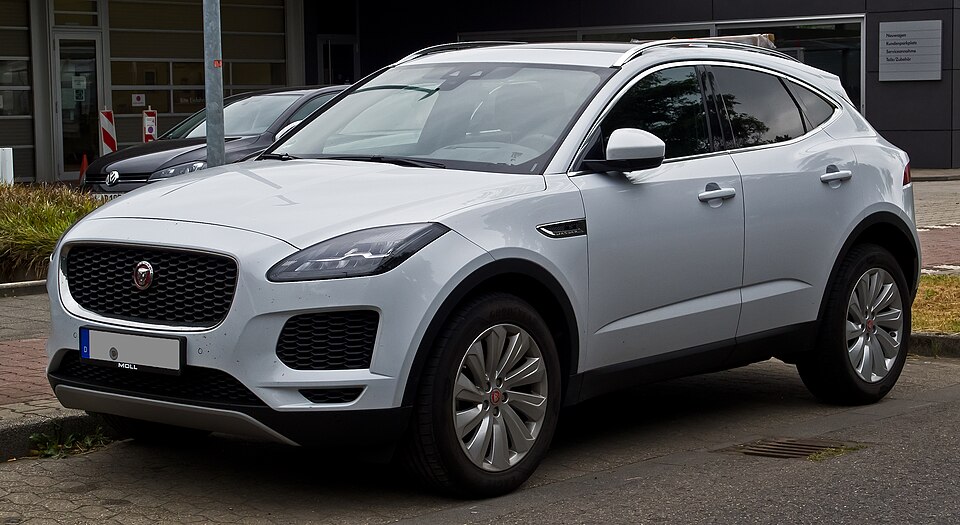
2018 Jaguar E-Pace
Trims, performance, features, fuel economy, safety and known problems — with the pros and cons against similar 2018 models.
- Class
- Small Sport Utility Vehicle 4WD
- Body styles
- 4dr SUV
- Engines
- 2.0L 4-cyl turbo
- Drivetrain
- All-Wheel Drive
- Fuel
- Premium Gasoline
- MPG (best)
- 24 combined · 21 city / 28 hwy
- Length
- 173.2 in
- Curb weight
- 4,039 lb
- NHTSA rating
- Not rated
- Recalls
- 2 campaigns
Pros & cons
What's good
Nothing stands out against similar models in the data.
Watch out for
- Premium fuel requiredEvery gasoline version is rated for premium, which raises running costs.
Calculated from EPA, NHTSA and vPIC data against 3 similar 2018 models — not a review. How we calculate this →
Overview
The 2018 Jaguar E-Pace is a small SUV offered with a 2.0L 4-cyl turbo engine and all-wheel drive.
It measures about 173 inches long and 78 inches wide on a 106-inch wheelbase, with a curb weight of roughly 4,039 lb.
EPA rates its most efficient version at 24 MPG combined (21 city / 28 highway), 3% better than the 2018 small SUV average of 23.2 MPG, for an estimated $3,400 a year in fuel.
NHTSA has not published a 5-Star overall rating for this model year.
It has 2 recall campaigns on file and owners have filed 14 complaints with NHTSA since 2015, most often about the engine.
Dimensions & weight
| Body | Length | Width | Height | Wheelbase | Track F / R | Curb weight | Weight F/R |
|---|---|---|---|---|---|---|---|
| 4dr SUV | 173.2 in | 78 in | 65 in | 105.5 in | 64.2 / 63.8 in | 4,039 lb |
Transport Canada CVS (Open Government Licence – Canada), Canadian-market figures.
Will it fit your garage? Check with your measurements →Engines, MPG & running costs
| Version | Engine | Transmission | Drive | City / Hwy / Comb | vs. class | Fuel / yr | CO₂ g/mi |
|---|---|---|---|---|---|---|---|
| E-Pace | 2.0L 4-cyl turbo | Automatic (S9) | All-Wheel Drive | 21 / 28 / 24 | +3% | $3,400 | 395 |
| E-Pace (296 Hp) | 2.0L 4-cyl turbo | Automatic (S9) | All-Wheel Drive | 21 / 27 / 23 | -1% | $3,550 | 379 |
EPA estimates; "vs. class" is combined MPG against the 2018 EPA class average. How we calculate this →
Safety ratings & technology
NHTSA has not published 5-Star ratings for the 2018 Jaguar E-Pace.
Similar 2018 small SUVs
| Model | Best MPG / range | NHTSA overall | Recalls |
|---|---|---|---|
| 2018 Jaguar E-Pace (this car) | 24 MPG | Not rated | 2 |
| 2018 Lexus NX | 31 MPG | Not rated | 1 |
| 2018 Lincoln MKC | 23 MPG | ★★★★★ | 4 |
| 2018 Mercedes-Benz GLA-Class | 27 MPG | Not rated | 0 |
Recalls (2)
Service Brakes, Hydraulic › Foundation Components › Hoses, Lines/Piping, And Fittings · Mar 1, 2018
NHTSA campaign 18V140000 · 41 vehicles
- Problem
- Jaguar Land Rover North America, LLC (Jaguar) is recalling certain 2018 Jaguar E-Pace vehicles. The brackets that secure the front brake hoses may not have been installed properly, allowing the front brake hoses to contact the tires, possibly resulting in a brake fluid leak.
- Risk
- A brake fluid leak can lengthen the distance needed to stop the vehicle, increasing the risk of a crash.
- Fix
- Jaguar will notify owners, and dealers will inspect the front brake hose brackets, replacing any that do not provide sufficient clearance, free of charge. The recall began on April 16, 2018. Owners may contact Jaguar customer service at 1-800-452-4827. Jaguar's number for this recall is H074.
Fuel System, Gasoline › Fuel Injection System › Fuel Rail · Feb 2, 2018
NHTSA campaign 18V090000 · 10,073 vehicles
- Problem
- Jaguar Land Rover North America, LLC (Jaguar) is recalling certain 2018 Jaguar XE, XF, E-PACE, F-PACE and F-TYPE vehicles equipped with a 2.0L gasoline engine. The fuel rail end caps may leak, possibly resulting in fuel vapor or liquid fuel leaking into the engine bay.
- Risk
- A fuel leak in the presence of an ignition source such as hot engine or exhaust components can increase the risk of a fire.
- Fix
- Jaguar will notify owners, and dealers will replace the fuel rail, free of charge. The recall began on March 8, 2018. Owners may contact Jaguar customer service at 1-800-452-4827. Jaguar's number for this recall is H081.
Not every 2018 Jaguar E-Pace is affected — only a VIN check confirms your car.
Owner-reported problems
Unverified owner reports; best-sellers collect more.
Used 2018 Jaguar E-Pace buyer's checklist
- Run the VIN at nhtsa.gov/recalls. 2 recalls this year — ask for proof of repairs.
- Engine — 6 owner reports. Cold-start the engine, listen for knocking, and watch for warning lights or hesitation on acceleration.
- Fuel/Propulsion System — 3 owner reports. Smell for fuel around the car and in the cabin, check that it starts easily when warm, and look at the oil dipstick for a fuel smell or rising level.
- Power Train — 2 owner reports. Test-drive through all gears, including reverse; note slipping, harsh or delayed shifts.
- Mileage to watch. Owners typically reported problems around 13,000 miles; ask what was repaired near that point.
- Before you pay: service records, a history report and an independent inspection.
Generated by DecodedCars from NHTSA recalls and owner complaints for the 2018 Jaguar E-Pace. Not a substitute for a professional inspection.
Other E-Pace years
Compare all years →| Year | MPG (best) | Length | Overall | Recalls | Complaints |
|---|---|---|---|---|---|
| 2024 E-Pace | 23 | 173.2 in | Not rated | 3 | 1 |
| 2023 E-Pace | 23 | 173.2 in | Not rated | 4 | 0 |
| 2022 E-Pace | 23 | 173.2 in | Not rated | 5 | 2 |
| 2021 E-Pace | 23 | 173.2 in | Not rated | 5 | 1 |
| 2020 E-Pace | 24 | 173.2 in | Not rated | 0 | 4 |
| 2019 E-Pace | 24 | 173.2 in | Not rated | 0 | 6 |
Sources: EPA, NHTSA, Transport Canada, Wikimedia Commons. Not affiliated with NHTSA, the EPA or Jaguar. How we calculate this →