 DecodedCars
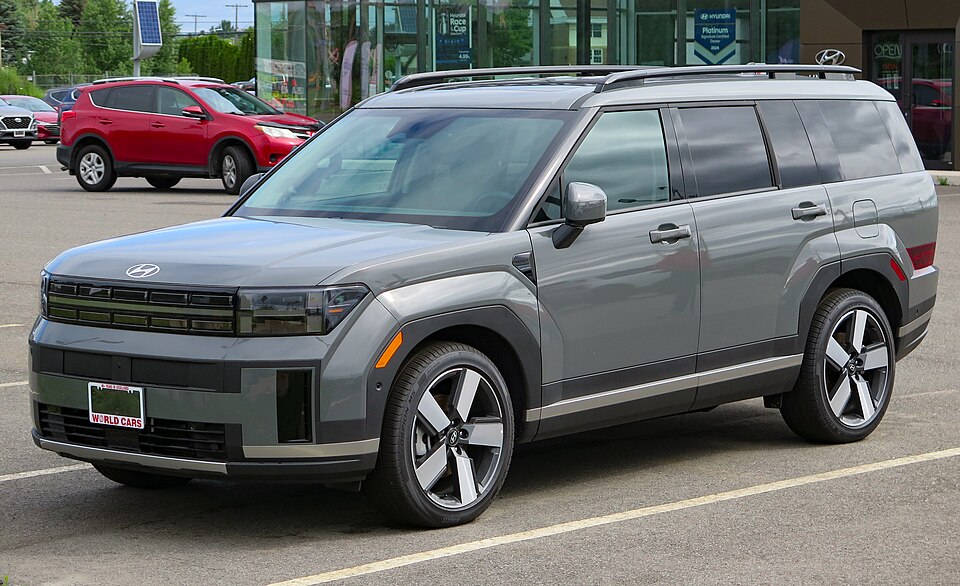
2019 Hyundai Santa Fe
Trims, performance, features, fuel economy, safety and known problems — with the pros and cons against similar 2019 models.
- Class
- Small Sport Utility Vehicle 2WD
- Body styles
- 4dr SUV 2.0l AWD, 4dr SUV AWD, 4dr SUV FWD, Xl AWD 4dr SUV
- Engines
- 2.4L 4-cyl, 2.0L 4-cyl turbo, 3.3L 6-cyl
- Horsepower
- 185–235 hp
- Drivetrain
- Front-Wheel Drive, All-Wheel Drive
- Seats
- 5–6
- Fuel
- Regular Gasoline
- MPG (best)
- 25 combined · 22 city / 29 hwy
- Length
- 187.8–192.9 in
- Curb weight
- 3,591–4,339 lb
- NHTSA rating
- ★★★★★
- Recalls
- 3 campaigns
Pros & cons
What's good
- AWD / 4WD available
- 5-star NHTSA safety ratingTop overall score in federal crash tests.
- Lots of standard safety tech4 of 5 key driver aids standard on the versions we checked.
Watch out for
- "Park outside" recallCheck that the recall repair was done before buying or driving.
Calculated from EPA, NHTSA and vPIC data against 25 similar 2019 models — not a review. How we calculate this →
Overview
The 2019 Hyundai Santa Fe is a small SUV offered with 3 engines (2.4L 4-cyl, 2.0L 4-cyl turbo and 3.3L 6-cyl) and front-wheel drive and all-wheel drive.
It measures about 188 inches long and 74 inches wide on a 109-inch wheelbase, with a curb weight of roughly 4,063 lb (4dr SUV 2.0l AWD).
EPA rates its most efficient version at 25 MPG combined (22 city / 29 highway), 0% better than the 2019 small SUV average of 25.1 MPG, for an estimated $2,700 a year in fuel.
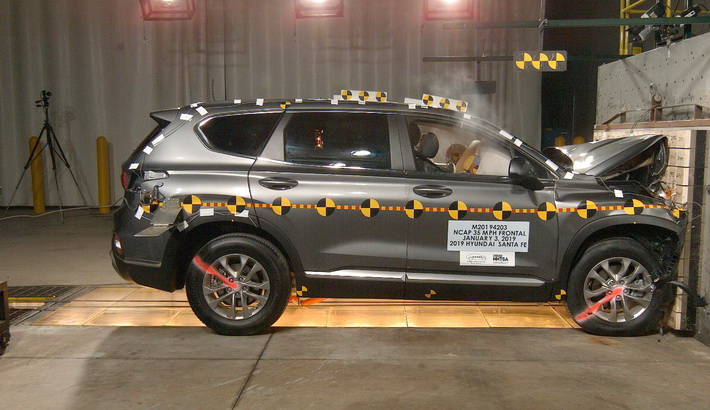
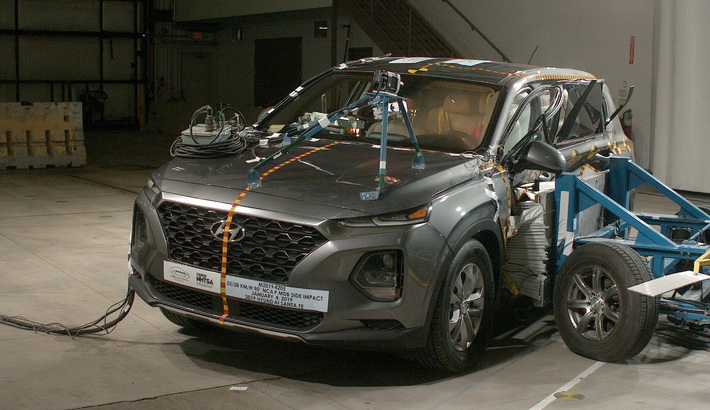
In NHTSA crash testing it earned the top 5-star overall rating.
It has 3 recall campaigns on file and owners have filed 229 complaints with NHTSA since 2015, most often about the engine.
What changed for 2019
- New body dimensions: 3.2 in longer, wheelbase +2.8 in — most likely a redesign or new generation
Compared with 2018; trim, feature and price changes aren't covered. See the 2018 Santa Fe →
Trims, performance & features
Trims
Safety & driver-assist features
NHTSA vPIC, as reported by the manufacturer for 5 2019 Santa Fe configurations; may not list every trim. How we calculate this →
Dimensions & weight
| Body | Length | Width | Height | Wheelbase | Track F / R | Curb weight | Weight F/R |
|---|---|---|---|---|---|---|---|
| 4dr SUV 2.0l AWD | 187.8 in | 74.4 in | 67.3 in | 109.1 in | 64.6 / 65 in | 4,063 lb | 57/43 |
| 4dr SUV AWD | 187.8 in | 74.4 in | 67.3 in | 109.1 in | 64.6 / 65 in | 3,735 lb | 57/43 |
| 4dr SUV FWD | 187.8 in | 74.4 in | 67.3 in | 109.1 in | 64.6 / 65 in | 3,591 lb | 58/42 |
| Xl AWD 4dr SUV | 192.9 in | 74.4 in | 66.9 in | 110.2 in | 64.2 / 64.6 in | 4,339 lb | 56/44 |
| Xl FWD 4dr SUV | 192.9 in | 74.4 in | 66.9 in | 110.2 in | 64.2 / 64.6 in | 3,946 lb | 56/44 |
Transport Canada CVS (Open Government Licence – Canada), Canadian-market figures.
Will it fit your garage? Check with your measurements →Engines, MPG & running costs
| Version | Engine | Transmission | Drive | City / Hwy / Comb | vs. class | Fuel / yr | CO₂ g/mi |
|---|---|---|---|---|---|---|---|
| Santa Fe FWD | 2.4L 4-cyl | Automatic (S8) | Front-Wheel Drive | 22 / 29 / 25 | 0% | $2,700 | 362 |
| Santa Fe AWD | 2.4L 4-cyl | Automatic (S8) | All-Wheel Drive | 21 / 27 / 23 | -3% | $2,900 | 380 |
| Santa Fe FWD | 2.0L 4-cyl turbo | Automatic (S8) | Front-Wheel Drive | 20 / 25 / 22 | -12% | $3,050 | 408 |
| Santa Fe XL FWD | 3.3L 6-cyl | Automatic (S6) | Front-Wheel Drive | 18 / 25 / 21 | -16% | $3,200 | 432 |
| Santa Fe AWD | 2.0L 4-cyl turbo | Automatic (S8) | All-Wheel Drive | 19 / 24 / 21 | -12% | $3,200 | 422 |
| Santa Fe XL Ultimate FWD | 3.3L 6-cyl | Automatic (S6) | Front-Wheel Drive | 18 / 23 / 20 | -20% | $3,350 | 453 |
| Santa Fe XL AWD | 3.3L 6-cyl | Automatic (S6) | All-Wheel Drive | 18 / 24 / 20 | -16% | $3,350 | 445 |
| Santa Fe XL Ultimate AWD | 3.3L 6-cyl | Automatic (S6) | All-Wheel Drive | 17 / 22 / 19 | -20% | $3,550 | 479 |
EPA estimates; "vs. class" is combined MPG against the 2019 EPA class average. How we calculate this →
Safety ratings & technology
| Version | Overall | Frontal | Driver / passenger | Side | Side pole | Rollover | Rollover risk |
|---|---|---|---|---|---|---|---|
| 2019 Hyundai Santa Fe SUV AWD | ★★★★★ | ★★★★★ | 4★ / 5★ | ★★★★★ | ★★★★★ | ★★★★★ | 14.6% |
| 2019 Hyundai Santa Fe SUV FWD | ★★★★★ | ★★★★★ | 4★ / 5★ | ★★★★★ | ★★★★★ | ★★★★★ | 15.5% |
Similar 2019 small SUVs
| Model | Best MPG / range | NHTSA overall | Recalls |
|---|---|---|---|
| 2019 Hyundai Santa Fe (this car) | 25 MPG | ★★★★★ | 3 |
| 2019 Toyota RAV4 | 40 MPG | ★★★★★ | 8 |
| 2019 Honda CR-V | 30 MPG | ★★★★★ | 8 |
| 2019 Toyota 4Runner | 18 MPG | ★★★★★ | 4 |
| 2019 Subaru Forester | 29 MPG | ★★★★★ | 3 |
| 2019 Mazda CX-5 | 29 MPG | ★★★★★ | 2 |
| 2019 Toyota Highlander | 29 MPG | ★★★★★ | 3 |
Recalls (3)
Trailer Hitches · Mar 17, 2023 Park outside
NHTSA campaign 23V181000 · 584,784 vehicles
- Problem
- Hyundai Motor America (Hyundai) is recalling certain 2019-2023 Santa Fe, 2021-2023 Santa Fe HEV, 2022-2023 Santa Fe Plug-in HEV and Santa Cruz vehicles potentially equipped with a tow hitch harness installed as original equipment, or purchased as an accessory through a Hyundai dealership. Water accumulation on the tow hitch harness module printed circuit board (PCB) may cause an electrical short, which can result in a fire.
- Risk
- A fire while parked or driving can increase the risk of injury.
- Fix
- Owners are advised to park their vehicles outside and away from structures until the remedy is completed. Dealers will install a new fuse and wire extension kit as necessary, free of charge. Owner notification letters were mailed starting May 16, 2023. Owners may contact Hyundai customer service at 1-855-371-9460. Hyundai's number for this recall is 244. This recall is an expansion of previous recall number 22V-633.
Service Brakes, Hydraulic › Antilock/Traction Control/Electronic Limited Slip › Control Unit/Module · Feb 3, 2022 Park outside
NHTSA campaign 22V056000 · 357,348 vehicles
- Problem
- Hyundai Motor America (Hyundai) is recalling certain 2016-2018 Santa Fe, 2017-2018 Santa Fe Sport, 2019 Santa Fe XL, and 2014-2015 Tucson vehicles. The Anti-Lock Brake System (ABS) module could malfunction and cause an electrical short, which could result in an engine compartment fire.
- Risk
- An engine compartment fire while parked or driving can increase the risk of injury.
- Fix
- Owners are advised to park outside and away from structures until the recall repair is complete. Dealers will replace the ABS multi-fuse, as necessary, free of charge. Owner notification letters were mailed May 31, 2022. Owners may contact Hyundai customer service at 1-855-371-9460. Hyundai's number for this recall is 218.
Air Bags › Side/Window · Oct 11, 2018
NHTSA campaign 18V715000 · 8,204 vehicles
- Problem
- Hyundai Motor America (Hyundai) is recalling certain 2019 Hyundai Santa Fe vehicles. The Side Curtain Air Bag (SCAB) mounting bolts may interfere with and damage the air bags during deployment.
- Risk
- In the event of a crash, if the air bags become damaged during deployment they may not inflate properly, increasing the risk of injury.
- Fix
- Hyundai will notify owners, and dealers will install a protective cover over the SCAB installation bolts, free of charge. The recall began December 3, 2018. Owners may contact Hyundai customer service at 1-855-371-9460. Hyundai's number for this recall is 177.
Not every 2019 Hyundai Santa Fe is affected — only a VIN check confirms your car.
Owner-reported problems
Unverified owner reports; best-sellers collect more.
Used 2019 Hyundai Santa Fe buyer's checklist
- Run the VIN at nhtsa.gov/recalls. 3 recalls this year — ask for proof of repairs.
- Safety-critical recall. At least one recall carries a "Do Not Drive" or "Park Outside" warning. Do not buy until the VIN shows it was repaired.
- Engine — 83 owner reports. Cold-start the engine, listen for knocking, and watch for warning lights or hesitation on acceleration.
- Power Train — 38 owner reports. Test-drive through all gears, including reverse; note slipping, harsh or delayed shifts.
- Electrical System — 28 owner reports. Test every window, lock, light, screen and USB port; check the battery age.
- Mileage to watch. Owners typically reported problems around 12,000 miles; ask what was repaired near that point.
- Before you pay: service records, a history report and an independent inspection.
Generated by DecodedCars from NHTSA recalls and owner complaints for the 2019 Hyundai Santa Fe. Not a substitute for a professional inspection.
Other Santa Fe years
Compare all years →| Year | MPG (best) | Length | Overall | Recalls | Complaints |
|---|---|---|---|---|---|
| 2027 Santa Fe | 36 | – | Not rated | 0 | 0 |
| 2026 Santa Fe | 36 | 190.2 in | Not rated | 4 | 58 |
| 2025 Santa Fe | 36 | 190.2 in | ★★★★★ | 5 | 240 |
| 2024 Santa Fe | 36 | 190.2 in | ★★★★★ | 7 | 191 |
| 2023 Santa Fe | 34 | 188.6 in | ★★★★★ | 2 | 290 |
| 2022 Santa Fe | 34 | 188.6 in | ★★★★★ | 8 | 265 |
| 2021 Santa Fe | 34 | 188.6 in | ★★★★★ | 8 | 187 |
| 2020 Santa Fe | 25 | 187.8 in | ★★★★★ | 2 | 218 |
| 2018 Santa Fe | 24 | 184.6 in | ★★★★★ | 5 | 432 |
| 2017 Santa Fe | 24 | 184.6 in | Not rated | 7 | 1,327 |
| 2016 Santa Fe | 23 | 184.6 in | Not rated | 3 | 306 |
| 2015 Santa Fe | 23 | 184.6 in | Not rated | 4 | 339 |
Sources: EPA, NHTSA, Transport Canada, Wikimedia Commons. Not affiliated with NHTSA, the EPA or Hyundai. How we calculate this →