 DecodedCars
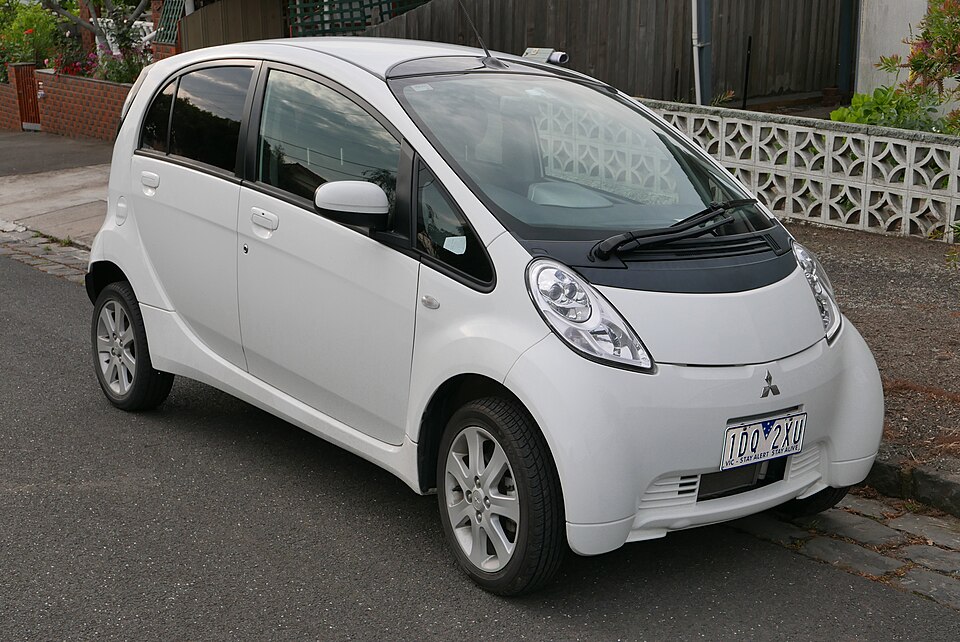
Mitsubishi i-MiEV 2012
Versiones, desempeño, equipamiento, consumo, seguridad y problemas conocidos, con sus ventajas y desventajas frente a modelos similares 2012.
- Clase
- Auto subcompacto
- Carrocerías
- Imiev
- Motores
- Motor eléctrico
- Tracción
- Tracción trasera
- Combustible
- Eléctrico
- Autonomía eléctrica
- 62 mi · 7 h a 240 V
- Largo
- 144.9 in
- Peso en vacío
- 2,582 lb
- Calificación NHTSA
- Sin calificar
- Retiros
- 6 campañas
Ventajas y desventajas
Lo bueno
Nada destaca frente a modelos similares en los datos.
A tener en cuenta
- Autonomía eléctrica cortaHasta 62 millas por carga (EPA): habrá que planificar la recarga.
- 6 retirosMás que modelos similares (unos 0). Confirma las reparaciones con el VIN.
Calculado con datos de la EPA, la NHTSA y vPIC frente a 5 modelos similares 2012; no es una reseña. Cómo lo calculamos →
Resumen
El Mitsubishi i-MiEV 2012 es un auto subcompacto 100 % eléctrico, con tracción trasera.
Mide unas 145 pulgadas de largo y 63 de ancho, con una distancia entre ejes de 100 pulgadas, y pesa alrededor de 2,582 lb.
La versión eléctrica tiene una autonomía EPA de hasta 62 millas y tarda unas 7 horas en cargarse con un cargador de nivel 2 (240 V).
La NHTSA no ha publicado una calificación general de 5 estrellas para este año modelo.
Tiene 6 campañas de retiro registradas y los propietarios han presentado 9 quejas ante la NHTSA desde 2015, sobre todo por problemas de frenos.
Dimensiones y peso
| Carrocería | Largo | Ancho | Alto | Distancia entre ejes | Vía del. / tras. | Peso en vacío | Peso del./tras. |
|---|---|---|---|---|---|---|---|
| Imiev | 144.9 in | 62.6 in | 63.8 in | 100.4 in | 55.9 / 54.3 in | 2,582 lb | 45/55 |
Transport Canada CVS (Open Government Licence – Canada), medidas del mercado canadiense.
¿Cabe en tu garaje? Compruébalo con tus medidas →Motores, consumo y costo de uso
| Versión | Motor | Transmisión | Tracción | Ciudad / Carr. / Comb. | vs. su clase | Combustible / año | CO₂ g/mi |
|---|---|---|---|---|---|---|---|
| i-MiEV Eléctrico | 49 kW DCPM | Automática (A1) | Tracción trasera | 62 mi · 30 kWh/100mi | – | $700 | – |
Estimaciones de la EPA; "vs. su clase" compara las MPG combinadas con el promedio 2012 de su clase EPA. Cómo lo calculamos →
Calificaciones de seguridad y tecnología
La NHTSA no ha publicado calificaciones de 5 estrellas para el Mitsubishi i-MiEV 2012.
Auto subcompacto similares 2012
| Modelo | Mejor MPG / autonomía | General NHTSA | Retiros |
|---|---|---|---|
| Mitsubishi i-MiEV 2012 (este auto) | 62 mi | Sin calificar | 6 |
| Toyota Yaris 2012 | 33 MPG | Sin calificar | 5 |
| MINI Clubman 2012 | 30 MPG | Sin calificar | 0 |
| Scion xD 2012 | 29 MPG | Sin calificar | 0 |
| Roush Performance Mustang 2012 | 18 MPG | Sin calificar | 0 |
| CODA Automotive CODA 2012 | 88 mi | Sin calificar | 0 |
Retiros (6)
Texto oficial de la NHTSA (en inglés).
Frenos hidráulicos › Power Assist › Vacuum · 8 nov 2019
Campaña NHTSA 19V804000 · 2,108 vehículos
- Problema
- Mitsubishi Motors North America, Inc. (MMNA) is recalling certain 2012-2017 i-MiEV vehicles. Water may penetrate the brake assist vacuum pump, causing corrosion and a failure of the brake vacuum pump.
- Riesgo
- Without the brake vacuum pump, the driver will experience a sudden loss of braking assist, lengthening the distance needed to stop the vehicle and increasing the risk of a crash.
- Solución
- MMNA will notify owners, and dealers will replace the brake vacuum pump, free of charge. The recall began January 7, 2020. Owners may contact MMNA customer service at 1-888-648-7820. MMNA's number for this recall is SR-19-002.
Bolsas de aire › Frontal › Passenger Side › Inflator Module · 10 ene 2017
Campaña NHTSA 17V022000 · 1,964 vehículos
- Problema
- Mitsubishi Motors North America, Inc. (MMNA) is recalling certain 2012 and 2014 i-MiEV vehicles. These vehicles are equipped with certain air bag inflators assembled as part of the passenger frontal air bag modules used as original equipment or replacement equipment. In the event of a crash necessitating deployment of the front air bags, these inflators may rupture due to propellant degradation occurring after long-term exposure to absolute humidity and temperature cycling.
- Riesgo
- An inflator rupture may result in metal fragments striking the vehicle occupants resulting in serious injury or death.
- Solución
- MMNA will notify owners, and dealers will replace the front passenger air bag inflator, free of charge. The recall began on March 10, 2017. Owners may contact MMNA customer service at 1-888-648-7820. MMNA's number for this recall is SR-17-001.
Bolsas de aire · 23 sept 2015
Campaña NHTSA 15V594000 · 13,558 vehículos
- Problema
- Mitsubishi Motors North America, Inc. (Mitsubishi) is recalling certain model year 2014 Mitsubishi Mirage vehicles manufactured July 27, 2013, to November 20, 2013, and 2012 Mitsubishi i-MiEV vehicles manufactured October 28, 2011, to September 7, 2012. Due to an increased resistance in the impact sensor for the air bag system, in the event of a crash necessitating deployment of the frontal, side and/or curtain air bags when the SRS warning is illuminated, the frontal air bag may have a delayed deployment and/or the side and curtian air bag may not deploy at all.
- Riesgo
- In the event of a crash, an air bag that does not deploy or deploys late, increases the risk of occupant injury.
- Solución
- Mitsubishi will notify owners, and dealers will replace the affected impact sensors, free of charge. The recall began on November 5, 2015. Owners may contact Mitsubishi customer service at 1-888-648-7820. Mitsubishi's number for this recall is SR-15-011.
Frenos hidráulicos › Power Assist › Vacuum · 2 sept 2014
Campaña NHTSA 14V522000 · 1,810 vehículos
- Problema
- Mitsubishi Motors North America, Inc. (Mitsubishi) is recalling certain model year 2010-2014 i-MiEV electric vehicles manufactured September 15, 2009, to March 25, 2014. Due to either software programming or corrosion caused by road salt, the brake vacuum pump may stop functioning.
- Riesgo
- If the brake vacuum pump stops functioning, the distance needed to stop the vehicle may be lengthened, increasing the risk of a crash.
- Solución
- Mitsubishi will notify owners, and depending on the affected vehicle, dealers will either reprogram the brake vacuum pump controller, replace the brake vacuum pump or do both, free of charge. The recall began on October 24, 2014. Owners may contact Mitsubishi customer service at 1-888-648-7820. Mitsubishi's number for this recall is SR-14-007.
Frenos hidráulicos › Power Assist · 25 ene 2013
Campaña NHTSA 13V031000 · 1,402 vehículos
- Problema
- Mitsubishi Motors North America is recalling certain model year 2012 i-MiEV electric vehicles manufactured December 2, 2011, through September 7, 2012. The brake system vacuum pump may fail, causing the vacuum pump to be inoperable.
- Riesgo
- If the vaccum pump system fails, it will reduce available brake power which would result in lengthened stopping distances, which may increase the risk of a vehicle crash.
- Solución
- Mitsubishi will notify owners, and dealers will replace the affected vacuum pumps free of charge. The recall began on February 28, 2013. Owners may contact Mitsubishi at 1-888-648-7820.
Bolsas de aire › Frontal › Sensor/Control Module-Inactive · 1 ago 2012
Campaña NHTSA 12V372000 · 261 vehículos
- Problema
- Mitsubishi is recalling certain model year 2012 i-MiEV vehicles manufactured between November 4, 2011, and December 22, 2011. Incompatibility between the air bag sensors and the self-diagnostic software may deactivate the frontal and side airbag system. Should this occur, the SRS warning lamp would illuminate to alert the driver.
- Riesgo
- The side and curtain air bags may not deploy in a crash for which those air bags were intended to deploy, increasing the risk of personal injury to the vehicle occupants.
- Solución
- Mitsubishi will notify owners, and dealers will replace the incompatible air bag sensors with new, compatible units, free of charge. The safety recall began on during August 2012. Owners may contact Mitsubishi at 1-800-222-0037.
No todos los i-MiEV 2012 están afectados: solo el VIN lo confirma.
Problemas reportados por propietarios
Reportes sin verificar; los más vendidos acumulan más.
Lista para comprar un Mitsubishi i-MiEV 2012 usado
- Consulta el VIN en nhtsa.gov/recalls. 6 retiros en este año: pide comprobantes de reparación.
- Frenos — 5 reportes de propietarios. Frena con fuerza a velocidad; revisa si se jala hacia un lado, si el pedal vibra o si se enciende la luz del ABS.
- Sistema eléctrico — 2 reportes de propietarios. Prueba todas las ventanas, seguros, luces, pantallas y puertos USB; revisa la antigüedad de la batería.
- Tren motriz — 2 reportes de propietarios. Prueba todas las marchas, incluida la reversa; nota patinazos o cambios bruscos o tardíos.
- Millaje a vigilar. Los propietarios suelen reportar problemas alrededor de las 41,800 millas; pregunta qué se reparó cerca de ese punto.
- Salud de la batería. Pide un reporte del estado de la batería, revisa la garantía restante y compara la autonomía al 100 % con las 62 millas de la EPA.
- Antes de pagar: historial de servicio, reporte de antecedentes e inspección de un mecánico independiente.
Generado por DecodedCars a partir de retiros y quejas de propietarios ante la NHTSA para el Mitsubishi i-MiEV 2012. No sustituye una inspección profesional.
Otros años del i-MiEV
Comparar todos los años →| Año | MPG (mejor) | Largo | General | Retiros | Quejas |
|---|---|---|---|---|---|
| i-MiEV 2017 | 59 mi | 144.9 in | Sin calificar | 2 | 1 |
| i-MiEV 2016 | 62 mi | 144.9 in | Sin calificar | 2 | 0 |
| i-MiEV 2014 | 62 mi | 144.9 in | Sin calificar | 3 | 0 |
| i-MiEV 2013 | 62 mi | 144.9 in | Sin calificar | 2 | 0 |
Fuentes: EPA, NHTSA, Transport Canada, Wikimedia Commons. Sin afiliación con la NHTSA, la EPA ni Mitsubishi. Cómo lo calculamos →