 DecodedCars
Lincoln MKX 2017
Versiones, desempeño, equipamiento, consumo, seguridad y problemas conocidos, con sus ventajas y desventajas frente a modelos similares 2017.
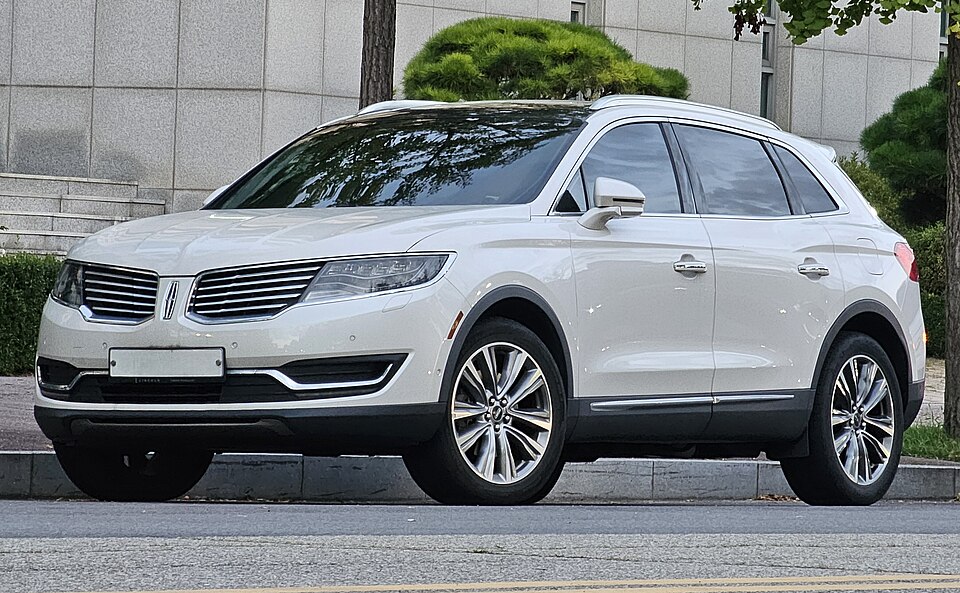
- Clase
- SUV pequeño (2WD)
- Carrocerías
- 4dr SUV
- Motores
- 3.7L 6 cil., 2.7L 6 cil. turbo
- Tracción
- Tracción delantera, Tracción total (AWD)
- Combustible
- Gasolina regular
- MPG (mejor)
- 20 combinadas · 18 ciudad / 25 carretera
- Largo
- 190.2 in
- Peso en vacío
- 4,387 lb
- Calificación NHTSA
- Sin calificar
- Retiros
- 5 campañas
Ventajas y desventajas
Lo bueno
- Tracción total / 4x4 disponible
A tener en cuenta
- Consumo por debajo del promedioSu versión más eficiente logra 20 MPG combinadas, un 18 % menos que el promedio de su clase (SUV pequeño, 2017: 24.3 MPG).
Calculado con datos de la EPA, la NHTSA y vPIC frente a 27 modelos similares 2017; no es una reseña. Cómo lo calculamos →
Resumen
El Lincoln MKX 2017 es un SUV pequeño disponible con 2 motores (3.7L 6 cil. y 2.7L 6 cil. turbo), con tracción delantera y tracción total (AWD).
Mide unas 190 pulgadas de largo y 76 de ancho, con una distancia entre ejes de 112 pulgadas, y pesa alrededor de 4,387 lb.
La EPA califica su versión más eficiente con 20 MPG combinadas (18 en ciudad / 25 en carretera), un 18 % peor que el promedio de su clase (SUV pequeño, 2017: 24.3 MPG), con un gasto estimado de $3,350 al año en combustible.
La NHTSA no ha publicado una calificación general de 5 estrellas para este año modelo.
Tiene 5 campañas de retiro registradas y los propietarios han presentado 52 quejas ante la NHTSA desde 2015, sobre todo por problemas de frenos.
Novedades del 2017
Sin cambios en motores, versiones, tracción, tamaño, consumo EPA ni calificación NHTSA respecto al MKX 2016: un año sin cambios según los datos.
Comparado con 2016; no incluye cambios de versiones, equipamiento ni precio. Ver el MKX 2016 →
Dimensiones y peso
| Carrocería | Largo | Ancho | Alto | Distancia entre ejes | Vía del. / tras. | Peso en vacío | Peso del./tras. |
|---|---|---|---|---|---|---|---|
| 4dr SUV | 190.2 in | 76 in | 66.1 in | 112.2 in | 65 / 64.6 in | 4,387 lb | 59/41 |
Transport Canada CVS (Open Government Licence – Canada), medidas del mercado canadiense.
¿Cabe en tu garaje? Compruébalo con tus medidas →Motores, consumo y costo de uso
| Versión | Motor | Transmisión | Tracción | Ciudad / Carr. / Comb. | vs. su clase | Combustible / año | CO₂ g/mi |
|---|---|---|---|---|---|---|---|
| MKX FWD | 3.7L 6 cil. | Automática (S6) | Tracción delantera | 17 / 25 / 20 | -18% | $3,350 | 440 |
| MKX FWD | 2.7L 6 cil. turbo | Automática (S6) | Tracción delantera | 18 / 25 / 20 | -18% | $3,350 | 444 |
| MKX AWD | 2.7L 6 cil. turbo | Automática (S6) | Tracción total (AWD) | 17 / 24 / 19 | -17% | $3,550 | 467 |
| MKX AWD | 3.7L 6 cil. | Automática (S6) | Tracción total (AWD) | 16 / 23 / 19 | -17% | $3,550 | 471 |
Estimaciones de la EPA; "vs. su clase" compara las MPG combinadas con el promedio 2017 de su clase EPA. Cómo lo calculamos →
Calificaciones de seguridad y tecnología
La NHTSA no ha publicado calificaciones de 5 estrellas para el Lincoln MKX 2017.
SUV pequeño similares 2017
| Modelo | Mejor MPG / autonomía | General NHTSA | Retiros |
|---|---|---|---|
| Lincoln MKX 2017 (este auto) | 20 MPG | Sin calificar | 5 |
| Porsche Cayenne 2017 | 22 MPG | Sin calificar | 2 |
| BMW X5 2017 | 25 MPG | Sin calificar | 6 |
| BMW X3 2017 | 24 MPG | Sin calificar | 6 |
| Lexus RX 2017 | 30 MPG | Sin calificar | 3 |
| Volvo XC90 2017 | 25 MPG | Sin calificar | 7 |
| Audi Q7 2017 | 22 MPG | Sin calificar | 7 |
Retiros (5)
Texto oficial de la NHTSA (en inglés).
Frenos hidráulicos › Foundation Components › Hoses, Lines/Piping, And Fittings · 22 ago 2025
Campaña NHTSA 25V544000 · 499,129 vehículos
- Problema
- Ford Motor Company (Ford) is recalling certain 2016-2018 Lincoln MKX and 2015-2018 Edge vehicles. The rear brake jounce hose may rupture and leak brake fluid.
- Riesgo
- A brake fluid leak can extend the distance required to stop the vehicle, increasing the risk of a crash.
- Solución
- Dealers will inspect and replace the brake jounce hoses and adjust brake jounce hoses with no damage present, free of charge. Owner notification letters were mailed September 17, 2026. Owners may contact Ford customer service at 1-866-436-7332. Ford's number for this recall is 25S87.
Frenos · 10 ago 2020
Campaña NHTSA 20V469000 · 488,594 vehículos
- Problema
- Ford Motor Company (Ford) is recalling certain 2015-2018 Ford Edge and 2016-2018 Lincoln MKX vehicles. The front brake hoses may rupture prematurely.
- Riesgo
- A ruptured front brake hose will cause a brake fluid leak, lengthening the distance needed to stop the vehicle, increasing the risk of a crash.
- Solución
- Ford will notify owners, and dealers will replace the front brake hoses with the new hoses that have a revised braid material, free of charge. Owner notification letters were mailed on May 13, 2021. Owners may contact Ford customer service at 1-866-436-7332. Ford's number for this recall is 20S42.
Asientos › Front Assembly › Power Adjust · 17 jul 2020
Campaña NHTSA 20V414000 · 19,299 vehículos
- Problema
- Ford Motor Company, Inc. (Ford) is recalling certain 2016-2018 Lincoln MKX and 2019-2020 Nautilus vehicles equipped with 16-way electric tilt seats. The seat cushion frame edge may contact the wire harness when the seat occupant uses the tilt function of the seat, potentially damaging one or more wires within the harness, which can result in either inadvertent deployment of the air bag or nondeployment of the air bag in the event of a crash.
- Riesgo
- An air bag that deploys inadvertently increases the risk of a crash. An air bag that does not deploy in the event of a crash increases the risk of injury.
- Solución
- Ford will notify owners, and dealers will install protective flocking tape onto the exposed edge of the 16-way seat cushion frames, and inspect the wire harness for damage, and repair or replace it as needed, free of charge. This recall began August 12, 2020. Owners may contact Ford/Lincoln customer service at 1-866-436-7332. Ford's number for this recall is 20S37.
Sistema eléctrico › 12v/24v/48v Battery › Cables · 12 nov 2019
Campaña NHTSA 19V809000 · 54,411 vehículos
- Problema
- Ford Motor Company (Ford) is recalling certain 2016-2017 Lincoln MKX vehicles equipped with 3.7L engines. The battery positive cable harness may contact the transmission shifter cable bracket resulting in a short circuit.
- Riesgo
- An electrical short increases the risk of a fire.
- Solución
- Ford will notify owners, and dealers will remove the battery harness clips and elbow guide, and install a wire channel shield and protective sleeve to the battery cable harness, free of charge. Interim notices informing owners of the safety risk were mailed on December 2, 2019. Owners will receive a second notice when the remedy becomes available, currently expected to be the end of April 2020. Owners may contact Ford customer service at 1-866-436-7332. Ford's number for this recall is 19S41.
Bolsas de aire › Frontal › Driver Side › Inflator Module · 27 feb 2017
Campaña NHTSA 17V123000 · 27,531 vehículos
- Problema
- Ford Motor Company (Ford) is recalling certain 2016-2017 Ford Edge and Lincoln MKX vehicles and 2017 Lincoln Continental vehicles. In the event of a crash, the driver's frontal air bag may not fully inflate or the air bag cushion may detach from the air bag module. As such, these vehicles fail to comply with the requirements of Federal Motor Vehicle Safety Standard (FMVSS) number 208, "Occupant Crash Protection."
- Riesgo
- During deployment, if the air bag does not fully inflate or the cushion detaches, there is an increased risk of injury in the event of a crash.
- Solución
- Ford will notify owners, and dealers will replace the driver frontal air bag module, free of charge. The recall began June 16, 2017. Owners may contact Ford customer service at 1-866-436-7332. Ford's number for this recall is 17C02.
No todos los MKX 2017 están afectados: solo el VIN lo confirma.
Problemas reportados por propietarios
Reportes sin verificar; los más vendidos acumulan más.
Lista para comprar un Lincoln MKX 2017 usado
- Consulta el VIN en nhtsa.gov/recalls. 5 retiros en este año: pide comprobantes de reparación.
- Frenos hidráulicos — 13 reportes de propietarios. Frena con fuerza a velocidad; revisa si se jala hacia un lado, si el pedal vibra o si se enciende la luz del ABS.
- Sistema eléctrico — 12 reportes de propietarios. Prueba todas las ventanas, seguros, luces, pantallas y puertos USB; revisa la antigüedad de la batería.
- Motor — 7 reportes de propietarios. Arranca el motor en frío, escucha si golpetea y fíjate en luces de advertencia o titubeos al acelerar.
- Millaje a vigilar. Los propietarios suelen reportar problemas alrededor de las 30,000 millas; pregunta qué se reparó cerca de ese punto.
- Antes de pagar: historial de servicio, reporte de antecedentes e inspección de un mecánico independiente.
Generado por DecodedCars a partir de retiros y quejas de propietarios ante la NHTSA para el Lincoln MKX 2017. No sustituye una inspección profesional.
Otros años del MKX
Comparar todos los años →| Año | MPG (mejor) | Largo | General | Retiros | Quejas |
|---|---|---|---|---|---|
| MKX 2018 | 20 | 190.2 in | ★★★★★ | 5 | 31 |
| MKX 2016 | 20 | 190.2 in | Sin calificar | 7 | 156 |
| MKX 2015 | 20 | 186.6 in | Sin calificar | 0 | 19 |
| MKX 2014 | 21 | 186.6 in | Sin calificar | 1 | 33 |
| MKX 2013 | 21 | 186.6 in | Sin calificar | 1 | 152 |
| MKX 2012 | 21 | 187.4 in | Sin calificar | 1 | 75 |
| MKX 2011 | 21 | 187.4 in | Sin calificar | 3 | 130 |
| MKX 2010 | 20 | 187 in | Sin calificar | 6 | 98 |
| MKX 2009 | 19 | 187 in | Sin calificar | 6 | 59 |
| MKX 2008 | 19 | 187 in | Sin calificar | 5 | 220 |
| MKX 2007 | 19 | 187 in | Sin calificar | 5 | 234 |
Fuentes: EPA, NHTSA, Transport Canada, Wikimedia Commons. Sin afiliación con la NHTSA, la EPA ni Lincoln. Cómo lo calculamos →