 DecodedCars
Hyundai Elantra 2009
Versiones, desempeño, equipamiento, consumo, seguridad y problemas conocidos, con sus ventajas y desventajas frente a modelos similares 2009.
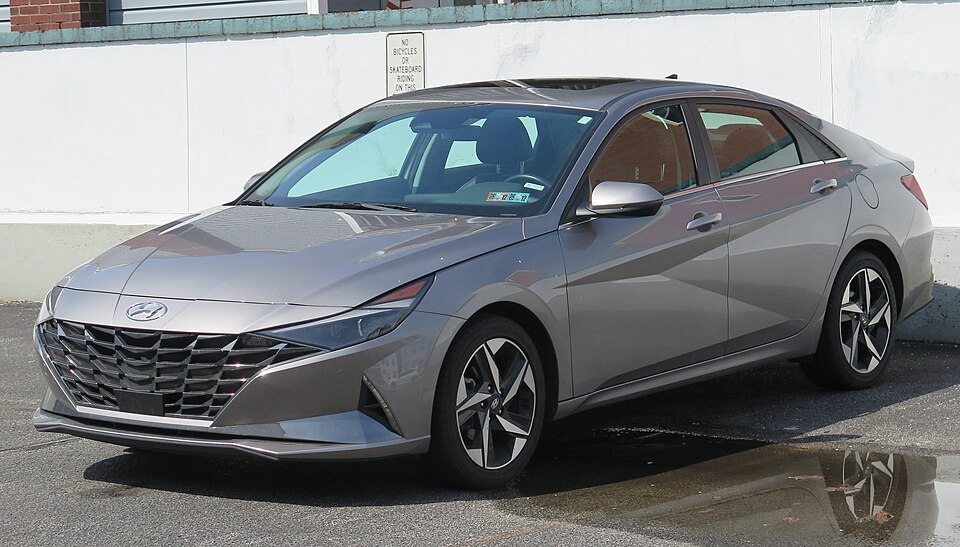
- Clase
- Auto mediano
- Carrocerías
- 4dr Sedan FWD Gls/Se, Touring 5dr Hatch FWD
- Motores
- 2.0L 4 cil.
- Tracción
- Tracción delantera
- Combustible
- Gasolina regular
- MPG (mejor)
- 28 combinadas · 25 ciudad / 33 carretera
- Largo
- 176.4–177.6 in
- Peso en vacío
- 2,895–2,937 lb
- Calificación NHTSA
- Sin calificar
- Retiros
- 4 campañas
Ventajas y desventajas
Lo bueno
- Excelente consumo de combustibleHasta 28 MPG combinadas: un 30 % mejor que el promedio de su clase (auto mediano, 2009: 21.6 MPG).
A tener en cuenta
- Muchas quejas de propietarios202 quejas ante la NHTSA frente a unas 64 de modelos similares; sobre todo por problemas de dirección.
Calculado con datos de la EPA, la NHTSA y vPIC frente a 22 modelos similares 2009; no es una reseña. Cómo lo calculamos →
Resumen
El Hyundai Elantra 2009 es un auto mediano con motor 2.0L 4 cil., con tracción delantera.
Mide unas 178 pulgadas de largo y 70 de ancho, con una distancia entre ejes de 104 pulgadas, y pesa alrededor de 2,895 lb (4dr Sedan FWD Gls/Se).
La EPA califica su versión más eficiente con 28 MPG combinadas (25 en ciudad / 33 en carretera), un 30 % mejor que el promedio de su clase (auto mediano, 2009: 21.6 MPG), con un gasto estimado de $2,400 al año en combustible.
Tiene 4 campañas de retiro registradas y los propietarios han presentado 202 quejas ante la NHTSA desde 2015, sobre todo por problemas de dirección.
Novedades del 2009
Sin cambios en motores, versiones, tracción, tamaño, consumo EPA ni calificación NHTSA respecto al Elantra 2008: un año sin cambios según los datos.
Comparado con 2008; no incluye cambios de versiones, equipamiento ni precio. Ver el Elantra 2008 →
Versiones, desempeño y equipamiento
Versiones
Fabricado en: Ulsan, South Korea · Hwasung, South Korea
NHTSA vPIC, según el fabricante, para 4 configuraciones del Elantra 2009; puede no incluir todas las versiones. Cómo lo calculamos →
Dimensiones y peso
| Carrocería | Largo | Ancho | Alto | Distancia entre ejes | Vía del. / tras. | Peso en vacío | Peso del./tras. |
|---|---|---|---|---|---|---|---|
| 4dr Sedan FWD Gls/Se | 177.6 in | 70.1 in | 58.3 in | 104.3 in | 60.6 / 59.8 in | 2,895 lb | 63/37 |
| Touring 5dr Hatch FWD | 176.4 in | 69.7 in | 59.8 in | 106.3 in | 60.2 / 60.6 in | 2,937 lb |
Transport Canada CVS (Open Government Licence – Canada), medidas del mercado canadiense.
¿Cabe en tu garaje? Compruébalo con tus medidas →Motores, consumo y costo de uso
| Versión | Motor | Transmisión | Tracción | Ciudad / Carr. / Comb. | vs. su clase | Combustible / año | CO₂ g/mi |
|---|---|---|---|---|---|---|---|
| Elantra | 2.0L 4 cil. | Automática 4-spd | Tracción delantera | 25 / 33 / 28 | +30% | $2,400 | 317 |
| Elantra | 2.0L 4 cil. | Manual 5-spd | Tracción delantera | 24 / 33 / 27 | +25% | $2,500 | 329 |
| Elantra Touring | 2.0L 4 cil. | Manual 5-spd | Tracción delantera | 23 / 31 / 26 | +11% | $2,600 | 342 |
| Elantra Touring | 2.0L 4 cil. | Automática 4-spd | Tracción delantera | 23 / 30 / 26 | +11% | $2,600 | 342 |
Estimaciones de la EPA; "vs. su clase" compara las MPG combinadas con el promedio 2009 de su clase EPA. Cómo lo calculamos →
Calificaciones de seguridad y tecnología
La NHTSA no ha publicado calificaciones de 5 estrellas para el Hyundai Elantra 2009 con el programa de pruebas actual (2011+).
Auto mediano similares 2009
| Modelo | Mejor MPG / autonomía | General NHTSA | Retiros |
|---|---|---|---|
| Hyundai Elantra 2009 (este auto) | 28 MPG | Sin calificar | 4 |
| Toyota Corolla 2009 | 30 MPG | Sin calificar | 12 |
| Honda Civic 2009 | 42 MPG | Sin calificar | 7 |
| Nissan GT-R 2009 | 18 MPG | Sin calificar | 1 |
| Toyota Prius 2009 | 46 MPG | Sin calificar | 5 |
| Ford Focus 2009 | 28 MPG | Sin calificar | 0 |
| Mitsubishi Lancer 2009 | 25 MPG | Sin calificar | 7 |
Retiros (4)
Texto oficial de la NHTSA (en inglés).
Frenos hidráulicos › Antilock/Traction Control/Electronic Limited Slip › Control Unit/Module · 4 feb 2020
Campaña NHTSA 20V061000 · 476,111 vehículos
- Problema
- Hyundai Motor America (Hyundai) is recalling certain 2007-2010 Elantra and 2009-2011 Elantra Touring vehicles. On February 21, 2020 Hyundai expanded the recall to include 46,425 model year 2007-2008 Entourage and 2007 Santa Fe vehicles. Moisture may enter the Anti-lock Brake (ABS) Module and result in an electrical short.
- Riesgo
- An electrical short within the ABS Module may cause an engine compartment fire, even when the car is turned off, increasing the risk of an injury.
- Solución
- Hyundai will notify owners, and dealers will install a relay in the vehicle's main junction box to prevent the risk of an ABS short-circuit while the car is turned off, free of charge. The recall began April 2, 2020. Owners may contact Hyundai customer service at 1-855-371-9460. Hyundai's number for this recall is 188.
Dirección › Electric Power Assist System · 23 feb 2015
Campaña NHTSA 15V100000 · 204,768 vehículos
- Problema
- Hyundai Motor America (Hyundai) is recalling certain model year 2008-2010 Elantra vehicles manufactured June 1, 2008, to April 30, 2010, and 2009-2010 Elantra Touring vehicles manufactured November 1, 2008, to April 30, 2010. The electronic power steering (EPS) electronic control unit (ECU) may sense a discrepancy in the steering input signals and, as a result, disable the steering power assist.
- Riesgo
- If power steering assist is lost, greater driver effort would be required to steer the vehicle at low speeds, increasing the risk of a crash.
- Solución
- Hyundai will verify the proper operation of the Electronic Power Steering (EPS) and update the EPS control unit, free of charge. The recall began April 14, 2015. Owners may contact Hyundai customer service at 1-855-671-3059. Hyundai's number for this recall is 127.
Iluminación exterior › Brake Lights › Switch · 1 abr 2013
Campaña NHTSA 13V113000 · 1,712,336 vehículos
- Problema
- Hyundai Motor Company (Hyundai) is recalling certain model year 2006-2009 Accent, model year 2007-2011 Azera, Sonata and Sante Fe,2006-2011 Tucson, 2009-2011 Elantra Touring, 2007-2010 Elantra, 2008-2011 Veracruz, 2009-2011 Genesis, 2010-2011 Genesis Coupe, 2007-2008 Entourage, and 2006-2008 Tiburon vehicles. Originally, in April 2013, Hyundai recalled 1,059,824 model year 2007-2009 Accent and Tucson, model year 2007-2010 Elantra, model year 2007-2011 Santa Fe, model year 2008-2009 Veracruz, model year 2010-2011 Genesis Coupe, and model year 2011 Sonata vehicles. In September 2013, Hyundai informed the agency that it was adding more vehicles to this campaign, representing an additional 652,512 units. The total number of vehicles being recalled is now 1,712,336. In the affected vehicles, the stop lamp switch may malfunction. A malfunctioning stop lamp switch may cause the brake lights to not illuminate when the brake pedal is depressed or may cause an inability to deactivate the cruise control by depressing the brake pedal. Additionally, a malfunctioning stop lamp switch may also result in intermittent operation of the push-button start feature, affect the operation of the brake transmission shift interlock feature, preventing the shifter from being moved out of the PARK position and cause the Electronic Stability Control (ESC) malfunction light to illuminate.
- Riesgo
- Failure to illuminate the stop lamps during braking or inability to disengage the cruise control could increase the risk of a crash. Additionally, when the ignition is in the 'ON' position, the transmission shifter may be able to be moved out of Park without first applying the brake. This may lead to unintentional movement of the car which may increase the risk of a crash.
- Solución
- Hyundai will notify owners, and dealers will replace the stop lamp switch, free of charge. The safety recall began on April 22, 2013. Owners may contact Hyundai at 1-800-633-5151. Hyundai's recall campaign number is 110.
Bolsas de aire › Frontal › Sensor/Control Module-Inactive · 15 mar 2011
Campaña NHTSA 11V143000 · 188,697 vehículos
- Problema
- HYUNDAI IS RECALLING CERTAIN MODEL YEAR 2007-2009 ELANTRA VEHICLES MANUFACTURED FROM JULY 14, 2006, THROUGH NOVEMBER 1, 2008. THE FRONT PASSENGER SEATS IN THE VEHICLES CONTAIN A WEIGHT SENSOR DESIGNED TO DEACTIVATE THE RIGHT FRONTAL AIRBAG WHEN OCCUPANTS OF CERTAIN WEIGHTS OCCUPY THE SEAT. THE ELECTRICAL CONNECTOR FOR THE WEIGHT SENSOR IS LOCATED UNDER THE CENTER CONSOLE, BETWEEN THE FRONT SEATS. UNDER CERTAIN CIRCUMSTANCES THE CONNECTOR COULD BECOME CONTAMINATED AND MALFUNCTION SUCH THAT THE FRONT PASSENGER AIRBAG WILL DEPLOY REGARDLESS OF THE WEIGHT OF THE OCCUPANT.
- Riesgo
- THE FRONT PASSENGER AIR BAG COULD DEPLOY IN CRASHES IN WHICH IT SHOULD NOT DEPLOY, INCREASING THE RISK OF INJURY TO THE SEAT OCCUPANT FROM THE DEPLOYED AIR BAG.
- Solución
- DEALERS WILL INSTALL A PROTECTIVE COVER OVER THE WEIGHT CLASSIFICATION SYSTEM CONNECTOR TO PREVENT CONTAMINATION. THIS SERVICE WILL BE PERFORMED FREE OF CHARGE. THE SAFETY RECALL IS EXPECTING TO BEGIN DURING APRIL 2011. OWNERS MAY CONTACT HYUNDAI'S CUSTOMER ASSISTANCE CENTER AT 1-800-633-5151.
No todos los Elantra 2009 están afectados: solo el VIN lo confirma.
Problemas reportados por propietarios
Reportes sin verificar; los más vendidos acumulan más.
Lista para comprar un Hyundai Elantra 2009 usado
- Consulta el VIN en nhtsa.gov/recalls. 4 retiros en este año: pide comprobantes de reparación.
- Dirección — 104 reportes de propietarios. Gira el volante de tope a tope estacionado y en marcha; escucha ruidos y nota si la dirección está dura o suelta.
- Bolsas de aire — 39 reportes de propietarios. Confirma que la luz de advertencia de las bolsas de aire se apague al arrancar y que cualquier retiro de bolsas de aire esté reparado.
- Sistema eléctrico — 20 reportes de propietarios. Prueba todas las ventanas, seguros, luces, pantallas y puertos USB; revisa la antigüedad de la batería.
- Millaje a vigilar. Los propietarios suelen reportar problemas alrededor de las 90,000 millas; pregunta qué se reparó cerca de ese punto.
- Antes de pagar: historial de servicio, reporte de antecedentes e inspección de un mecánico independiente.
Generado por DecodedCars a partir de retiros y quejas de propietarios ante la NHTSA para el Hyundai Elantra 2009. No sustituye una inspección profesional.
Otros años del Elantra
Comparar todos los años →| Año | MPG (mejor) | Largo | General | Retiros | Quejas |
|---|---|---|---|---|---|
| Elantra 2026 | 54 | 185.4 in | Sin calificar | 4 | 4 |
| Elantra 2025 | 54 | 185.4 in | ★★★★★ | 2 | 34 |
| Elantra 2024 | 54 | 185.4 in | ★★★★★ | 2 | 63 |
| Elantra 2023 | 54 | 183.9 in | ★★★★★ | 4 | 170 |
| Elantra 2022 | 54 | 183.9 in | ★★★★★ | 8 | 159 |
| Elantra 2021 | 54 | 183.9 in | ★★★★★ | 7 | 162 |
| Elantra 2020 | 36 | 181.9 in | ★★★★★ | 3 | 262 |
| Elantra 2019 | 35 | 181.9 in | ★★★★★ | 1 | 266 |
| Elantra 2018 | 35 | 179.9 in | ★★★★★ | 1 | 335 |
| Elantra 2017 | 35 | 179.9 in | ★★★★★ | 4 | 796 |
| Elantra 2016 | 31 | 179.1 in | ★★★★★ | 2 | 300 |
| Elantra 2015 | 31 | 179.1 in | ★★★★★ | 3 | 261 |
Fuentes: EPA, NHTSA, Transport Canada, Wikimedia Commons. Sin afiliación con la NHTSA, la EPA ni Hyundai. Cómo lo calculamos →