 DecodedCars
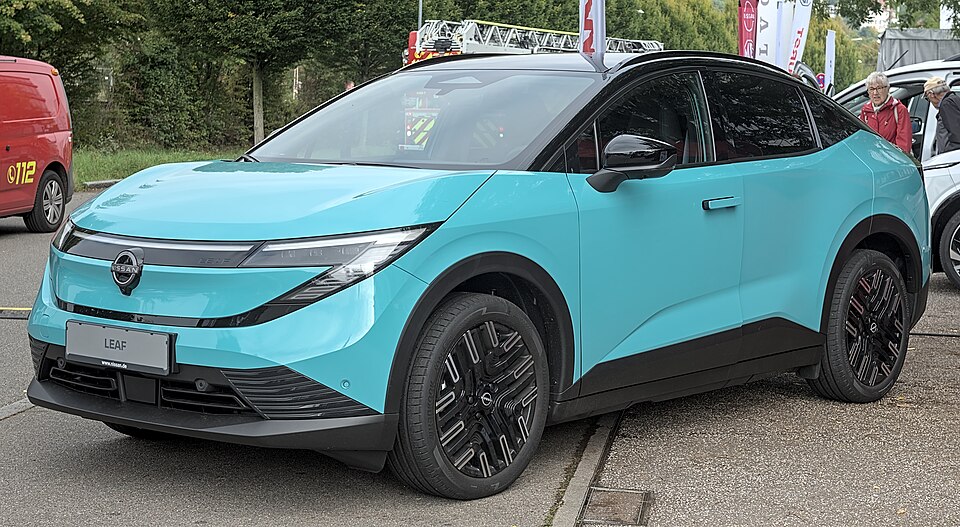
2023 Nissan Leaf
Trims, performance, features, fuel economy, safety and known problems — with the pros and cons against similar 2023 models.
- Class
- Midsize Cars
- Body styles
- 5dr Hatchback
- Engines
- Electric motor
- Transmission
- 1-speed automatic
- Drivetrain
- Front-Wheel Drive
- Seats
- 5
- Fuel
- EV
- EV range
- 212 mi · 8 h on 240 V
- Length
- 176.4 in
- Curb weight
- 3,439 lb
- NHTSA rating
- Not rated
- Recalls
- 3 campaigns
Pros & cons
What's good
- Lots of standard safety tech5 of 5 key driver aids standard on the versions we checked.
Watch out for
No weak spots against similar models in the data.
Calculated from EPA, NHTSA and vPIC data against 16 similar 2023 models — not a review. How we calculate this →
Overview
The 2023 Nissan Leaf is a midsize car powered by electricity and front-wheel drive.
It measures about 176 inches long and 71 inches wide on a 106-inch wheelbase, with a curb weight of roughly 3,439 lb.
The electric version has an EPA-rated range of up to 212 miles and takes about 8 hours to charge on a 240-volt Level 2 charger.
NHTSA has not published a 5-Star overall rating for this model year.
It has 3 recall campaigns on file and owners have filed 22 complaints with NHTSA since 2015, most often about the unknown or other.
What changed for 2023
- Longest EV range down from 226 to 212 miles
Compared with 2022; trim, feature and price changes aren't covered. See the 2022 Leaf →
Trims, performance & features
Trims
Safety & driver-assist features
Built in: Smyrna, Tennessee
NHTSA vPIC, as reported by the manufacturer for 2 2023 Leaf configurations; may not list every trim. How we calculate this →
Dimensions & weight
| Body | Length | Width | Height | Wheelbase | Track F / R | Curb weight | Weight F/R |
|---|---|---|---|---|---|---|---|
| 5dr Hatchback | 176.4 in | 70.5 in | 61.4 in | 106.3 in | 60.6 / 61 in | 3,439 lb | 58/42 |
Transport Canada CVS (Open Government Licence – Canada), Canadian-market figures.
Will it fit your garage? Check with your measurements →Engines, MPG & running costs
| Version | Engine | Transmission | Drive | City / Hwy / Comb | vs. class | Fuel / yr | CO₂ g/mi |
|---|---|---|---|---|---|---|---|
| LEAF EV | TBD | Automatic (A1) | Front-Wheel Drive | 149 mi · 30.4264 kWh/100mi | – | $700 | – |
| LEAF SV EV | TBD | Automatic (A1) | Front-Wheel Drive | 212 mi · 30.7824 kWh/100mi | – | $700 | – |
EPA estimates; "vs. class" is combined MPG against the 2023 EPA class average. How we calculate this →
Safety ratings & technology
NHTSA has not published 5-Star ratings for the 2023 Nissan Leaf.
Similar 2023 midsize cars
| Model | Best MPG / range | NHTSA overall | Recalls |
|---|---|---|---|
| 2023 Nissan Leaf (this car) | 212 mi | Not rated | 3 |
| 2023 Toyota Corolla | 50 MPG | ★★★★★ | 4 |
| 2023 Honda Civic | 36 MPG | Not rated | 5 |
| 2023 Nissan GT-R | 18 MPG | Not rated | 0 |
| 2023 Toyota Prius | 57 MPG | ★★★★★ | 4 |
| 2023 Subaru Impreza | 32 MPG | ★★★★★ | 2 |
| 2023 Hyundai Elantra | 54 MPG | ★★★★★ | 4 |
Recalls (3)
Vehicle Speed Control · Jul 17, 2023
NHTSA campaign 23V494000 · 66,159 vehicles
- Problem
- Nissan North America, Inc. (Nissan) is recalling certain 2018-2023 LEAF vehicles. The vehicle may accelerate unintentionally if the driving mode is changed ("D" to "B"; e-Pedal "On"; or "ECO" mode) after disengaging the cruise control.
- Risk
- Unintentional acceleration can increase the risk of a crash.
- Fix
- Dealers will reprogram the vehicle control module (VCM), free of charge. Owner notification letters are expected to be mailed August 30, 2023. Owners may contact Nissan's customer service at 1-800-867-7669. Nissan's number for this recall is R23A6.
Service Brakes, Hydraulic › Foundation Components › Hoses, Lines/Piping, And Fittings · May 22, 2023
NHTSA campaign 23V362000 · 758 vehicles
- Problem
- Nissan North America, Inc. (Nissan) is recalling certain 2023 LEAF vehicles. The right-hand brake tubes may have been damaged during production and could corrode, possibly causing a hole in the brake line and a brake fluid leak.
- Risk
- A brake fluid leak can reduce braking performance and extend the distance required to stop, increasing the risk of a crash.
- Fix
- Dealers will inspect and replace the right-hand brake tube, as necessary, free of charge. Owner notification letters are expected to be mailed July 7, 2023. Owners may contact Nissan's customer service at 1-800-867-7669. Nissan's number for this recall is PC976.
Equipment › Other › Owners/Service/Other Manual · Feb 2, 2023
NHTSA campaign 23V048000 · 64,732 vehicles
- Problem
- Nissan North America, Inc. (Nissan) is recalling certain 2018-2023 LEAF vehicles. The Owner's Manual instructions for defroster operation are incorrect, and may result in reduced defroster performance under specific conditions. As such, these vehicles fail to comply with the requirements of Federal Motor Vehicle Safety Standard number 103, "Windshield Defrosting and Defogging Systems."
- Risk
- Reduced defroster performance can limit visibility out of the windshield, increasing the risk of a crash.
- Fix
- Nissan will mail an addendum with updated instructions on how to operate the defroster, free of charge. Owner notification letters are expected to be mailed April 1, 2023. Owners may contact Nissan's customer service at 1-800-867-7669. Nissan's number for this recall is R22C5.
Not every 2023 Nissan Leaf is affected — only a VIN check confirms your car.
Owner-reported problems
Unverified owner reports; best-sellers collect more.
Used 2023 Nissan Leaf buyer's checklist
- Run the VIN at nhtsa.gov/recalls. 3 recalls this year — ask for proof of repairs.
- Vehicle Speed Control — 8 owner reports. Ask the seller and mechanic specifically about this system.
- Electrical System — 4 owner reports. Test every window, lock, light, screen and USB port; check the battery age.
- Visibility/Wiper — 3 owner reports. Check all exterior lights, wipers and the windshield for cracks.
- Mileage to watch. Owners typically reported problems around 8,000 miles; ask what was repaired near that point.
- Battery health. Ask for a battery state-of-health report, check the remaining battery warranty, and compare the displayed range at 100% charge with the EPA's 212 miles.
- Before you pay: service records, a history report and an independent inspection.
Generated by DecodedCars from NHTSA recalls and owner complaints for the 2023 Nissan Leaf. Not a substitute for a professional inspection.
Other Leaf years
Compare all years →| Year | MPG (best) | Length | Overall | Recalls | Complaints |
|---|---|---|---|---|---|
| 2026 Leaf | 303 mi | 173.6 in | Not rated | 2 | 3 |
| 2025 Leaf | 212 mi | 176.4 in | Not rated | 0 | 7 |
| 2024 Leaf | 212 mi | 176.4 in | Not rated | 0 | 5 |
| 2022 Leaf | 226 mi | 176.4 in | Not rated | 4 | 96 |
| 2021 Leaf | 226 mi | 176.4 in | ★★★★★ | 4 | 57 |
| 2020 Leaf | 226 mi | 176.4 in | ★★★★★ | 6 | 167 |
| 2019 Leaf | 226 mi | 176.4 in | Not rated | 5 | 260 |
| 2018 Leaf | 151 mi | 176.4 in | Not rated | 4 | 67 |
| 2017 Leaf | 107 mi | 175.2 in | Not rated | 2 | 17 |
| 2016 Leaf | 107 mi | 175.2 in | Not rated | 4 | 36 |
| 2015 Leaf | 84 mi | 175.2 in | Not rated | 4 | 109 |
| 2014 Leaf | 84 mi | 175.2 in | Not rated | 6 | 31 |
Sources: EPA, NHTSA, Transport Canada, Wikimedia Commons. Not affiliated with NHTSA, the EPA or Nissan. How we calculate this →