 DecodedCars
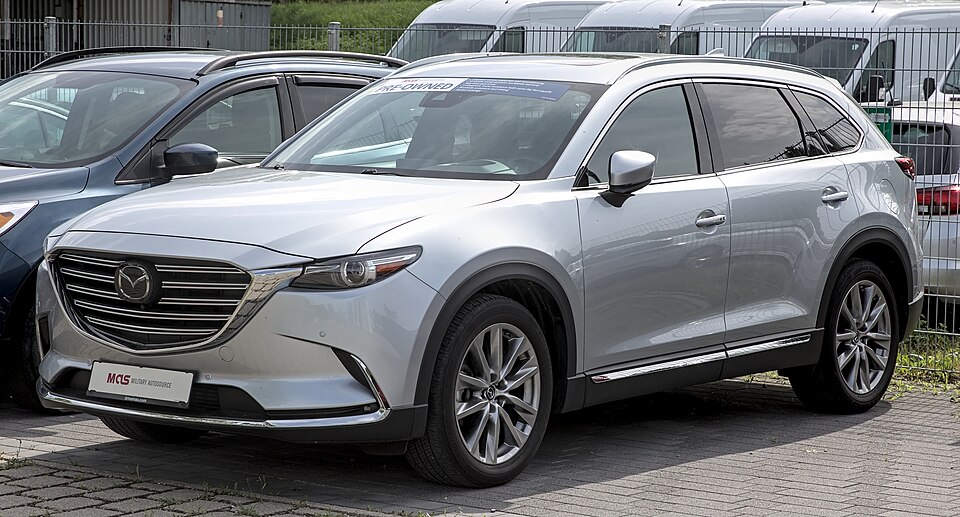
Mazda CX-9
17 model years from 2007 to 2023, compared on size, efficiency, safety and reliability.
- Model years
- 2007–2023
- Class
- Small Sport Utility Vehicle 4WD, Small Sport Utility Vehicle 2WD, Sport Utility Vehicle - 2WD
- Latest engines
- 2.5L 4-cyl turbo
- Best MPG
- 18–24 combined, by year
- Latest rating
- ★★★★★ (2023)
- Recalls
- 12 campaigns, all years
- Most complaints
- 2012 (188)
- Fewest problems
- 2022
- Interest
- 5,630 Wikipedia views / 30 days
The 2023 CX-9 in brief
The 2023 Mazda CX-9 is a small SUV offered with a 2.5L 4-cyl turbo engine and 4-wheel drive.
It measures about 200 inches long and 78 inches wide on a 115-inch wheelbase, with a curb weight of roughly 4,387 lb.
EPA rates its most efficient version at 23 MPG combined (20 city / 26 highway), 8% worse than the 2023 small SUV average of 25 MPG, for an estimated $2,900 a year in fuel.
In NHTSA crash testing it earned the top 5-star overall rating.
It has 0 recall campaigns on file and owners have filed 13 complaints with NHTSA since 2015, most often about the unknown or other.
The Mazda CX-9 has 17 model years in our data, from 2007 to 2023, classed as Small Sport Utility Vehicle 4WD, Small Sport Utility Vehicle 2WD, Sport Utility Vehicle - 2WD.
Its most efficient year was 2021 at 24 MPG combined; across all years the best version ranged from 18 to 24 MPG.
Owners most often report problems with the engine (342), service brakes (327), suspension (142).
Buying used? 2023 has the fewest problems in our data, and 2018 is the year to avoid.
2010 has the most recalls (6); all years together count 12 campaigns and 1,280 owner complaints.
How the 2007 CX-9 compares
The 2007 Mazda CX-9 is a SUV - offered with a 3.5L 6-cyl engine and front-wheel drive and 4-wheel or all-wheel drive.
It measures about 200 inches long and 76 inches wide on a 113-inch wheelbase, with a curb weight of roughly 4,312 lb.
About the Mazda CX-9
The Mazda CX-9 is a mid-size crossover SUV manufactured by Mazda from 2006 to 2023 through two generations with three-row seating. It was Mazda's largest passenger vehicle until the arrival of the Mazda CX-90.
From the Wikipedia article "Mazda CX-9", licensed under CC BY-SA 4.0.
2023 CX-9 pros & cons
Full 2023 details →What's good
- 5-star NHTSA safety ratingTop overall score in federal crash tests.
- Few owner complaints13 complaints filed with NHTSA versus about 76 for similar models.
- No recalls so far
Watch out for
No weak spots against similar models in the data.
Best and worst years to buy used
2023 CX-9
13 owner complaints · 0 recalls · 3 crash reports
NHTSA overall: ★★★★★
Year to avoid2018 CX-9
128 owner complaints · 2 recalls · 1 fire report · 4 crash reports
Most reported: Engine
NHTSA recalls and complaints for 9 model years since 2015; use it alongside a pre-purchase inspection. How we calculate this →
CX-9 changes by model year
- 2020
- Lightest version 337 lb heavier
- 2018
- Now crash-tested by NHTSA: 5 stars overall
- 2016
- New body dimensions: 1.6 in shorter, wheelbase +2.0 in — most likely a redesign or new generation
- Engine added: 2.5L 4-cyl turbo
- Engine dropped: 3.7L 6-cyl
- Best combined MPG up from 19 to 24
- 2008
- Engine added: 3.7L 6-cyl
- Engine dropped: 3.5L 6-cyl
Years without a measurable change are left out.
Show all 17 model years side by side
| Year | Latest engines | Best MPG / range | Length | Weight | Overall | Recalls | Complaints |
|---|---|---|---|---|---|---|---|
| 2023 | 2.5L 4-cyl turbo | 23 MPG | 199.6 in | 4,387 lb | ★★★★★ | 0 | 13 |
| 2022 | 2.5L 4-cyl turbo | 23 MPG | 199.6 in | 4,387 lb | ★★★★★ | 0 | 11 |
| 2021 | 2.5L 4-cyl turbo | 24 MPG | 199.6 in | 4,387 lb | ★★★★★ | 1 | 40 |
| 2020 | 2.5L 4-cyl turbo | 24 MPG | 199.6 in | 4,387 lb | ★★★★★ | 1 | 19 |
| 2019 | 2.5L 4-cyl turbo | 24 MPG | 199.6 in | 4,381 lb | ★★★★★ | 2 | 53 |
| 2018 | 2.5L 4-cyl turbo | 24 MPG | 199.6 in | 4,341 lb | ★★★★★ | 2 | 128 |
| 2017 | 2.5L 4-cyl turbo | 24 MPG | 199.6 in | 4,341 lb | Not rated | 0 | 61 |
| 2016 | 2.5L 4-cyl turbo | 24 MPG | 199.6 in | 4,341 lb | Not rated | 0 | 107 |
| 2015 | 3.7L 6-cyl | 19 MPG | 201.2 in | 4,248 lb | Not rated | 2 | 35 |
| 2014 | 3.7L 6-cyl | 19 MPG | 201.2 in | 4,546 lb | Not rated | 3 | 53 |
| 2013 | 3.7L 6-cyl | 19 MPG | 201.2 in | 4,533 lb | Not rated | 4 | 58 |
| 2012 | 3.7L 6-cyl | 19 MPG | 200.4 in | 4,533 lb | Not rated | 4 | 188 |
| 2011 | 3.7L 6-cyl | 19 MPG | 200.4 in | 4,533 lb | Not rated | 4 | 138 |
| 2010 | 3.7L 6-cyl | 18 MPG | 200.4 in | 4,533 lb | Not rated | 6 | 135 |
| 2009 | 3.7L 6-cyl | 18 MPG | 199.6 in | 4,312 lb | Not rated | 5 | 48 |
| 2008 | 3.7L 6-cyl | 18 MPG | 199.6 in | 4,312 lb | Not rated | 4 | 132 |
| 2007 | 3.5L 6-cyl | 18 MPG | 199.6 in | 4,312 lb | Not rated | 4 | 61 |
Alternatives to the 2023 CX-9
| Model | Best MPG / range | NHTSA overall | Recalls |
|---|---|---|---|
| 2023 Toyota RAV4 Prime | 38 MPG | ★★★★★ | 2 |
| 2023 Toyota 4Runner | 17 MPG | ★★★★★ | 1 |
| 2023 Ford Explorer | 27 MPG | ★★★★★ | 15 |
| 2023 Toyota Highlander | 36 MPG | ★★★★★ | 9 |
| 2023 Kia Telluride | 23 MPG | ★★★★★ | 6 |
| 2023 Nissan Pathfinder | 23 MPG | ★★★★★ | 1 |
Most common owner-reported problems
Sources: EPA, NHTSA, Transport Canada, Wikipedia, Wikimedia Commons. Not affiliated with NHTSA, the EPA or Mazda. How we calculate this →