 DecodedCars
2005 Kia Optima
Trims, performance, features, fuel economy, safety and known problems — with the pros and cons against similar 2005 models.
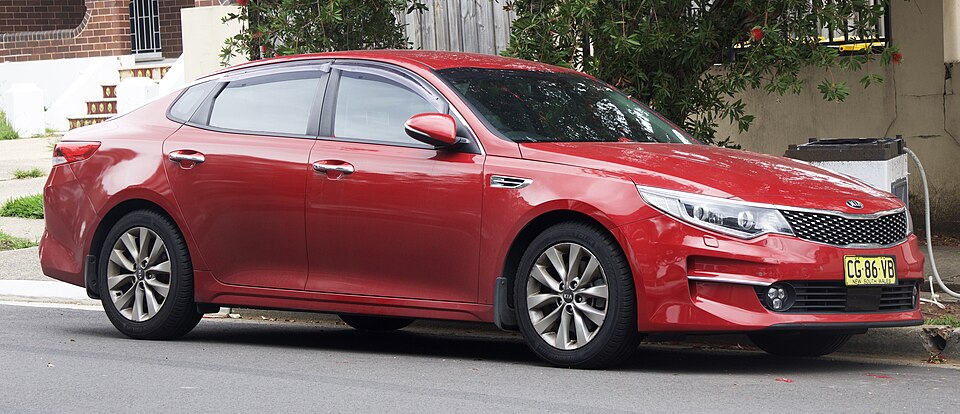
- Class
- Midsize Cars
- Engines
- 2.4L 4-cyl, 2.7L 6-cyl
- Drivetrain
- Front-Wheel Drive
- Fuel
- Regular Gasoline
- MPG (best)
- 23 combined · 20 city / 28 hwy
- Length
- –
- Curb weight
- –
- NHTSA rating
- Not rated
- Recalls
- 0 campaigns
Pros & cons
What's good
- No recalls so far
Watch out for
No weak spots against similar models in the data.
Calculated from EPA, NHTSA and vPIC data against 24 similar 2005 models — not a review. How we calculate this →
Overview
The 2005 Kia Optima is a midsize car offered with 2 engines (2.4L 4-cyl and 2.7L 6-cyl) and front-wheel drive.
EPA rates its most efficient version at 23 MPG combined (20 city / 28 highway), 12% better than the 2005 midsize car average of 20.6 MPG, for an estimated $2,900 a year in fuel.
It has 0 recall campaigns on file and owners have filed 23 complaints with NHTSA since 2015, most often about the electrical system.
Engines, MPG & running costs
| Version | Engine | Transmission | Drive | City / Hwy / Comb | vs. class | Fuel / yr | CO₂ g/mi |
|---|---|---|---|---|---|---|---|
| Optima | 2.4L 4-cyl | Manual 5-spd | Front-Wheel Drive | 20 / 27 / 23 | +12% | $2,900 | 386 |
| Optima | 2.4L 4-cyl | Automatic 4-spd | Front-Wheel Drive | 19 / 28 / 22 | +7% | $3,050 | 404 |
| Optima | 2.7L 6-cyl | Automatic 4-spd | Front-Wheel Drive | 18 / 25 / 21 | +2% | $3,200 | 423 |
| Optima | 2.7L 6-cyl | Manual 5-spd | Front-Wheel Drive | 18 / 26 / 21 | +2% | $3,200 | 423 |
EPA estimates; "vs. class" is combined MPG against the 2005 EPA class average. How we calculate this →
Safety ratings & technology
NHTSA has not published 5-Star ratings for the 2005 Kia Optima under the current (2011+) test program.
Similar 2005 midsize cars
| Model | Best MPG / range | NHTSA overall | Recalls |
|---|---|---|---|
| 2005 Kia Optima (this car) | 23 MPG | Not rated | 0 |
| 2005 Honda Accord | 28 MPG | Not rated | 11 |
| 2005 Toyota Camry | 25 MPG | Not rated | 4 |
| 2005 Toyota Prius | 46 MPG | Not rated | 3 |
| 2005 Hyundai Elantra | 26 MPG | Not rated | 0 |
| 2005 Chevrolet Malibu | 25 MPG | Not rated | 4 |
| 2005 Volkswagen Passat | 27 MPG | Not rated | 0 |
Recalls (0)
No vehicle recalls on file with NHTSA for the 2005 Kia Optima.
Check your VIN for open recalls at NHTSA ↗Not every 2005 Kia Optima is affected — only a VIN check confirms your car.
Owner-reported problems
Unverified owner reports; best-sellers collect more.
Used 2005 Kia Optima buyer's checklist
- Run the VIN at nhtsa.gov/recalls. No recalls on file, but check anyway.
- Electrical System — 8 owner reports. Test every window, lock, light, screen and USB port; check the battery age.
- Structure › Body — 7 owner reports. Open and close every door, the hood and tailgate; look for rust or misaligned panels.
- Air Bags — 6 owner reports. Confirm the airbag warning light turns off after start-up and any airbag recall was completed.
- Mileage to watch. Owners typically reported problems around 120,000 miles; ask what was repaired near that point.
- Before you pay: service records, a history report and an independent inspection.
Generated by DecodedCars from NHTSA recalls and owner complaints for the 2005 Kia Optima. Not a substitute for a professional inspection.
Other Optima years
Compare all years →| Year | MPG (best) | Length | Overall | Recalls | Complaints |
|---|---|---|---|---|---|
| 2020 Optima | 42 | 191.3 in | ★★★★★ | 0 | 153 |
| 2019 Optima | 41 | 191.3 in | ★★★★★ | 1 | 213 |
| 2018 Optima | 42 | 191.3 in | ★★★★★ | 3 | 244 |
| 2017 Optima | 42 | 191.3 in | ★★★★★ | 4 | 306 |
| 2016 Optima | 37 | 191.3 in | Not rated | 5 | 764 |
| 2015 Optima | 37 | 190.6 in | Not rated | 4 | 1,020 |
| 2014 Optima | 37 | 190.6 in | Not rated | 7 | 580 |
| 2013 Optima | 37 | 190.6 in | Not rated | 10 | 1,352 |
| 2012 Optima | 36 | 190.6 in | Not rated | 6 | 917 |
| 2011 Optima | 36 | – | Not rated | 6 | 544 |
| 2010 Optima | 25 | – | Not rated | 1 | 41 |
| 2009 Optima | 25 | – | Not rated | 1 | 55 |
Sources: EPA, NHTSA, Transport Canada, Wikimedia Commons. Not affiliated with NHTSA, the EPA or Kia. How we calculate this →