 DecodedCars
2005 Honda Accord
Trims, performance, features, fuel economy, safety and known problems — with the pros and cons against similar 2005 models.
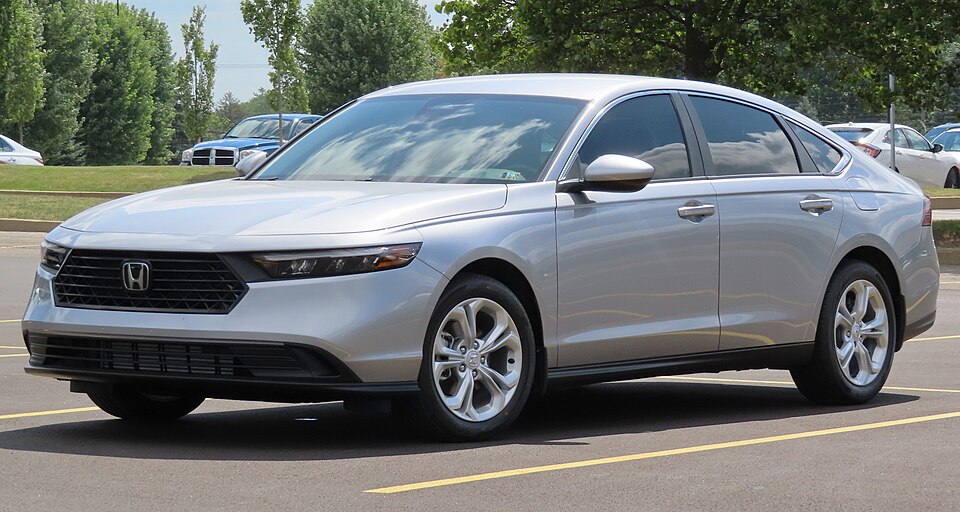
- Class
- Midsize Cars
- Body styles
- 2dr Coupe EX-V6/EX-V6 Mt, 2dr Coupe LX-G/EX-L, 4dr Sedan DX/LX-G/EX-L, 4dr Sedan LX V6/EX V6
- Engines
- 3.0L 6-cyl, 2.4L 4-cyl
- Horsepower
- 160–253 hp
- Transmission
- 5-speed automatic
- Drivetrain
- Front-Wheel Drive
- Fuel
- Hybrid, Regular Gasoline
- MPG (best)
- 28 combined · 25 city / 33 hwy
- Length
- 187.8–189.4 in
- Curb weight
- 3,009–3,501 lb
- NHTSA rating
- Not rated
- Recalls
- 11 campaigns
Pros & cons
What's good
- Excellent fuel economyUp to 28 MPG combined — 36% better than the average 2005 midsize car (20.6 MPG).
- Hybrid version availableOffered as a hybrid as well as gas.
Watch out for
- Many owner complaints257 complaints filed with NHTSA versus about 30 for similar models — most often about the air bags.
- 11 recallsMore than similar models (about 0). Confirm repairs with the VIN.
Calculated from EPA, NHTSA and vPIC data against 34 similar 2005 models — not a review. How we calculate this →
Overview
The 2005 Honda Accord is a midsize car offered with 2 engines (3.0L 6-cyl and 2.4L 4-cyl), including a hybrid version and front-wheel drive.
It measures about 188 inches long and 71 inches wide on a 105-inch wheelbase, with a curb weight of roughly 3,289 lb (2dr Coupe EX-V6/EX-V6 Mt).
EPA rates its most efficient version at 28 MPG combined (25 city / 33 highway), 36% better than the 2005 midsize car average of 20.6 MPG, for an estimated $2,400 a year in fuel.
It has 11 recall campaigns on file and owners have filed 257 complaints with NHTSA since 2015, most often about the air bags.
Trims, performance & features
Trims
Built in: Marysville, Ohio · Sayama, Saitama
NHTSA vPIC, as reported by the manufacturer for 5 2005 Accord configurations; may not list every trim. How we calculate this →
Dimensions & weight
| Body | Length | Width | Height | Wheelbase | Track F / R | Curb weight | Weight F/R |
|---|---|---|---|---|---|---|---|
| 2dr Coupe EX-V6/EX-V6 Mt | 187.8 in | 71.3 in | 55.9 in | 105.1 in | 61.4 / 61 in | 3,289 lb | 61/39 |
| 2dr Coupe LX-G/EX-L | 187.8 in | 71.3 in | 55.9 in | 105.1 in | 61.4 / 61 in | 3,009 lb | 61/39 |
| 4dr Sedan DX/LX-G/EX-L | 189.4 in | 71.7 in | 57.5 in | 107.9 in | 61.8 / 61.4 in | 3,062 lb | 61/39 |
| 4dr Sedan LX V6/EX V6 | 189.4 in | 71.7 in | 57.5 in | 107.9 in | 61.8 / 61.4 in | 3,316 lb | 61/39 |
| Hybrid 4dr Sedan FWD | 189.4 in | 71.7 in | 57.5 in | 107.9 in | 61.8 / 61.4 in | 3,501 lb | 61/39 |
Transport Canada CVS (Open Government Licence – Canada), Canadian-market figures.
Will it fit your garage? Check with your measurements →Engines, MPG & running costs
| Version | Engine | Transmission | Drive | City / Hwy / Comb | vs. class | Fuel / yr | CO₂ g/mi |
|---|---|---|---|---|---|---|---|
| Accord Hybrid Hybrid | 3.0L 6-cyl | Automatic 5-spd | Front-Wheel Drive | 25 / 33 / 28 | +36% | $2,400 | 317 |
| Accord | 2.4L 4-cyl | Manual 5-spd | Front-Wheel Drive | 23 / 31 / 26 | +26% | $2,600 | 342 |
| Accord | 2.4L 4-cyl | Automatic 5-spd | Front-Wheel Drive | 21 / 31 / 24 | +17% | $2,800 | 370 |
| Accord | 3.0L 6-cyl | Automatic 5-spd | Front-Wheel Drive | 19 / 28 / 22 | +7% | $3,050 | 404 |
| Accord | 3.0L 6-cyl | Manual 6-spd | Front-Wheel Drive | 18 / 27 / 21 | +2% | $3,200 | 423 |
EPA estimates; "vs. class" is combined MPG against the 2005 EPA class average. How we calculate this →
Safety ratings & technology
NHTSA has not published 5-Star ratings for the 2005 Honda Accord under the current (2011+) test program.
Similar 2005 midsize cars
| Model | Best MPG / range | NHTSA overall | Recalls |
|---|---|---|---|
| 2005 Honda Accord (this car) | 28 MPG | Not rated | 11 |
| 2005 Toyota Corolla | 31 MPG | Not rated | 7 |
| 2005 Ford Mustang | 20 MPG | Not rated | 4 |
| 2005 Toyota Camry | 25 MPG | Not rated | 4 |
| 2005 Chevrolet Malibu | 25 MPG | Not rated | 4 |
| 2005 Volkswagen Passat | 27 MPG | Not rated | 0 |
| 2005 Mitsubishi Lancer | 26 MPG | Not rated | 3 |
Recalls (11)
Air Bags › Frontal › Passenger Side › Inflator Module · Jun 27, 2019
NHTSA campaign 19V501000 · 1,657,752 vehicles
- Problem
- Honda (American Honda Motor Co.) is recalling certain 2003-2006 Acura MDX, 2005-2012 RL, 2003-2007 Honda Accord, 2001-2005 Civic, 2003-2005 Civic Hybrid, 2001-2005 Civic GX NGV, 2002-2006 CR-V, 2003-2011 Element, 2007-2008 Fit, 2002-2004 Odyssey, 2003-2008 Pilot, and 2006-2014 Ridgeline vehicles. The vehicles are equipped with passenger frontal air bag inflators assembled as a recall remedy part or replacement service part, that may explode due to propellant degradation occurring after long-term exposure to high absolute humidity, temperature and temperature cycling.
- Risk
- An inflator explosion may result in sharp metal fragments striking the driver or other occupants resulting in serious injury or death.
- Fix
- Honda will notify owners, and dealers will replace the passenger frontal airbag inflator, free of charge. The recall began August 12, 2019. Owners may contact Honda customer service at 1-888-234-2138. Honda's numbers for this recall are E5D and X5C.
Air Bags › Frontal › Driver Side › Inflator Module · Jun 27, 2019
NHTSA campaign 19V499000 · 3,947 vehicles
- Problem
- Honda (American Honda Motor Co.) is recalling certain 2003 Acura 3.2CL, 2002-2003 3.2TL, 2003-2006 MDX, 2001-2007 Honda Accord, 2001-2005 Civic, 2003-2005 Civic Hybrid, 2001-2005 Civic GX NGV, 2002-2006 CR-V, 2003-2011 Element, 2002-2004 Odyssey, 2003-2008 Pilot and 2006 Ridgeline vehicles. These vehicles are equipped with driver frontal air bag inflators assembled as a recall remedy part or replacement service part, that may explode due to propellant degradation occurring after long-term exposure to high absolute humidity, temperature and temperature cycling.
- Risk
- An inflator explosion may result in sharp metal fragments striking the driver or other occupants resulting in serious injury or death.
- Fix
- Honda will notify owners, and dealers will replace the driver frontal air bag inflator, free of charge. The recall began August 12, 2019. Owners may contact Honda customer service at 1-888-234-2138. Honda's numbers for this recall are Q5A and Y58.
Air Bags › Frontal › Driver Side › Inflator Module · Mar 6, 2019
NHTSA campaign 19V182000 · 1,101,534 vehicles
- Problem
- Honda (American Honda Motor Co.) is recalling specific 2003 Acura 3.2CL, 2013-2016 ILX, 2013-2014 ILX Hybrid, 2003-2006 MDX, 2007-2016 RDX, 2002-2003 3.2TL, 2004-2006, and 2009-2014 TL, 2010-2013 ZDX and 2001-2007 and 2009 Honda Accord, 2001-2005 Civic, 2003-2005 Civic Hybrid, 2001-2005 Civic GX NGV, 2002-2007 and 2010-2011 CR-V, 2003-2011 Element, 2007 Fit, 2002-2004 Odyssey, 2003-2008 Pilot, and 2006-2014 Ridgeline vehicles. The affected vehicles received a replacement driver air bag inflator as part of a previous Takata inflator recall remedy or a replacement driver air bag module containing the same inflator type as a service part. Due to a manufacturing error, in the event of a crash necessitating deployment of the driver frontal air bag, these inflators may explode.
- Risk
- An explosion of an inflator within the driver frontal air bag module may result in sharp metal fragments striking the driver, front seat passenger or other occupants resulting in serious injury or death.
- Fix
- Honda will notify owners, and dealers will replace the driver's air bag inflator with an alternate inflator, free of charge. The recall began April 10, 2019. Honda owners may contact customer service at 1-888-234-2138. Honda's number for this recall is O41. Acura owners may contact customer service at 1-888-234-2138. Acura's number for this recall is U40.
Air Bags › Frontal › Passenger Side › Inflator Module · Apr 26, 2018
NHTSA campaign 18V268000 · 1,335 vehicles
- Problem
- Honda (American Honda Motor Co.) is recalling certain 2003-2012 Honda Accord and Pilot, 2010 Accord Crosstour, 2001-2011 Civic, 2002-2011 CR-V, 2003-2004, 2006-2008 and 2011 Element, 2007 and 2009-2013 Fit, 2010-2012 Insight, 2002-2004 Odyssey, and 2012 Ridgeline vehicles. The front passenger air bag may have been installed incorrectly during replacement.
- Risk
- An incorrectly installed air bag may deploy improperly in the event of a crash, increasing the risk of injury.
- Fix
- Honda will notify owners, and dealers will inspect and, if necessary, replace the passenger frontal air bag module assembly, free of charge. The recall began June 22, 2018. Owners may contact Honda customer service at 1-888-234-2138. Honda's numbers for this recall are K1P, and M1O.
Air Bags › Frontal › Passenger Side › Inflator Module · Mar 30, 2016
NHTSA campaign 16V178000 · 11,602 vehicles
- Problem
- Honda (American Honda Motor Co.) is recalling certain model year 2004-2007 Accord vehicles manufactured October 1, 2003, to August 17, 2007. The affected vehicles may have been assembled with an incorrect passenger frontal air bag module that does not comply with the advanced air bag requirements. As such, these vehicles fail to comply with the requirements of Federal Motor Vehicle Safety Standard (FMVSS) number 208, "Occupant Crash Protection."
- Risk
- An air bag module does not meet the advanced air bag requirements can increase the risk of injury or death in the event of a crash.
- Fix
- Honda will notify owners, and dealers will inspect and replace the air bag module as necessary, free of charge. The recall began on May 2, 2016. Owners may contact Honda customer service at 1-800-999-1009. Honda's number for this recall is JZ3.
Air Bags › Frontal › Passenger Side › Inflator Module · Jun 15, 2015
NHTSA campaign 15V370000 · 3,498,481 vehicles
- Problem
- Honda (American Honda Motor Co.) is recalling certain model year 2001-2005 Honda Civic vehicles manufactured March 21, 2000, to January 20, 2005, 2001-2004 Honda Civic GX vehicles manufactured June 14, 2000, to August 19, 2004, 2003-2005 Honda Civic Hybrid vehicles manufactured February 24, 2002, to January 18, 2005, 2003-2007 Honda Accord vehicles manufactured February 21, 2002, to August 28, 2007, 2002-2004 Honda CR-V vehicles, 2002-2003 Honda Odyssey vehicles manufactured June 19, 2001, to July 12, 2003, 2003 Acura MDX vehicles manufactured September 19, 2002, to June 19, 2003, 2003 Honda Element vehicles manufactured June 25, 2002, to July 31, 2003, and 2003 Honda Pilot vehicles manufactured November 26, 2001, to August 21, 2003. The affected vehicles have a passenger side frontal air bag that may be susceptible to moisture intrusion which, over time, could cause the inflator to rupture upon its deployment.
- Risk
- In the event of a crash necessitating deployment of the passenger's frontal air bag, the inflator could rupture with metal fragments striking the passenger seat occupant or other occupants possibly causing serious injury or death.
- Fix
- Honda will notify owners, and dealers will replace the passenger air bag inflator, free of charge. The recall began on July 1, 2015. Owners may contact Honda customer service at 1-888-234-2138. Honda's numbers for this recall are JU4, JU5, JU6, and JU7. Note: Vehicles that have already received a replacement passenger air bag inflator as part of the recall remedy for an earlier campaign such as 14V353 or 14V700 (Honda recall numbers S95, JH6, JH7, JH8, JH9, JJ0, JJ1, JJ2, JJ6, JM5 and JM6) are not included in this recall. However, this recall does supersede 13V132 and 14V349. Note: On December 18, 2015 Honda informed NHTSA of an expansion of this recall to include certain model year 2004 Honda CR-V vehicles in addition to additional model year 2003 CR-V vehicles.
Air Bags › Frontal › Driver Side › Inflator Module · May 28, 2015
NHTSA campaign 15V320000 · 6,281,043 vehicles
- Problem
- Honda (American Honda Motor Co.) is recalling certain model year 2001-2007 Accord, 2001-2005 Civic, 2001-2004 Honda Civic GX, 2003-2005 Honda Civic Hybrid, 2002-2006 CR-V, 2003-2011 Element, 2002-2004 Odyssey, 2003-2008 Pilot, 2006 Ridgeline, 2003 Acura 3.2CL, 2003-2006 Acura MDX, and 2002-2003 Acura 3.2TL vehicles. The affected vehicles are equipped with a dual-stage driver frontal air bag that may be susceptible to moisture intrusion and other factors, including manufacturing variability that, over time, could cause the inflator to rupture.
- Risk
- In the event of a crash necessitating deployment of the driver's frontal air bag, the inflator could rupture with metal fragments striking the driver or other occupants resulting in serious injury or death.
- Fix
- Honda will notify owners, and dealers will replace the driver frontal air bag inflator, free of charge. The recall began on July 1, 2015. Owners may contact Honda customer service at 1-888-234-2138. Owners may contact Acura customer service at 1-800-382-2238, select option 4. Note: Vehicles that have had their driver frontal air bag replaced previously as part of a recall remedy prior to September 12, 2014 need to have their air bag replaced under this recall as well. Vehicles that, on or after September 12, 2014, received a remedy for a prior driver frontal air bag inflator recall already received an inflator of a different design, and therefore are not included in this recall and do not require additional servicing. Note: This recall fully supersedes recalls 08V-593, 09V-259, 10V-041, 11V-260, 14V-351 and 15V-153. Honda's numbers for this recall are JQ9, JR0, JR1, JR2, JR3, JR4, JR5, JR6, JR7, and JR8.
Air Bags · Nov 4, 2014
NHTSA campaign 14V700000
- Problem
- American Honda Motor Co. (Honda) is recalling certain model year 2001-2005 Honda Civic, 2003-2004 Civic CNG and Element, 2002-2005 CR-V, 2002-2004 Odyssey, 2003-2005 Accord, Pilot, Civic Hybrid, and Acura MDX, 2005 Acura RL and 2006 Honda Ridgeline vehicles originally sold, or ever registered, in geographic locations associated with high absolute humidity. Specifically, vehicles sold, or ever registered, in Alabama, Florida, Georgia, Hawaii, Louisiana, Mississippi, South Carolina, Texas, Puerto Rico, U.S. Virgin Islands, Saipan, Guam, and American Samoa are addressed by this recall. Upon deployment of the passenger side frontal air bag, excessive internal pressure may cause the inflator to rupture.
- Risk
- In the event of a crash necessitating deployment of the passengerÂs frontal air bag, the inflator could rupture with metal fragments striking the vehicle occupants potentially resulting in serious injury or death.
- Fix
- Honda will notify owners, and dealers will replace the passenger side air bag inflator, free of charge. The recall began January 26, 2015. Owners may contact Honda customer service at 1-800-999-1009.
Air Bags · Jun 20, 2014
NHTSA campaign 14V353000 · 133,207 vehicles
- Problem
- American Honda Motor Company, Inc.'s (Honda) is conducting a limited regional recall for certain model year 2003-2005 Accord, Civic, CR-V, Pilot and Acura MDX, model year 2003-2004 Odyssey and Element, and model year 2005 Acura RL, and 2006 Honda Ridgeline vehicles originally sold, or ever registered in California, and equipped with Takata-brand air bag inflators. Upon deployment of the passenger side frontal air bag, excessive internal pressure may cause the inflator to rupture.
- Risk
- In the event of a crash necessitating deployment of the passengerÂs frontal air bag, the inflator could rupture with metal fragments striking the vehicle occupants potentially resulting in serious injury or death.
- Fix
- Honda will notify owners, and dealers will replace the inflators in all affected vehicles, free of charge. The recall is expected to begin during August 2014. Owners may contact Honda customer service at 1-800-999-1009.
Steering › Hydraulic Power Assist › Hose, Piping, And Connections · May 17, 2012
NHTSA campaign 12V222000 · 625,762 vehicles
- Problem
- Honda is recalling certain model year 2007 and 2008 Acura TL and model year 2003-2007 Accord V6 vehicles. In May 2012, Honda filed a defect report to recall certain model year 2007 and 2008 Acura TL vehicles. In September 2012, Honda informed the agency that it was including an additional 573,147 vehicles including certain model year 2003 through 2007 Accord V6 vehicles. The total number of vehicles being recalled is now 625,762. Prolonged under-hood and power steering fluid temperatures may cause the power steering hose to deteriorate prematurely, resulting in cracks and power steering fluid leakage.
- Risk
- If this occurs, power steering fluid can leak onto a hot catalytic converter, leading to smoke and possibly an under-hood fire.
- Fix
- Honda will notify owners, and dealers will install a new heat resistant power steering hose, free of charge. The original recall began in June 2012, and owners of those vehicles may obtain the free remedy. Sufficient parts are not yet available for owners of the vehicles covered by the September 2012 expansion, but are expected to be available in early 2013. Honda will notify owners of these vehicles beginning on October 26, 2012, and will notify these owners again when parts are available so those vehicles can be brought to dealers for applications of the free remedy. Owners may contact Honda customer service at 1-800-999-1009.
Power Train › Automatic Transmission › Control Module (Tcm/Pcm/Tecm) · Aug 4, 2011
NHTSA campaign 11V395000 · 1,512,107 vehicles
- Problem
- HONDA IS RECALLING CERTAIN MODEL YEAR 2005-2010 ACCORD, 2007-2010 CR-V, AND 2005-2008 ELEMENT PASSENGER CARS MANUFACTURED FROM JULY 1, 2004, THROUGH SEPTEMBER 3, 2010. THE OUTER RACE OF THE SECONDARY SHAFT BEARING MAY BE BROKEN DURING CERTAIN DRIVING STYLES. A BROKEN OUTER RACE MAY CAUSE ABNORMAL NOISE, THE MALFUNCTION INDICATOR LIGHT TO TURN ON, AND ALLOW CONTACT BETWEEN THE TRANSMISSION IDLE GEAR AND AN ELECTRONIC SENSOR HOUSING WITHIN THE TRANSMISSION.
- Risk
- THIS COULD RESULT IN A SHORT CIRCUIT CAUSING THE ENGINE TO STALL. ADDITIONALLY, BROKEN PIECES OF THE OUTER RACE OR BALL BEARING FROM THE SECONDARY SHAFT MAY BECOME LODGED IN THE PARKING PAWL RESULTING IN THE VEHICLE ROLLING AFTER THE DRIVER HAS PLACED THE GEAR SELECTOR IN THE PARK POSITION. ENGINE STALL AND UNEXPECTED VEHICLE MOVEMENT INCREASES THE RISK OF A CRASH OR PERSONAL INJURY TO PERSONS WITHIN THE PATH OF A ROLLING VEHICLE.
- Fix
- HONDA WILL NOTIFY OWNERS AND DEALERS WILL UPDATE THE AUTOMATIC TRANSMISSION CONTROL MODULE SOFTWARE FREE OF CHARGE. THE SAFETY RECALL BEGAN ON AUGUST 27, 2011. OWNERS MAY CONTACT HONDA AUTOMOBILE CUSTOMER SERVICE AT 1-800-999-1009.
Not every 2005 Honda Accord is affected — only a VIN check confirms your car.
Owner-reported problems
Unverified owner reports; best-sellers collect more.
Used 2005 Honda Accord buyer's checklist
- Run the VIN at nhtsa.gov/recalls. 11 recalls this year — ask for proof of repairs.
- Air Bags — 123 owner reports. Confirm the airbag warning light turns off after start-up and any airbag recall was completed.
- Electrical System — 38 owner reports. Test every window, lock, light, screen and USB port; check the battery age.
- Engine — 25 owner reports. Cold-start the engine, listen for knocking, and watch for warning lights or hesitation on acceleration.
- Mileage to watch. Owners typically reported problems around 117,000 miles; ask what was repaired near that point.
- Hybrid system. Check for hybrid-system warning lights and ask whether the high-voltage battery has been replaced or is still under warranty.
- Before you pay: service records, a history report and an independent inspection.
Generated by DecodedCars from NHTSA recalls and owner complaints for the 2005 Honda Accord. Not a substitute for a professional inspection.
Other Accord years
Compare all years →| Year | MPG (best) | Length | Overall | Recalls | Complaints |
|---|---|---|---|---|---|
| 2026 Accord | 48 | 195.7 in | Not rated | 2 | 15 |
| 2025 Accord | 48 | 195.7 in | Not rated | 3 | 120 |
| 2024 Accord | 48 | 195.7 in | Not rated | 6 | 231 |
| 2023 Accord | 48 | 195.7 in | Not rated | 9 | 232 |
| 2022 Accord | 47 | 192.1 in | ★★★★★ | 4 | 316 |
| 2021 Accord | 48 | 192.1 in | ★★★★★ | 4 | 293 |
| 2020 Accord | 48 | 192.1 in | Not rated | 6 | 404 |
| 2019 Accord | 48 | 192.1 in | Not rated | 6 | 792 |
| 2018 Accord | 47 | 190.2 in | Not rated | 6 | 2,013 |
| 2017 Accord | 48 | 190.2 in | Not rated | 3 | 584 |
| 2016 Accord | 30 | 190.2 in | Not rated | 4 | 612 |
| 2015 Accord | 47 | 189 in | Not rated | 6 | 638 |
Sources: EPA, NHTSA, Transport Canada, Wikimedia Commons. Not affiliated with NHTSA, the EPA or Honda. How we calculate this →