 DecodedCars
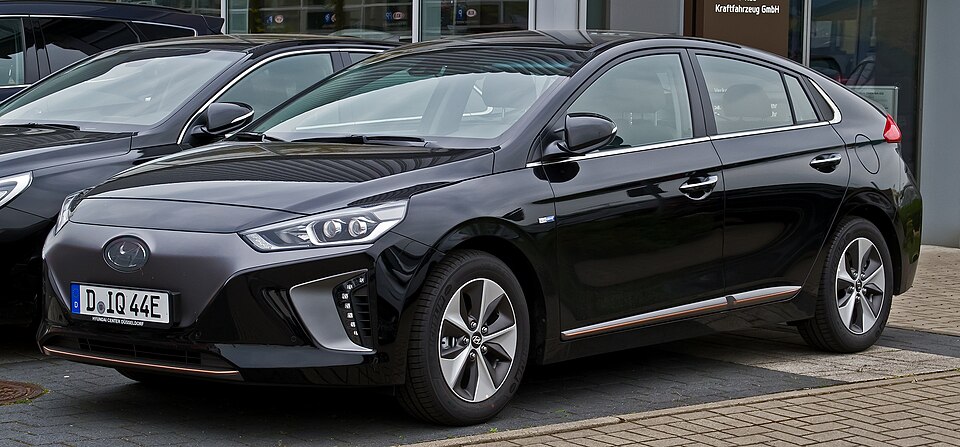
2017 Hyundai Ioniq
Trims, performance, features, fuel economy, safety and known problems — with the pros and cons against similar 2017 models.
- Class
- Midsize Cars
- Body styles
- 4dr Hatch
- Engines
- 1.6L 4-cyl
- Drivetrain
- Front-Wheel Drive
- Fuel
- EV, Hybrid
- MPG (best)
- 58 combined · 57 city / 59 hwy
- EV range
- 124 mi · 4 h on 240 V
- Length
- 176 in
- Curb weight
- 3,014 lb
- NHTSA rating
- Not rated
- Recalls
- 5 campaigns
Pros & cons
What's good
- Excellent fuel economyUp to 58 MPG combined — 116% better than the average 2017 midsize car (26.9 MPG).
- Hybrid version availableOffered as a hybrid and electric as well as gas.
Watch out for
- 5 recallsMore than similar models (about 2). Confirm repairs with the VIN.
Calculated from EPA, NHTSA and vPIC data against 28 similar 2017 models — not a review. How we calculate this →
Overview
The 2017 Hyundai Ioniq is a midsize car offered with a 1.6L 4-cyl engine, including a hybrid version and front-wheel drive.
It measures about 176 inches long and 72 inches wide on a 106-inch wheelbase, with a curb weight of roughly 3,014 lb.
EPA rates its most efficient version at 58 MPG combined (57 city / 59 highway), 116% better than the 2017 midsize car average of 26.9 MPG, for an estimated $550 a year in fuel.
The electric version has an EPA-rated range of up to 124 miles and takes about 4 hours to charge on a 240-volt Level 2 charger.
NHTSA has not published a 5-Star overall rating for this model year.
It has 5 recall campaigns on file and owners have filed 51 complaints with NHTSA since 2015, most often about the electrical system.
Dimensions & weight
| Body | Length | Width | Height | Wheelbase | Track F / R | Curb weight | Weight F/R |
|---|---|---|---|---|---|---|---|
| 4dr Hatch | 176 in | 71.7 in | 57.1 in | 106.3 in | 61.4 / 62.2 in | 3,014 lb |
Transport Canada CVS (Open Government Licence – Canada), Canadian-market figures.
Will it fit your garage? Check with your measurements →Engines, MPG & running costs
| Version | Engine | Transmission | Drive | City / Hwy / Comb | vs. class | Fuel / yr | CO₂ g/mi |
|---|---|---|---|---|---|---|---|
| Ioniq Electric EV | 88 kW AC PMSM | Automatic (A1) | Front-Wheel Drive | 124 mi · 25 kWh/100mi | – | $550 | – |
| Ioniq Blue Hybrid | 1.6L 4-cyl | Automatic (AM6) | Front-Wheel Drive | 57 / 59 / 58 | +159% | $1,150 | 154 |
| Ioniq Hybrid | 1.6L 4-cyl | Automatic (AM6) | Front-Wheel Drive | 55 / 54 / 55 | +146% | $1,200 | 163 |
EPA estimates; "vs. class" is combined MPG against the 2017 EPA class average. How we calculate this →
Safety ratings & technology
NHTSA has not published 5-Star ratings for the 2017 Hyundai Ioniq.
Similar 2017 midsize cars
| Model | Best MPG / range | NHTSA overall | Recalls |
|---|---|---|---|
| 2017 Hyundai Ioniq (this car) | 58 MPG | Not rated | 5 |
| 2017 Toyota Corolla | 34 MPG | ★★★★★ | 3 |
| 2017 Honda Civic | 36 MPG | ★★★★★ | 6 |
| 2017 Nissan GT-R | 18 MPG | Not rated | 0 |
| 2017 Toyota Prius | 56 MPG | ★★★★★ | 3 |
| 2017 Subaru Impreza/Outback Sport | 32 MPG | Not rated | 0 |
| 2017 Hyundai Elantra | 35 MPG | ★★★★★ | 4 |
Recalls (5)
Hybrid Propulsion System › Inverter · Jun 28, 2022
NHTSA campaign 22V459000 · 10,575 vehicles
- Problem
- Hyundai Motor America (Hyundai) is recalling certain 2017-2018 Ioniq HEV and Ionic PHV vehicles previously recalled under recall number 18V-704. The Power Relay Assembly (PRA) located underneath the rear seat may overheat.
- Risk
- An overheated PRA increases the risk of a fire.
- Fix
- Dealers will inspect and replace the main relay or PRA, as necessary, free of charge. Owner notification letters were mailed August 23, 2022. Owners may contact Hyundai customer service at 1-855-371-9460. Hyundai's number for this recall is 232. This recall replaces NHTSA recall number 18V-704. Vehicles already repaired under the previous recall will need to have the new remedy completed.
Electrical System › Propulsion System › Charging › Module › Onboard (Obcm) · Dec 7, 2021
NHTSA campaign 21V944000 · 2,679 vehicles
- Problem
- Hyundai Motor America (Hyundai) is recalling certain 2017-2019 Ioniq electric vehicles. An unstable electrical ground may cause the vehicle to enter a fail-safe mode with reduced acceleration and power. In certain conditions while in fail-safe mode, the vehicle may accelerate after the gas pedal is released.
- Risk
- Unexpected acceleration following gas pedal release can increase the risk of a crash.
- Fix
- Dealers will update the EPCU (Electric Power Control Unit) software and repair the ground wiring, free of charge. Owner notification letters were mailed February 9, 2022. Owners may contact Hyundai customer service at 1-855-371-9460. Hyundai's number for this recall is 215.
Hybrid Propulsion System › Inverter · Oct 5, 2018
NHTSA campaign 18V704000 · 10,575 vehicles
- Problem
- Hyundai Motor America (Hyundai) is recalling certain 2017-2018 Hyundai Ioniq Hybrid and 2018 Ioniq Plug-In Hybrid vehicles. The Main Relay within the Power Relay Assembly (PRA) may have inadequate connections between its contacts, causing increased electrical resistance.
- Risk
- The increased electrical resistance can overheat the rear seat which is above the PRA, increasing the risk of a fire.
- Fix
- Hyundai will notify owners, and dealers will inspect the Power Relay Assembly (PRA) for damage. If no damage is found, the main relay will be replaced. If damage is found, the PRA will be replaced. These repairs will be performed free of charge. The recall began February 28, 2019. Owners may contact Hyundai customer service at 1-855-371-9460. Hyundai's number for this recall is 178.
Hybrid Propulsion System · Apr 24, 2018
NHTSA campaign 18V260000 · 10,156 vehicles
- Problem
- Hyundai Motor America (Hyundai) is recalling certain 2017 Hyundai Ioniq Hybrid vehicles. The Hydraulic Clutch Actuator (HCA) inner oil seal may leak, allowing oil to accumulate in the cap area, possibly resulting in an electrical short.
- Risk
- An electrical short can increase the risk of a fire.
- Fix
- Hyundai will notify owners, and dealers will inspect the HCA caps for leaked oil and replace the HCA assembly if needed, free of charge. The recall is expected to begin June 20, 2018. Owners may contact Hyundai customer service at 1-855-371-9460. Hyundai's number for this recall is 176.
Hybrid Propulsion System · Aug 28, 2017
NHTSA campaign 17V532000 · 218 vehicles
- Problem
- Hyundai Motor Company (Hyundai) is recalling certain 2017 Ioniq Electric Vehicles. Manufacturing defects within the Electronic Power Control Unit (EPCU) may allow coolant to contact the unit's circuit board.
- Risk
- If coolant contacts the EPCU, a stall may result, increasing the risk of a crash.
- Fix
- Hyundai will notify owners, and dealers will inspect and replace the EPCU, as necessary, free of charge. Interim notices informing owners of the safety risk are expected were mailed October 26, 2017. Owners will receive a second notice when the remedy becomes available. Owners may contact Hyundai Customer Service at 1-800-633-5151. Hyundai's number for this recall is 166.
Not every 2017 Hyundai Ioniq is affected — only a VIN check confirms your car.
Owner-reported problems
Unverified owner reports; best-sellers collect more.
Used 2017 Hyundai Ioniq buyer's checklist
- Run the VIN at nhtsa.gov/recalls. 5 recalls this year — ask for proof of repairs.
- Electrical System — 22 owner reports. Test every window, lock, light, screen and USB port; check the battery age.
- Engine — 12 owner reports. Cold-start the engine, listen for knocking, and watch for warning lights or hesitation on acceleration.
- Power Train — 9 owner reports. Test-drive through all gears, including reverse; note slipping, harsh or delayed shifts.
- Mileage to watch. Owners typically reported problems around 34,000 miles; ask what was repaired near that point.
- Battery health. Ask for a battery state-of-health report, check the remaining battery warranty, and compare the displayed range at 100% charge with the EPA's 124 miles.
- Before you pay: service records, a history report and an independent inspection.
Generated by DecodedCars from NHTSA recalls and owner complaints for the 2017 Hyundai Ioniq. Not a substitute for a professional inspection.
Other Ioniq years
Compare all years →| Year | MPG (best) | Length | Overall | Recalls | Complaints |
|---|---|---|---|---|---|
| 2022 Ioniq | 59 | 176 in | Not rated | 0 | 27 |
| 2021 Ioniq | 59 | 176 in | Not rated | 0 | 20 |
| 2020 Ioniq | 58 | 176 in | Not rated | 1 | 31 |
| 2019 Ioniq | 58 | 176 in | Not rated | 2 | 33 |
| 2018 Ioniq | 58 | 176 in | Not rated | 3 | 17 |
Sources: EPA, NHTSA, Transport Canada, Wikimedia Commons. Not affiliated with NHTSA, the EPA or Hyundai. How we calculate this →