 DecodedCars
2010 Hyundai Elantra
Trims, performance, features, fuel economy, safety and known problems — with the pros and cons against similar 2010 models.
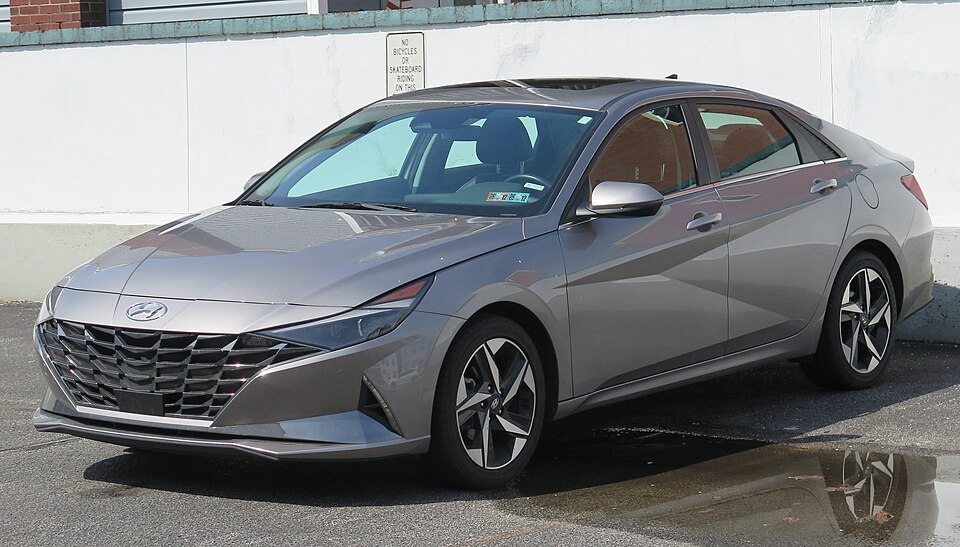
- Class
- Midsize Cars
- Body styles
- 4dr Sedan FWD L/Gl/Gls/Limited, Touring 5dr Hatch FWD Gl/Gls, Touring 5dr Hatch FWD L
- Engines
- 2.0L 4-cyl
- Drivetrain
- Front-Wheel Drive
- Fuel
- Regular Gasoline
- MPG (best)
- 29 combined · 26 city / 35 hwy
- Length
- 176.4–177.6 in
- Curb weight
- 2,747–3,080 lb
- NHTSA rating
- Not rated
- Recalls
- 4 campaigns
Pros & cons
What's good
- Excellent fuel economyUp to 29 MPG combined — 31% better than the average 2010 midsize car (22.2 MPG).
Watch out for
- Many owner complaints334 complaints filed with NHTSA versus about 80 for similar models — most often about the steering.
Calculated from EPA, NHTSA and vPIC data against 24 similar 2010 models — not a review. How we calculate this →
Overview
The 2010 Hyundai Elantra is a midsize car offered with a 2.0L 4-cyl engine and front-wheel drive.
It measures about 178 inches long and 70 inches wide on a 104-inch wheelbase, with a curb weight of roughly 2,747 lb (4dr Sedan FWD L/Gl/Gls/Limited).
EPA rates its most efficient version at 29 MPG combined (26 city / 35 highway), 31% better than the 2010 midsize car average of 22.2 MPG, for an estimated $2,300 a year in fuel.
It has 4 recall campaigns on file and owners have filed 334 complaints with NHTSA since 2015, most often about the steering.
What changed for 2010
No changes to engines, powertrains, drivetrains, size, EPA ratings or NHTSA crash rating compared with the 2009 Elantra — a carry-over year in the data.
Compared with 2009; trim, feature and price changes aren't covered. See the 2009 Elantra →
Dimensions & weight
| Body | Length | Width | Height | Wheelbase | Track F / R | Curb weight | Weight F/R |
|---|---|---|---|---|---|---|---|
| 4dr Sedan FWD L/Gl/Gls/Limited | 177.6 in | 70.1 in | 58.3 in | 104.3 in | 60.6 / 59.8 in | 2,747 lb | 63/37 |
| Touring 5dr Hatch FWD Gl/Gls | 176.4 in | 69.7 in | 59.8 in | 106.3 in | 60.2 / 60.6 in | 3,080 lb | 60/40 |
| Touring 5dr Hatch FWD L | 176.4 in | 69.7 in | 59.8 in | 106.3 in | 60.2 / 60.6 in | 2,937 lb | 60/40 |
Transport Canada CVS (Open Government Licence – Canada), Canadian-market figures.
Will it fit your garage? Check with your measurements →Engines, MPG & running costs
| Version | Engine | Transmission | Drive | City / Hwy / Comb | vs. class | Fuel / yr | CO₂ g/mi |
|---|---|---|---|---|---|---|---|
| Elantra | 2.0L 4-cyl | Automatic 4-spd | Front-Wheel Drive | 26 / 34 / 29 | +31% | $2,300 | 306 |
| Elantra Blue | 2.0L 4-cyl | Manual 5-spd | Front-Wheel Drive | 26 / 35 / 29 | +31% | $2,300 | 306 |
| Elantra | 2.0L 4-cyl | Manual 5-spd | Front-Wheel Drive | 25 / 34 / 29 | +31% | $2,300 | 306 |
| Elantra Touring | 2.0L 4-cyl | Manual 5-spd | Front-Wheel Drive | 23 / 31 / 26 | +7% | $2,600 | 342 |
| Elantra Touring | 2.0L 4-cyl | Automatic 4-spd | Front-Wheel Drive | 23 / 30 / 26 | +7% | $2,600 | 342 |
EPA estimates; "vs. class" is combined MPG against the 2010 EPA class average. How we calculate this →
Safety ratings & technology
NHTSA has not published 5-Star ratings for the 2010 Hyundai Elantra under the current (2011+) test program.
Similar 2010 midsize cars
| Model | Best MPG / range | NHTSA overall | Recalls |
|---|---|---|---|
| 2010 Hyundai Elantra (this car) | 29 MPG | Not rated | 4 |
| 2010 Toyota Corolla | 30 MPG | Not rated | 15 |
| 2010 Honda Civic | 42 MPG | Not rated | 8 |
| 2010 Nissan GT-R | 17 MPG | Not rated | 0 |
| 2010 Toyota Prius | 50 MPG | Not rated | 10 |
| 2010 Ford Focus | 28 MPG | Not rated | 0 |
| 2010 Mitsubishi Lancer | 26 MPG | Not rated | 7 |
Recalls (4)
Service Brakes, Hydraulic › Antilock/Traction Control/Electronic Limited Slip › Control Unit/Module · Feb 4, 2020
NHTSA campaign 20V061000 · 476,111 vehicles
- Problem
- Hyundai Motor America (Hyundai) is recalling certain 2007-2010 Elantra and 2009-2011 Elantra Touring vehicles. On February 21, 2020 Hyundai expanded the recall to include 46,425 model year 2007-2008 Entourage and 2007 Santa Fe vehicles. Moisture may enter the Anti-lock Brake (ABS) Module and result in an electrical short.
- Risk
- An electrical short within the ABS Module may cause an engine compartment fire, even when the car is turned off, increasing the risk of an injury.
- Fix
- Hyundai will notify owners, and dealers will install a relay in the vehicle's main junction box to prevent the risk of an ABS short-circuit while the car is turned off, free of charge. The recall began April 2, 2020. Owners may contact Hyundai customer service at 1-855-371-9460. Hyundai's number for this recall is 188.
Steering › Electric Power Assist System · Feb 23, 2015
NHTSA campaign 15V100000 · 204,768 vehicles
- Problem
- Hyundai Motor America (Hyundai) is recalling certain model year 2008-2010 Elantra vehicles manufactured June 1, 2008, to April 30, 2010, and 2009-2010 Elantra Touring vehicles manufactured November 1, 2008, to April 30, 2010. The electronic power steering (EPS) electronic control unit (ECU) may sense a discrepancy in the steering input signals and, as a result, disable the steering power assist.
- Risk
- If power steering assist is lost, greater driver effort would be required to steer the vehicle at low speeds, increasing the risk of a crash.
- Fix
- Hyundai will verify the proper operation of the Electronic Power Steering (EPS) and update the EPS control unit, free of charge. The recall began April 14, 2015. Owners may contact Hyundai customer service at 1-855-671-3059. Hyundai's number for this recall is 127.
Structure › Frame And Members · Jun 10, 2014
NHTSA campaign 14V310000 · 35,000 vehicles
- Problem
- Hyundai Motor Company (Hyundai) is recalling certain model year 2010-2012 Elantra Touring vehicles manufactured December 15, 2009, through May 7, 2012. The affected vehicles have a support bracket attached to the headliner that may become displaced during a side curtain airbag deployment.
- Risk
- If the headliner support bracket makes contact with an occupant during a crash, it may cause a laceration injury.
- Fix
- Hyundai will notify owners, and dealers will apply adhesive strips to the headliner, free of charge. The recall began on July 28, 2014. Owners may contact Hyundai customer service at 1-800-633-5151. Hyundai's number for this recall is 117.
Exterior Lighting › Brake Lights › Switch · Apr 1, 2013
NHTSA campaign 13V113000 · 1,712,336 vehicles
- Problem
- Hyundai Motor Company (Hyundai) is recalling certain model year 2006-2009 Accent, model year 2007-2011 Azera, Sonata and Sante Fe,2006-2011 Tucson, 2009-2011 Elantra Touring, 2007-2010 Elantra, 2008-2011 Veracruz, 2009-2011 Genesis, 2010-2011 Genesis Coupe, 2007-2008 Entourage, and 2006-2008 Tiburon vehicles. Originally, in April 2013, Hyundai recalled 1,059,824 model year 2007-2009 Accent and Tucson, model year 2007-2010 Elantra, model year 2007-2011 Santa Fe, model year 2008-2009 Veracruz, model year 2010-2011 Genesis Coupe, and model year 2011 Sonata vehicles. In September 2013, Hyundai informed the agency that it was adding more vehicles to this campaign, representing an additional 652,512 units. The total number of vehicles being recalled is now 1,712,336. In the affected vehicles, the stop lamp switch may malfunction. A malfunctioning stop lamp switch may cause the brake lights to not illuminate when the brake pedal is depressed or may cause an inability to deactivate the cruise control by depressing the brake pedal. Additionally, a malfunctioning stop lamp switch may also result in intermittent operation of the push-button start feature, affect the operation of the brake transmission shift interlock feature, preventing the shifter from being moved out of the PARK position and cause the Electronic Stability Control (ESC) malfunction light to illuminate.
- Risk
- Failure to illuminate the stop lamps during braking or inability to disengage the cruise control could increase the risk of a crash. Additionally, when the ignition is in the 'ON' position, the transmission shifter may be able to be moved out of Park without first applying the brake. This may lead to unintentional movement of the car which may increase the risk of a crash.
- Fix
- Hyundai will notify owners, and dealers will replace the stop lamp switch, free of charge. The safety recall began on April 22, 2013. Owners may contact Hyundai at 1-800-633-5151. Hyundai's recall campaign number is 110.
Not every 2010 Hyundai Elantra is affected — only a VIN check confirms your car.
Owner-reported problems
Unverified owner reports; best-sellers collect more.
Used 2010 Hyundai Elantra buyer's checklist
- Run the VIN at nhtsa.gov/recalls. 4 recalls this year — ask for proof of repairs.
- Steering — 197 owner reports. Turn lock-to-lock while parked and on the road; listen for noises and feel for heavy or loose steering.
- Electrical System — 39 owner reports. Test every window, lock, light, screen and USB port; check the battery age.
- Air Bags — 31 owner reports. Confirm the airbag warning light turns off after start-up and any airbag recall was completed.
- Mileage to watch. Owners typically reported problems around 80,000 miles; ask what was repaired near that point.
- Before you pay: service records, a history report and an independent inspection.
Generated by DecodedCars from NHTSA recalls and owner complaints for the 2010 Hyundai Elantra. Not a substitute for a professional inspection.
Other Elantra years
Compare all years →| Year | MPG (best) | Length | Overall | Recalls | Complaints |
|---|---|---|---|---|---|
| 2026 Elantra | 54 | 185.4 in | Not rated | 4 | 4 |
| 2025 Elantra | 54 | 185.4 in | ★★★★★ | 2 | 34 |
| 2024 Elantra | 54 | 185.4 in | ★★★★★ | 2 | 63 |
| 2023 Elantra | 54 | 183.9 in | ★★★★★ | 4 | 170 |
| 2022 Elantra | 54 | 183.9 in | ★★★★★ | 8 | 159 |
| 2021 Elantra | 54 | 183.9 in | ★★★★★ | 7 | 162 |
| 2020 Elantra | 36 | 181.9 in | ★★★★★ | 3 | 262 |
| 2019 Elantra | 35 | 181.9 in | ★★★★★ | 1 | 266 |
| 2018 Elantra | 35 | 179.9 in | ★★★★★ | 1 | 335 |
| 2017 Elantra | 35 | 179.9 in | ★★★★★ | 4 | 796 |
| 2016 Elantra | 31 | 179.1 in | Not rated | 2 | 300 |
| 2015 Elantra | 31 | 179.1 in | Not rated | 3 | 261 |
Sources: EPA, NHTSA, Transport Canada, Wikimedia Commons. Not affiliated with NHTSA, the EPA or Hyundai. How we calculate this →