 DecodedCars
2019 Hyundai Accent
Trims, performance, features, fuel economy, safety and known problems — with the pros and cons against similar 2019 models.
- Class
- Compact Cars
- Body styles
- 4dr Sedan (Auto), 4dr Sedan (Manual), 5dr Hatch
- Engines
- 1.6L 4-cyl
- Drivetrain
- Front-Wheel Drive
- Fuel
- Regular Gasoline
- MPG (best)
- 32 combined · 28 city / 38 hwy
- Length
- 165–172.8 in
- Curb weight
- 2,507–2,685 lb
- NHTSA rating
- Not rated
- Recalls
- 1 campaign
Pros & cons
What's good
- Excellent fuel economyUp to 32 MPG combined — 19% better than the average 2019 compact car (26.8 MPG).
Watch out for
No weak spots against similar models in the data.
Calculated from EPA, NHTSA and vPIC data against 26 similar 2019 models — not a review. How we calculate this →
Overview
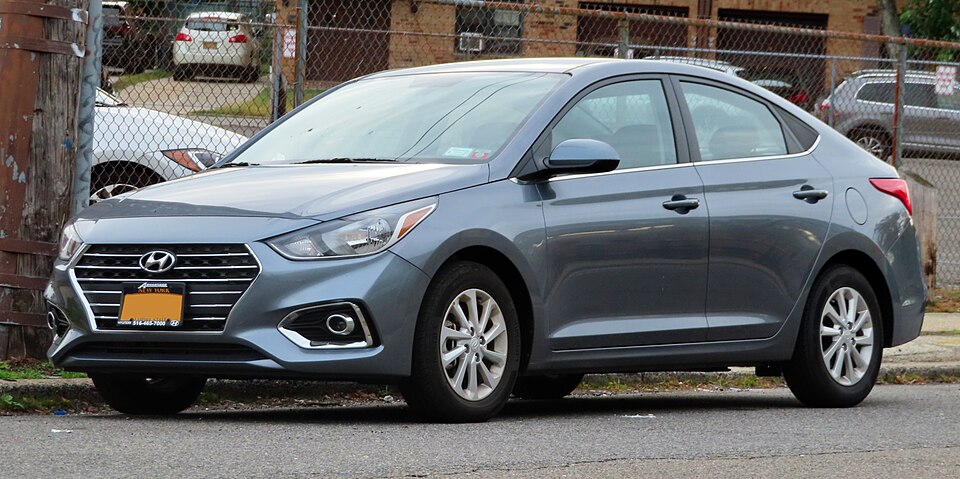
The 2019 Hyundai Accent is a compact car offered with a 1.6L 4-cyl engine and front-wheel drive.
It measures about 173 inches long and 67 inches wide on a 102-inch wheelbase, with a curb weight of roughly 2,685 lb (4dr Sedan (Auto)).
EPA rates its most efficient version at 32 MPG combined (28 city / 38 highway), 19% better than the 2019 compact car average of 26.8 MPG, for an estimated $2,100 a year in fuel.
NHTSA has not published a 5-Star overall rating for this model year.
It has 1 recall campaign on file and owners have filed 31 complaints with NHTSA since 2015, most often about the engine.
What changed for 2019
No changes to engines, powertrains, drivetrains, size, EPA ratings or NHTSA crash rating compared with the 2018 Accent — a carry-over year in the data.
Compared with 2018; trim, feature and price changes aren't covered. See the 2018 Accent →
Dimensions & weight
| Body | Length | Width | Height | Wheelbase | Track F / R | Curb weight | Weight F/R |
|---|---|---|---|---|---|---|---|
| 4dr Sedan (Auto) | 172.8 in | 66.9 in | 56.3 in | 101.6 in | 59.4 / 60.2 in | 2,685 lb | 61/39 |
| 4dr Sedan (Manual) | 172.8 in | 66.9 in | 56.3 in | 101.6 in | 59.4 / 60.2 in | 2,507 lb | 61/39 |
| 5dr Hatch | 165 in | 66.9 in | 56.3 in | 101.6 in | 59.4 / 60.2 in | 2,568 lb | 61/39 |
Transport Canada CVS (Open Government Licence – Canada), Canadian-market figures.
Will it fit your garage? Check with your measurements →Engines, MPG & running costs
| Version | Engine | Transmission | Drive | City / Hwy / Comb | vs. class | Fuel / yr | CO₂ g/mi |
|---|---|---|---|---|---|---|---|
| Accent | 1.6L 4-cyl | Automatic (S6) | Front-Wheel Drive | 28 / 38 / 32 | +19% | $2,100 | 277 |
| Accent | 1.6L 4-cyl | Manual 6-spd | Front-Wheel Drive | 28 / 37 / 31 | +16% | $2,150 | 284 |
EPA estimates; "vs. class" is combined MPG against the 2019 EPA class average. How we calculate this →
Safety ratings & technology
NHTSA has not published 5-Star ratings for the 2019 Hyundai Accent.
Similar 2019 compact cars
| Model | Best MPG / range | NHTSA overall | Recalls |
|---|---|---|---|
| 2019 Hyundai Accent (this car) | 32 MPG | Not rated | 1 |
| 2019 Toyota Corolla | 36 MPG | ★★★★★ | 6 |
| 2019 Honda Civic | 36 MPG | ★★★★★ | 4 |
| 2019 Toyota Prius | 56 MPG | ★★★★★ | 3 |
| 2019 Mazda 3 | 30 MPG | Not rated | 0 |
| 2019 Volkswagen Golf/GTI | 32 MPG | ★★★★★ | 6 |
| 2019 Subaru Impreza | 32 MPG | ★★★★★ | 5 |
Recalls (1)
Latches/Locks/Linkages › Trunk Lid › Latch · Aug 6, 2021
NHTSA campaign 21V619000 · 348,158 vehicles
- Problem
- Hyundai Motor America (Hyundai) is recalling certain 2017-2018 Sonata, 2016-2018 Sonata Hybrid, 2018-2020 Accent, and 2016-2017 Azera vehicles. The trunk latch may become damaged, preventing the opening of the trunk from the inside. As such, these vehicles fail to comply with the requirements of Federal Motor Vehicle Safety Standard number 401, "Internal Trunk Release."
- Risk
- A person inside the trunk compartment may become trapped, increasing their risk of injury.
- Fix
- Dealers will replace the trunk latch base, free of charge. Owner notification letters were mailed December 4, 2021. Owners may contact Hyundai customer service at 1-855-371-9460. Hyundai's number for this recall is 208.
Not every 2019 Hyundai Accent is affected — only a VIN check confirms your car.
Owner-reported problems
Unverified owner reports; best-sellers collect more.
Used 2019 Hyundai Accent buyer's checklist
- Run the VIN at nhtsa.gov/recalls. 1 recall this year — ask for proof of repairs.
- Engine — 19 owner reports. Cold-start the engine, listen for knocking, and watch for warning lights or hesitation on acceleration.
- Air Bags — 4 owner reports. Confirm the airbag warning light turns off after start-up and any airbag recall was completed.
- Engine And Engine Cooling — 3 owner reports. Cold-start the engine, listen for knocking, and watch for warning lights or hesitation on acceleration.
- Mileage to watch. Owners typically reported problems around 55,000 miles; ask what was repaired near that point.
- Before you pay: service records, a history report and an independent inspection.
Generated by DecodedCars from NHTSA recalls and owner complaints for the 2019 Hyundai Accent. Not a substitute for a professional inspection.
Other Accent years
Compare all years →| Year | MPG (best) | Length | Overall | Recalls | Complaints |
|---|---|---|---|---|---|
| 2022 Accent | 36 | – | ★★★★★ | 2 | 17 |
| 2021 Accent | 36 | – | ★★★★★ | 4 | 16 |
| 2020 Accent | 36 | 172.8 in | ★★★★★ | 4 | 12 |
| 2018 Accent | 32 | 172.8 in | Not rated | 1 | 19 |
| 2017 Accent | 31 | 162.2 in | Not rated | 0 | 68 |
| 2016 Accent | 31 | 162.2 in | Not rated | 0 | 102 |
| 2015 Accent | 31 | 162.2 in | Not rated | 2 | 70 |
| 2014 Accent | 31 | 162.2 in | Not rated | 1 | 79 |
| 2013 Accent | 32 | 162.2 in | Not rated | 1 | 117 |
| 2012 Accent | 32 | 162.2 in | Not rated | 2 | 121 |
| 2011 Accent | 30 | 159.4 in | Not rated | 1 | 23 |
| 2010 Accent | 31 | 159.4 in | Not rated | 1 | 41 |
Sources: EPA, NHTSA, Transport Canada, Wikimedia Commons. Not affiliated with NHTSA, the EPA or Hyundai. How we calculate this →