 DecodedCars
Toyota Sequoia 2005
Versiones, desempeño, equipamiento, consumo, seguridad y problemas conocidos, con sus ventajas y desventajas frente a modelos similares 2005.
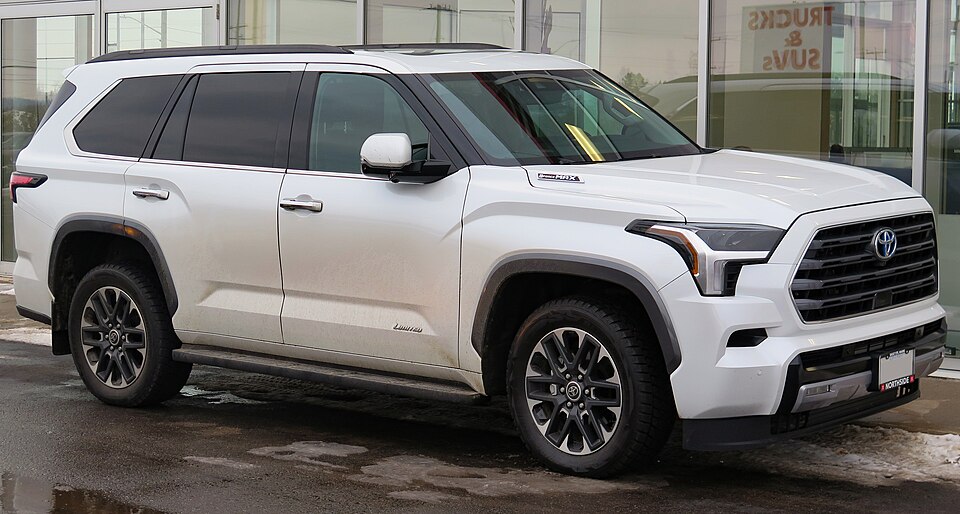
- Clase
- SUV (2WD)
- Carrocerías
- 4dr SUV 4WD Sr5/Ltd
- Motores
- 4.7L 8 cil.
- Tracción
- Tracción trasera, Tracción 4x4
- Combustible
- Gasolina regular
- MPG (mejor)
- 15 combinadas · 14 ciudad / 17 carretera
- Largo
- 203.9 in
- Peso en vacío
- 5,269 lb
- Calificación NHTSA
- Sin calificar
- Retiros
- 8 campañas
Ventajas y desventajas
Lo bueno
- Tracción total / 4x4 disponible
A tener en cuenta
- Consumo por debajo del promedioSu versión más eficiente logra 15 MPG combinadas, un 17 % menos que el promedio de su clase (SUV, 2005: 18 MPG).
- Muchas quejas de propietarios129 quejas ante la NHTSA frente a unas 42 de modelos similares; sobre todo por problemas de bolsas de aire.
- 8 retirosMás que modelos similares (unos 0). Confirma las reparaciones con el VIN.
Calculado con datos de la EPA, la NHTSA y vPIC frente a 15 modelos similares 2005; no es una reseña. Cómo lo calculamos →
Resumen
El Toyota Sequoia 2005 es un SUV con motor 4.7L 8 cil., con tracción trasera y tracción 4x4.
Mide unas 204 pulgadas de largo y 79 de ancho, con una distancia entre ejes de 118 pulgadas, y pesa alrededor de 5,269 lb.
La EPA califica su versión más eficiente con 15 MPG combinadas (14 en ciudad / 17 en carretera), un 17 % peor que el promedio de su clase (SUV, 2005: 18 MPG), con un gasto estimado de $4,450 al año en combustible.
Tiene 8 campañas de retiro registradas y los propietarios han presentado 129 quejas ante la NHTSA desde 2015, sobre todo por problemas de bolsas de aire.
Dimensiones y peso
| Carrocería | Largo | Ancho | Alto | Distancia entre ejes | Vía del. / tras. | Peso en vacío | Peso del./tras. |
|---|---|---|---|---|---|---|---|
| 4dr SUV 4WD Sr5/Ltd | 203.9 in | 79.1 in | 73.6 in | 118.1 in | 66.1 / 66.1 in | 5,269 lb | 52/48 |
Transport Canada CVS (Open Government Licence – Canada), medidas del mercado canadiense.
¿Cabe en tu garaje? Compruébalo con tus medidas →Motores, consumo y costo de uso
| Versión | Motor | Transmisión | Tracción | Ciudad / Carr. / Comb. | vs. su clase | Combustible / año | CO₂ g/mi |
|---|---|---|---|---|---|---|---|
| Sequoia 2WD | 4.7L 8 cil. | Automática 5-spd | Tracción trasera | 14 / 17 / 15 | -17% | $4,450 | 592 |
| Sequoia 4WD | 4.7L 8 cil. | Automática 5-spd | Tracción 4x4 | 13 / 16 / 15 | -10% | $4,450 | 592 |
Estimaciones de la EPA; "vs. su clase" compara las MPG combinadas con el promedio 2005 de su clase EPA. Cómo lo calculamos →
Calificaciones de seguridad y tecnología
La NHTSA no ha publicado calificaciones de 5 estrellas para el Toyota Sequoia 2005 con el programa de pruebas actual (2011+).
SUV similares 2005
| Modelo | Mejor MPG / autonomía | General NHTSA | Retiros |
|---|---|---|---|
| Toyota Sequoia 2005 (este auto) | 15 MPG | Sin calificar | 8 |
| Toyota Land Cruiser 2005 | 13 MPG | Sin calificar | 2 |
| Chevrolet Tahoe 2005 | 16 MPG | Sin calificar | 1 |
| GMC Yukon 2005 | 16 MPG | Sin calificar | 0 |
| Ford Expedition 2005 | 14 MPG | Sin calificar | 0 |
| Dodge Durango 2005 | 16 MPG | Sin calificar | 3 |
| Subaru Legacy/Outback 2005 | 23 MPG | Sin calificar | 0 |
Retiros (8)
Texto oficial de la NHTSA (en inglés).
Bolsas de aire › Frontal › Passenger Side › Inflator Module · 17 oct 2019
Campaña NHTSA 19V741000 · 928,220 vehículos
- Problema
- Toyota Motor Engineering & Manufacturing (Toyota) is recalling certain 2010-2016 4Runner, 2003-2006 Tundra, 2003-2013 Corolla, 2009-2010 Corolla Matrix, 2004-2005 RAV4, 2002-2007 Sequoia, 2011-2013 Sienna, 2008-2012 Scion xB, 2008-2009 Lexus IS-F, 2007-2012 Yaris and Lexus ES350, 2010-2017 Lexus GX460, 2002-2010 Lexus SC430, 2006-2012 Lexus IS250 and IS350 and 2010-2015 Lexus IS250C and IS350C vehicles. These vehicles had their driver or passenger frontal air bag inflators previously replaced under a prior recall using inflators of the same design. The inflators may explode due to propellant degradation occurring after long-term exposure to high absolute humidity, temperature and temperature cycling.
- Riesgo
- An inflator explosion may result in sharp metal fragments striking the driver or other occupants resulting in serious injury or death.
- Solución
- Toyota will notify owners. Depending on the vehicle model, dealers will replace the front driver inflator, front passenger airbag inflator, the airbag assembly, or the front passenger airbag sub-assembly and inflator. The recall began November 20, 2019. Owners may contact Toyota customer service at 1-888-270-9371 or Lexus customer service at 1-800-255-3987. Toyota's numbers for this recall are J0A, J0B, and J0C. Lexus' numbers for this recall are JLI, JLJ, and JLK.
Bolsas de aire › Frontal › Passenger Side › Inflator Module · 12 dic 2018
Campaña NHTSA 18V883000 · 168,993 vehículos
- Problema
- Toyota Motor Engineering & Manufacturing (Toyota) is recalling certain 2002-2005 Lexus SC and Toyota Sequoia, 2003-2005 Toyota Corolla and Tundra, and 2003-2007 Pontiac Vibe vehicles. These vehicles are equipped with certain air bag inflators assembled as part of the passenger frontal air bag modules used as original equipment or replacement equipment. In the event of a crash necessitating deployment of the passenger frontal air bag, these inflators may explode due to propellant degradation.
- Riesgo
- An inflator explosion may result in sharp metal fragments striking the driver or other occupants resulting in serious injury or death.
- Solución
- Toyota will notify the Toyota and Lexus owners. General Motors will notify the Pontiac Vibe owners. Depending on the vehicle model, dealers will replace the front passenger air bag inflator with an alternate inflator, or replace the air bag assembly that includes an alternate inflator, free of charge. The recall began January 23, 2019. Owners may contact Toyota customer service at 1-888-270-9371, Lexus customer service at 1-800-255-3987 or Pontiac customer service at 1-800-762-2737. Toyota's numbers for these recalls are J0A (Zone A Toyota), J0B (Zone B Toyota), J0C (Zone C Toyota), JLI (Zone A Lexus), JLJ (Zone B Lexus), and JLK (Zone C Lexus). Note: This recall includes vehicles that have had their air bag previously replaced under an earlier air bag campaign.
Asientos › Front Assembly › Seat Heater/Cooler · 2 jun 2016
Campaña NHTSA 16V396000 · 7,749 vehículos
- Problema
- Southeast Toyota Distributors, LLC (SET) is recalling certain 2005-2011 4Runner, Highlander, Sequoia, and Sienna, 2005-2010 Avalon and Tundra, 2006-2008 Camry Solara, 2006-2010 Highlander hybrid, 2006-2011 Rav4 and Tacoma, 2007-2010 FJ Cruiser, 2007-2011 Camry hybrid, 2009-2010 Venza, 2010-2012 Prius, 1988-1990 and 2005-2010 Camry, and 1989 and 2009-2010 Corolla vehicles equipped with aftermarket accessory seat heaters with a copper strand heating element. The electrical wiring in the seat heaters may be damaged when the seat cushion is compressed.
- Riesgo
- If damaged, the copper strand heating element may short circuit, increasing the risk of a fire.
- Solución
- SET will notify owners, and dealers will disconnect the seat heaters, free of charge, and refund the purchase price of the seat heater accessory. The recall began on July 14, 2016. Owners may contact SET customer service at 1-866-405-4226. SET number for this recall is SET16B.
Bolsas de aire › Side/Window · 5 feb 2016
Campaña NHTSA 16V065000 · 320,409 vehículos
- Problema
- Toyota Motor Engineering & Manufacturing (Toyota) is recalling certain model year 2003-2006 Toyota Land Cruiser and Lexus LX470, 2005-2006 Toyota Tundra and Sequoia, 2004-2006 Toyota 4Runner and Lexus GX470 vehicles equipped with side curtain-shield-air bags. The affected vehicles have an air bag control module that may be improperly programmed, causing the side curtain-shield-air bags to deploy inadvertently.
- Riesgo
- If the side curtain-shield-air bags deploy unexpectedly, it can increase the risk of occupant injury.
- Solución
- Toyota will notify owners, and dealers will replace the air bag control module with one that has improved programming, free of charge. The recall began on December 1, 2016. Owners may contact Toyota customer service at 1-888-271-9371. Toyota's number for this recall is G0C and GLB.
Bolsas de aire · 13 may 2015
Campaña NHTSA 15V285000 · 1,973,468 vehículos
- Problema
- Toyota Motor Engineering & Manufacturing (Toyota) notified the agency on May 13, 2015 that they are recalling certain model year 2004 Sequoia vehicles manufactured August 18, 2003, to August 19, 2004, and 2003-2004 Tundra vehicles manufactured March 18, 2003, to August 25, 2004. On June 16, 2015, Toyota expanded the recall to include an additional 1,270,468 vehicles, including model year 2002-2003 and 2005-2007 Sequoia, 2005-2006 Tundra, 2003-2007 Corolla, 2003-2007 Corolla Matrix, 2003-2007 Pontiac Vibe and 2002-2007 Lexus SC vehicles. This is to address a safety defect in the passenger side frontal air bag inflator which may produce excessive internal pressure causing the inflator to rupture upon deployment of the air bag. This recall addresses both the passenger side frontal air bags that were originally installed in the vehicles, as well as replacement air bags that may have been installed as replacement service parts. A replacement air bag may have been installed, as one example, if a vehicle had been in a crash necessitating the replacement of the passenger side frontal air bag.
- Riesgo
- In the event of a crash necessitating deployment of the passenger's frontal air bag, the inflator could rupture with metal fragments striking the vehicle occupants potentially resulting in serious injury or death.
- Solución
- 2003-2004 Corolla and Corolla Matrix vehicles that are recalled under both 15V-043 and 15V-285 are under a Do Not Drive advisory. Owners of these vehicles are advised not to drive their vehicles until the recall remedy has been completed. Toyota will notify their owners. Pontiac Vibe owners will be notified by GM. Dealers will replace the front passenger air bag. The recall began on July 13, 2015. Toyota owners may contact Toyota customer service at 1-800-331-4331. Pontiac owners may call 1-800-762-2737. NOTE: This recall supersedes recall 14V-312 in its entirety.
Bolsas de aire · 13 may 2015
Campaña NHTSA 15V286000 · 1,069,055 vehículos
- Problema
- Toyota Motor Engineering & Manufacturing (Toyota) notified the agency on May 13, 2015, that they are recalling 2005-2007 Lexus SC, Toyota Corolla, Corolla Matrix, Sequoia, and Pontiac Vibe, and 2005-2006 Toyota Tundra vehicles that were originally sold, or ever registered, in Florida, along the Gulf Coast, Puerto Rico, Hawaii, the U.S. Virgin Islands, Guam, Saipan and American Samoa. On June 16, 2015 Toyota expanded the recall to cover an additional 769,055 vehicles, including certain model year 2002-2004 Lexus SC, Toyota Sequoia, 2003-2004 Toyota Corolla Matrix, Toyota Corolla, Pontiac Vibe, and Toyota Tundra vehicles, as well the vehicles covered by the May 13, 2015 notification in the portions of Georgia, Alabama, Louisiana, Mississippi and Texas that were not previously included. The inflators in the front passenger air bags are susceptible to rupture in the event of a crash necessitating the deployment of the front passenger air bag.
- Riesgo
- In the event of a crash necessitating deployment of the passenger's frontal air bag, the inflator could rupture with metal fragments striking the vehicle occupants potentially resulting in serious injury or death.
- Solución
- 2003-2004 Corolla and Corolla Matrix vehicles that are recalled under both 15V-043 and 15V-286 are under a Do Not Drive advisory. Owners of these vehicles are advised not to drive their vehicles until the recall remedy has been completed. Toyota will notify their owners. Pontiac Vibe owners will be notified by GM. Dealers will replace the passenger side front air bag, free of charge. Owners may contact Toyota customer service at 1-800-331-4331. Toyota began the recall on July 13, 2015. Pontiac Vibe owners may contact GM at 1-800-762-2737. GM began the recall on June 29, 2015. NOTE: This recacll supersedes recall 14V-655 in its entirety. For vehicles located in the U.S. states not listed above, please see Toyota recall 15V-285 which covers all other U.S. states.
Asientos › Front Assembly › Seat Heater/Cooler · 19 nov 2014
Campaña NHTSA 14V743000 · 3,233 vehículos
- Problema
- Southeast Toyota Distributors, LLC (SET) is recalling certain model year 2010-2011 Prius and Corolla, 2009-2011 Venza, 2006-2010 Avalon, 2007-2010 FJ Cruiser, 2005-2011 Sienna and Sequoia, 2006-2011 Tacoma 4x2 and 4x4, Camry, Highlander, Tundra 4x2 and 4x4, and 2007-2011 Rav4 and 4Runner. The affected vehicles may experience compression of the seat cushion which may damage the seat heater wiring.
- Riesgo
- Damage to the seat heater wiring could cause the wires to short, increasing the risk of the seat burning and causing personal injury to the occupant.
- Solución
- SET will notify owners, and dealers will disconnect the heaters with copper strand heating elements and refund the purchase price of the seat heater accessory, free of charge. The recall is expected to began in January 2015. Owners may contact SET customer service at 1-866-405-4226.
Equipamiento › Other › Labels · 3 feb 2010
Campaña NHTSA 10V036000 · 153,418 vehículos
- Problema
- SOUTHEAST TOYOTA IS RECALLING CERTAIN MODEL YEAR 2005-2011 PASSENGER VEHICLES FOR FAILING TO COMPLY WITH THE REQUIREMENTS OF FEDERAL MOTOR VEHICLE SAFETY STANDARD NO. 110, "TIRE SELECTION AND RIMS." THESE VEHICLES WERE SOLD WITHOUT THE REQUISITE LOAD CARRYING CAPACITY MODIFICATION LABELS.
- Riesgo
- A DRIVER MAY OVERLOAD A VEHICLE WHICH MAY INCREASE THE RISK OF A CRASH.
- Solución
- DEALERS WILL MAIL TO CONSUMERS THE CORRECTED LABEL OR THE CUSTOMER WILL HAVE THE OPTION FOR DEALERS TO INSTALL THE LABEL FREE OF CHARGE. THE SAFETY RECALL BEGAN ON MAY 27, 2010. OWNERS MAY CONTACT SOUTHEAST TOYOTA AT 1-800-301-6859.
No todos los Sequoia 2005 están afectados: solo el VIN lo confirma.
Problemas reportados por propietarios
Reportes sin verificar; los más vendidos acumulan más.
Lista para comprar un Toyota Sequoia 2005 usado
- Consulta el VIN en nhtsa.gov/recalls. 8 retiros en este año: pide comprobantes de reparación.
- Bolsas de aire — 35 reportes de propietarios. Confirma que la luz de advertencia de las bolsas de aire se apague al arrancar y que cualquier retiro de bolsas de aire esté reparado.
- Control de estabilidad (ESC) — 25 reportes de propietarios. Pregunta al vendedor y al mecánico específicamente por este sistema.
- Frenos — 25 reportes de propietarios. Frena con fuerza a velocidad; revisa si se jala hacia un lado, si el pedal vibra o si se enciende la luz del ABS.
- Millaje a vigilar. Los propietarios suelen reportar problemas alrededor de las 120,500 millas; pregunta qué se reparó cerca de ese punto.
- Antes de pagar: historial de servicio, reporte de antecedentes e inspección de un mecánico independiente.
Generado por DecodedCars a partir de retiros y quejas de propietarios ante la NHTSA para el Toyota Sequoia 2005. No sustituye una inspección profesional.
Otros años del Sequoia
Comparar todos los años →| Año | MPG (mejor) | Largo | General | Retiros | Quejas |
|---|---|---|---|---|---|
| Sequoia 2026 | 22 | 208.3 in | Sin calificar | 0 | 10 |
| Sequoia 2025 | 22 | 208.3 in | Sin calificar | 2 | 11 |
| Sequoia 2024 | 22 | 208.3 in | Sin calificar | 5 | 38 |
| Sequoia 2023 | 22 | 208.3 in | Sin calificar | 5 | 39 |
| Sequoia 2022 | 15 | 205.1 in | Sin calificar | 1 | 1 |
| Sequoia 2021 | 15 | 205.1 in | Sin calificar | 1 | 4 |
| Sequoia 2020 | 15 | 205.1 in | Sin calificar | 1 | 4 |
| Sequoia 2019 | 15 | 205.1 in | Sin calificar | 5 | 7 |
| Sequoia 2018 | 15 | 205.1 in | Sin calificar | 4 | 20 |
| Sequoia 2017 | 15 | 205.1 in | Sin calificar | 2 | 7 |
| Sequoia 2016 | 15 | 205.1 in | Sin calificar | 2 | 11 |
| Sequoia 2015 | 15 | 205.1 in | Sin calificar | 2 | 9 |
Fuentes: EPA, NHTSA, Transport Canada, Wikimedia Commons. Sin afiliación con la NHTSA, la EPA ni Toyota. Cómo lo calculamos →