 DecodedCars
2022 Chevrolet Bolt EV
Trims, performance, features, fuel economy, safety and known problems — with the pros and cons against similar 2022 models.
- Class
- Small Station Wagons
- Body styles
- 4dr Hatchback
- Engines
- Electric motor
- Transmission
- 1-speed automatic
- Drivetrain
- Front-Wheel Drive
- Seats
- 5
- Fuel
- EV
- EV range
- 259 mi · 7.5 h on 240 V
- Length
- 163.4 in
- Curb weight
- 3,589 lb
- NHTSA rating
- ★★★★★
- Recalls
- 7 campaigns
Pros & cons
What's good
- 5-star NHTSA safety ratingTop overall score in federal crash tests.
Watch out for
- "Park outside" recallCheck that the recall repair was done before buying or driving.
Calculated from EPA, NHTSA and vPIC data against 5 similar 2022 models — not a review. How we calculate this →
Overview
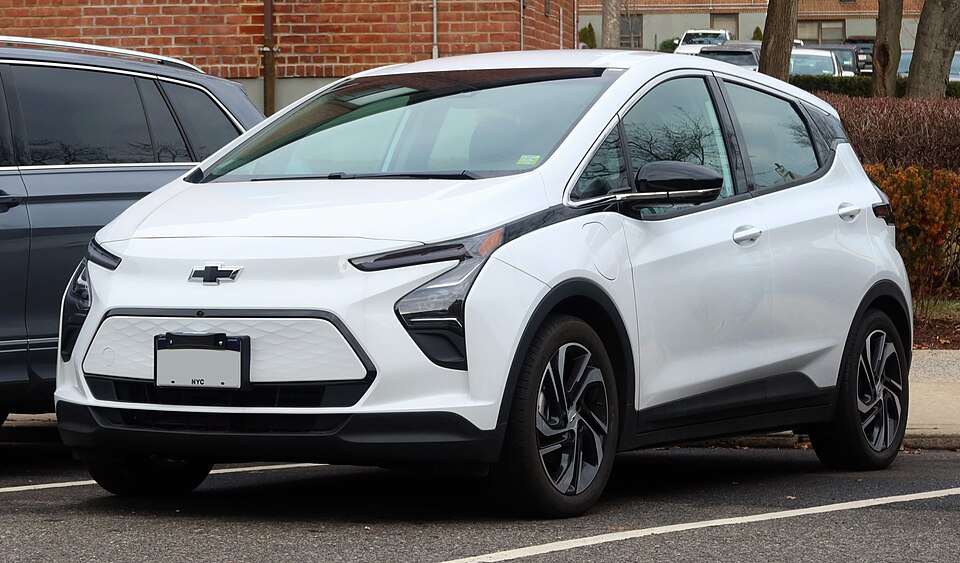
The 2022 Chevrolet Bolt EV is a small station wagon powered by electricity and front-wheel drive.
It measures about 163 inches long and 70 inches wide on a 102-inch wheelbase, with a curb weight of roughly 3,589 lb.
The electric version has an EPA-rated range of up to 259 miles and takes about 7.5 hours to charge on a 240-volt Level 2 charger.
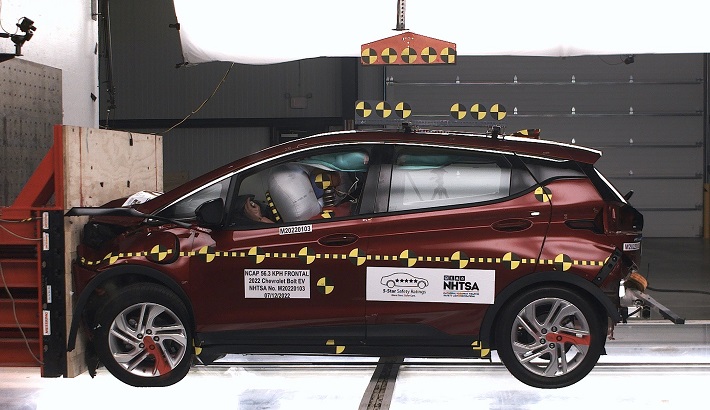
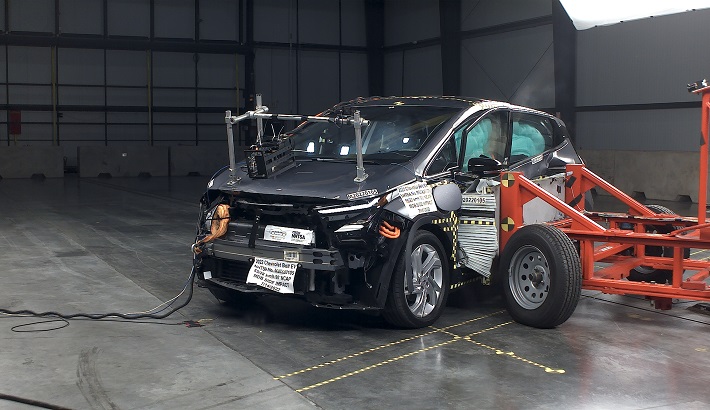
In NHTSA crash testing it earned the top 5-star overall rating.
It has 7 recall campaigns on file and owners have filed 59 complaints with NHTSA since 2015, most often about the electrical system.
What changed for 2022
No changes to engines, powertrains, drivetrains, size, EPA ratings or NHTSA crash rating compared with the 2021 Bolt EV — a carry-over year in the data.
Compared with 2021; trim, feature and price changes aren't covered. See the 2021 Bolt EV →
Trims, performance & features
Trims
Safety & driver-assist features
Built in: Orion, Michigan
NHTSA vPIC, as reported by the manufacturer for 4 2022 Bolt EV configurations; may not list every trim. How we calculate this →
Dimensions & weight
| Body | Length | Width | Height | Wheelbase | Track F / R | Curb weight | Weight F/R |
|---|---|---|---|---|---|---|---|
| 4dr Hatchback | 163.4 in | 69.7 in | 63.4 in | 102.4 in | 59.1 / 59.1 in | 3,589 lb | 56/44 |
Transport Canada CVS (Open Government Licence – Canada), Canadian-market figures.
Will it fit your garage? Check with your measurements →Engines, MPG & running costs
| Version | Engine | Transmission | Drive | City / Hwy / Comb | vs. class | Fuel / yr | CO₂ g/mi |
|---|---|---|---|---|---|---|---|
| Bolt EV EV | 150 kW ACPM | Automatic (variable gear ratios) | Front-Wheel Drive | 259 mi · 28.1083 kWh/100mi | – | $650 | – |
EPA estimates; "vs. class" is combined MPG against the 2022 EPA class average. How we calculate this →
Safety ratings & technology
| Version | Overall | Frontal | Driver / passenger | Side | Side pole | Rollover | Rollover risk |
|---|---|---|---|---|---|---|---|
| 2022 Chevrolet Bolt EV 5 HB FWD | ★★★★★ | ★★★★★ | 5★ / 4★ | ★★★★★ | ★★★★★ | ★★★★★ | 9.7% |
Similar 2022 small station wagons
| Model | Best MPG / range | NHTSA overall | Recalls |
|---|---|---|---|
| 2022 Chevrolet Bolt EV (this car) | 259 mi | ★★★★★ | 7 |
| 2022 Honda HR-V | 30 MPG | ★★★★★ | 3 |
| 2022 Kia Niro | 50 MPG | ★★★★★ | 3 |
| 2022 Chevrolet Bolt EUV | 247 mi | ★★★★★ | 4 |
| 2022 Kia Soul | 31 MPG | ★★★★★ | 1 |
| 2022 Nissan Rogue Sport | 28 MPG | ★★★★★ | 1 |
Recalls (7)
Electrical System › Propulsion System › Traction Battery · Oct 31, 2024 Park outside
NHTSA campaign 24V812000 · 107 vehicles
- Problem
- General Motors, LLC (GM) is recalling certain 2020-2022 Chevrolet Bolt EV and 2022 Bolt EUV vehicles previously repaired under Recall 21V-650. The installation of advanced diagnostic software may have failed. As such, the high voltage battery could catch fire when charged to full or nearly full capacity.
- Risk
- A battery fire increases the risk of injury.
- Fix
- Owners are advised to take the following interim steps: Set the Target Charge Level feature in their vehicle to limit the charge level to 90%, charge their vehicle more frequently, avoid depleting the battery to 70 miles range remaining, park outside after charging, and do not charge the vehicle indoors overnight. Dealers will reinstall advanced diagnostic software, free of charge. Owner notification letters were mailed December 3, 2024. Owners may contact the Bolt EV Concierge Team at 1-833-382-4389. GM's number for this recall is N242470160.
Electrical System › Propulsion System › Traction Battery · Jun 27, 2024 Park outside
NHTSA campaign 24V481000 · 72 vehicles
- Problem
- General Motors, LLC (GM) is recalling certain 2020-2022 Chevrolet Bolt EV and 2022 Chevrolet Bolt EUV vehicles that were previously remedied under recall number 21V-650. The advanced diagnostic software may have been incorrectly installed and fail to detect defective battery modules, possibly resulting in a battery fire.
- Risk
- A battery fire increases the risk of injury.
- Fix
- Owners are advised to take the following interim steps: Set the Target Charge Level feature in their vehicle to limit the charge level to 90%, charge their vehicle more frequently, avoid depleting the battery to 70 miles range remaining, park outside after charging, and do not charge the vehicle indoors overnight. Dealers will reinstall the advanced diagnostic software, free of charge. Owner notification letters were mailed on August 1, 2024. Owners may contact the Bolt EV Concierge Team at 1-833-382-4389. GM's numbers for this recall are N242443000 and N242443002.
Seat Belts › Pretensioner · Dec 14, 2023
NHTSA campaign 23V845000 · 6,771 vehicles
- Problem
- General Motors, LLC (GM) is recalling certain 2017-2023 Chevrolet Bolt EV vehicles. This recall includes certain vehicles previously repaired incorrectly under NHTSA recall number 22V-930. After a crash with seat belt pretensioner deployment, the pretensioner exhaust may ignite carpet fibers near the B-pillar, causing a fire.
- Risk
- A fire increases the risk of injury.
- Fix
- Dealers will inspect both front seat belt pretensioners and, if necessary, install metal foil at the carpet near the pretensioner exhaust. Certain vehicles will also need a pretensioner cover installed. Repairs will be performed free of charge. Owner notification letters were mailed January 24, 2024. These vehicles were previously recalled for this same issue under recall number 22V-930 and will need to have the new remedy performed. Owners may contact GM EV Concierge at 1-833-EVCHEVY (1-833-382-4389) (TTY 711 / 1-800-833-2438) or Customer Service at 1-800-222-1020. GM's number for this recall is N232421970.
Electrical System › Instrument Cluster/Panel · Aug 10, 2023
NHTSA campaign 23V567000 · 317 vehicles
- Problem
- General Motors, LLC (GM) is recalling certain 2022-2023 Chevrolet Bolt EV vehicles. The instrument panel may be missing the perforation on the underside of the panel cover that allows the passenger-side air bag to deploy properly.
- Risk
- An air bag that does not deploy properly in a crash increases the risk of injury.
- Fix
- Dealers will replace the instrument panel, free of charge. Owner notification letters were mailed December 21, 2023. Owners may contact Chevrolet customer service at 1-800-222-1020. GM's number for this recall is N232414710.
Seat Belts › Pretensioner · Dec 15, 2022
NHTSA campaign 22V930000 · 111,242 vehicles
- Problem
- General Motors, LLC (GM) is recalling certain 2017-2023 Chevrolet Bolt EV vehicles. After a crash with seat belt pretensioner deployment, the pretensioner exhaust may ignite carpet fibers near the B-pillar, causing a fire.
- Risk
- A vehicle fire can increase the risk of injury.
- Fix
- Dealers will install metal foil at the carpet near the pretensioner exhaust, and install a pretensioner cover as necessary, free of charge. Owner notification letters were mailed between January 23, 2023 and April 25, 2023. Owners may contact Chevrolet customer service at 1-800-222-1020. GM's number for this recall is N222383790.
Electrical System › Propulsion System › Traction Battery · Aug 20, 2021 Park outside
NHTSA campaign 21V650000 · 52,414 vehicles
- Problem
- General Motors, LLC (GM) is recalling certain 2020-2022 Chevrolet Bolt EV and 2022 Chevrolet Bolt EUV vehicles. The high voltage battery could catch fire when charged to full or nearly full capacity.
- Risk
- A battery fire increases the risk of injury.
- Fix
- Owners are advised to take the following interim steps: Set the Target Charge Level feature in their vehicle to limit the charge level to 90%, charge their vehicle more frequently, avoid depleting the battery to 70 miles range remaining, park outside after charging, and do not charge the vehicle indoors overnight. Defective battery modules will be replaced by GM, free of charge. Owner notification letters were mailed on October 1, 2021 and June 23, 2023. Owners may contact the Bolt EV Concierge Team at 1-833-382-4389. This recall is an expansion of NHTSA recall 21V-560. GM's number for this recall is N212345940.
Air Bags › Critical Fasteners · Jul 8, 2021
NHTSA campaign 21V517000 · 28 vehicles
- Problem
- General Motors, LLC. (GM) is recalling certain 2022 Chevrolet Bolt EV and Bolt EUV vehicles. One of the two fasteners that secure the driver's frontal air bag to the steering wheel may be missing or improperly tightened.
- Risk
- An improperly installed air bag may not deploy properly in a crash, increasing the risk of injury.
- Fix
- Dealers will inspect and replace as necessary, the driver-side air bag fasteners. If the fasteners cannot be tightened properly, the air bag assembly will be replaced. All repairs will be performed free of charge. Owner notification letters were mailed on July 29, 2021. Owners may contact Chevrolet customer service at 1-800-222-1020. GM's number for this recall is N212340860.
Not every 2022 Chevrolet Bolt EV is affected — only a VIN check confirms your car.
Owner-reported problems
Unverified owner reports; best-sellers collect more.
Used 2022 Chevrolet Bolt EV buyer's checklist
- Run the VIN at nhtsa.gov/recalls. 7 recalls this year — ask for proof of repairs.
- Safety-critical recall. At least one recall carries a "Do Not Drive" or "Park Outside" warning. Do not buy until the VIN shows it was repaired.
- Electrical System — 28 owner reports. Test every window, lock, light, screen and USB port; check the battery age.
- Fuel/Propulsion System — 11 owner reports. Smell for fuel around the car and in the cabin, check that it starts easily when warm, and look at the oil dipstick for a fuel smell or rising level.
- Power Train — 10 owner reports. Test-drive through all gears, including reverse; note slipping, harsh or delayed shifts.
- Mileage to watch. Owners typically reported problems around 6,612 miles; ask what was repaired near that point.
- Battery health. Ask for a battery state-of-health report, check the remaining battery warranty, and compare the displayed range at 100% charge with the EPA's 259 miles.
- Before you pay: service records, a history report and an independent inspection.
Generated by DecodedCars from NHTSA recalls and owner complaints for the 2022 Chevrolet Bolt EV. Not a substitute for a professional inspection.
Other Bolt EV years
Compare all years →| Year | MPG (best) | Length | Overall | Recalls | Complaints |
|---|---|---|---|---|---|
| 2023 Bolt EV | 259 mi | 163.4 in | ★★★★★ | 3 | 61 |
| 2021 Bolt EV | 259 mi | – | ★★★★★ | 5 | 67 |
| 2020 Bolt EV | 259 mi | – | ★★★★★ | 8 | 176 |
| 2019 Bolt EV | 238 mi | – | ★★★★★ | 6 | 178 |
| 2018 Bolt EV | 238 mi | – | Not rated | 5 | 89 |
| 2017 Bolt EV | 238 mi | – | Not rated | 4 | 349 |
Sources: EPA, NHTSA, Transport Canada, Wikimedia Commons. Not affiliated with NHTSA, the EPA or Chevrolet. How we calculate this →