 DecodedCars
2010 Volkswagen CC
Trims, performance, features, fuel economy, safety and known problems — with the pros and cons against similar 2010 models.
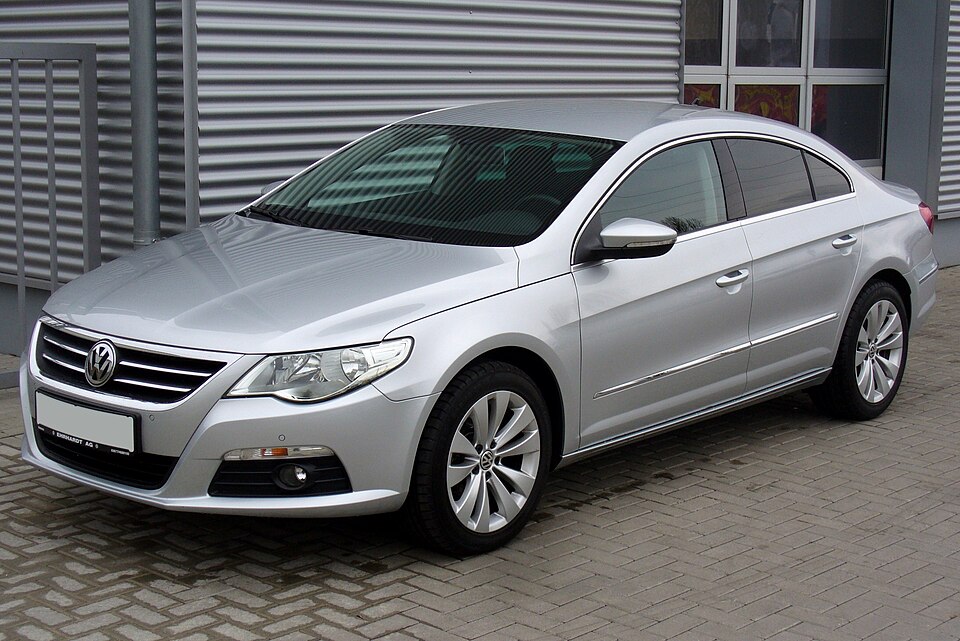
- Class
- Compact Cars
- Engines
- 2.0L 4-cyl turbo, 3.6L 6-cyl
- Horsepower
- 200 hp
- Transmission
- automatic
- Drivetrain
- Front-Wheel Drive, All-Wheel Drive
- Fuel
- Premium Gasoline
- MPG (best)
- 25 combined · 22 city / 31 hwy
- Length
- –
- Curb weight
- –
- NHTSA rating
- Not rated
- Recalls
- 4 campaigns
Pros & cons
What's good
- Strong performanceUp to 200 hp, versus about 140 hp for similar 2010 models.
- AWD / 4WD available
Watch out for
- Premium fuel requiredEvery gasoline version is rated for premium, which raises running costs.
Calculated from EPA, NHTSA and vPIC data against 20 similar 2010 models — not a review. How we calculate this →
Overview
The 2010 Volkswagen CC is a compact car offered with 2 engines (2.0L 4-cyl turbo and 3.6L 6-cyl) and front-wheel drive and all-wheel drive.
EPA rates its most efficient version at 25 MPG combined (22 city / 31 highway), 6% better than the 2010 compact car average of 23.6 MPG, for an estimated $3,300 a year in fuel.
It has 4 recall campaigns on file and owners have filed 199 complaints with NHTSA since 2015, most often about the air bags.
What changed for 2010
No changes to engines, powertrains, drivetrains, size, EPA ratings or NHTSA crash rating compared with the 2009 CC — a carry-over year in the data.
Compared with 2009; trim, feature and price changes aren't covered. See the 2009 CC →
Trims, performance & features
Trims
Built in: Emden, Germany
NHTSA vPIC, as reported by the manufacturer for 1 2010 CC configuration; may not list every trim. How we calculate this →
Engines, MPG & running costs
| Version | Engine | Transmission | Drive | City / Hwy / Comb | vs. class | Fuel / yr | CO₂ g/mi |
|---|---|---|---|---|---|---|---|
| CC | 2.0L 4-cyl turbo | Automatic (S6) | Front-Wheel Drive | 22 / 31 / 25 | +6% | $3,300 | 355 |
| CC | 2.0L 4-cyl turbo | Manual 6-spd | Front-Wheel Drive | 21 / 31 / 25 | +6% | $3,300 | 355 |
| CC | 3.6L 6-cyl | Automatic (S6) | Front-Wheel Drive | 18 / 27 / 21 | -11% | $3,900 | 423 |
| CC 4motion | 3.6L 6-cyl | Automatic (S6) | All-Wheel Drive | 17 / 25 / 20 | -15% | $4,100 | 444 |
EPA estimates; "vs. class" is combined MPG against the 2010 EPA class average. How we calculate this →
Safety ratings & technology
NHTSA has not published 5-Star ratings for the 2010 Volkswagen CC under the current (2011+) test program.
Similar 2010 compact cars
| Model | Best MPG / range | NHTSA overall | Recalls |
|---|---|---|---|
| 2010 Volkswagen CC (this car) | 25 MPG | Not rated | 4 |
| 2010 Toyota Corolla | 30 MPG | Not rated | 15 |
| 2010 Honda Civic | 42 MPG | Not rated | 8 |
| 2010 Honda Accord | 25 MPG | Not rated | 13 |
| 2010 Chevrolet Camaro | 22 MPG | Not rated | 1 |
| 2010 Mazda 3 | 28 MPG | Not rated | 0 |
| 2010 Volkswagen Golf/GTI | 32 MPG | Not rated | 4 |
Recalls (4)
Air Bags › Frontal › Driver Side › Inflator Module · Mar 6, 2018
NHTSA campaign 18V148000 · 363,713 vehicles
- Problem
- Volkswagen Group of America, Inc. (Volkswagen) is recalling certain 2009-2014 Volkswagen CC, 2010-2014 Golf, 2010-2014 Eos, 2007-2010 Passat Sedan and Wagon, and 2012-2014 Passat vehicles. Upon deployment of the driver's frontal air bag, excessive internal pressure may cause the inflator to explode.
- Risk
- In the event of a crash necessitating deployment of the driver's frontal air bag, the inflator could explode with metal fragments striking the vehicle occupants potentially resulting in serious injury or death.
- Fix
- Volkswagen will notify owners, and dealers will replace the driver's frontal air bag inflator with an alternative inflator, free of charge. The recall began March 16, 2018. Owners may contact Volkswagen customer service at 1-800-893-5298. Volkswagen's number for this recall is 69Q9. Note: This recall partially supersedes recall 16V-078.
Fuel System, Gasoline › Delivery › Fuel Pump · Aug 16, 2017
NHTSA campaign 17V509000 · 280,915 vehicles
- Problem
- Volkswagen Group of America, Inc. (Volkswagen) is recalling certain 2009-2016 Volkswagen CC, 2006-2010 Passat and Passat Wagon vehicles. Interruption of electrical power to the fuel pump control module may cause the fuel pump to fail.
- Risk
- If the fuel pump fails, the engine will stall, increasing the risk of a crash.
- Fix
- Volkswagen will notify owners, and dealers will replace the fuel pump control module, free of charge. The recall began June 26, 2018. Owners may contact Volkswagen customer service at 1-800-893-5298. Volkswagen's number for this recall is 20AE.
Air Bags › Frontal › Driver Side › Inflator Module · Feb 10, 2016
NHTSA campaign 16V078000 · 659,493 vehicles
- Problem
- Volkswagen Group of America, Inc. (Volkswagen) is recalling certain model year 2010-2014 Golf, 2007-2010 Passat sedans and wagon, 2012-2014 Passat sedan and Eos, 2009-2014 CC, 2009-2012 Audi Q5, 2010-2012 S5 Cabriolet and 2010-2012 Audi A5 Cabriolet vehicles. Upon deployment of the driver's frontal air bag, excessive internal pressure may cause the inflator to rupture.
- Risk
- In the event of a crash necessitating deployment of the driver's frontal air bag, the inflator could rupture with metal fragments striking the vehicle occupants potentially resulting in serious injury or death.
- Fix
- Volkswagen will notify owners, and dealers will replace the driver's frontal air bag inflators, free of charge. Volkswagen issued an interim notification to owners on April 12, 2016, and will send a second notification when parts are available. Volkswagen will notify owners again once parts are available. Volkswagen owners may contact Volkswagen customer service at 1-800-893-5298. Audi owners may contact Audi customer service at 1-800-253-2834.
Air Bags › Frontal · Aug 4, 2015
NHTSA campaign 15V483000 · 415,825 vehicles
- Problem
- Volkswagen Group of America, Inc. (Volkswagen) is recalling certain model year 2010-2014 Volkswagen CC, and Passat, 2010-2013 Eos, 2011-2014 Golf, GTI, Jetta, and Tiguan, and 2012-2014 Jetta Sportwagen vehicles. In the affected vehicles, debris may contaminate the air bag clock spring, a spiral wound, flat cable that keeps the air bag powered while the steering wheel is being turned. This contamination may tear the cable and result in a loss of electrical connection to the driver's frontal air bag.
- Risk
- A loss of electrical connection to the driver's frontal air bag will prevent the air bag from deploying in the event of a vehicle crash, increasing the risk of injury.
- Fix
- Volkswagen will notify owners, and dealers will install a protective cover over the steering wheel clock spring if the air bag light is off. If the airbag light is on and the steering wheel clock spring requires replacement, dealers will install a new steering wheel clock spring. These repairs will be performed free of charge. The recall began on January 15, 2016. Owners may contact Volkswagen customer service at 1-800-822-8987.
Not every 2010 Volkswagen CC is affected — only a VIN check confirms your car.
Owner-reported problems
Unverified owner reports; best-sellers collect more.
Used 2010 Volkswagen CC buyer's checklist
- Run the VIN at nhtsa.gov/recalls. 4 recalls this year — ask for proof of repairs.
- Air Bags — 83 owner reports. Confirm the airbag warning light turns off after start-up and any airbag recall was completed.
- Fuel/Propulsion System — 44 owner reports. Smell for fuel around the car and in the cabin, check that it starts easily when warm, and look at the oil dipstick for a fuel smell or rising level.
- Engine — 42 owner reports. Cold-start the engine, listen for knocking, and watch for warning lights or hesitation on acceleration.
- Mileage to watch. Owners typically reported problems around 83,973 miles; ask what was repaired near that point.
- Before you pay: service records, a history report and an independent inspection.
Generated by DecodedCars from NHTSA recalls and owner complaints for the 2010 Volkswagen CC. Not a substitute for a professional inspection.
Other CC years
Compare all years →Sources: EPA, NHTSA, Transport Canada, Wikimedia Commons. Not affiliated with NHTSA, the EPA or Volkswagen. How we calculate this →