 DecodedCars
2017 Lexus RX
Trims, performance, features, fuel economy, safety and known problems — with the pros and cons against similar 2017 models.
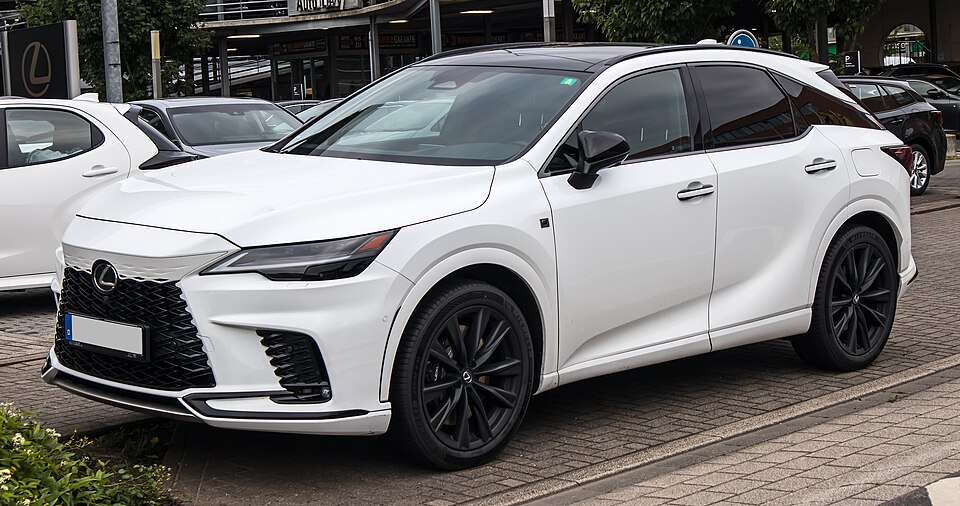
- Class
- Standard Sport Utility Vehicle 4WD
- Body styles
- 350 4dr SUV, 450h 4dr SUV
- Engines
- 3.5L 6-cyl
- Horsepower
- 270 hp
- Drivetrain
- All-Wheel Drive, Front-Wheel Drive
- Seats
- 5
- Fuel
- Hybrid, Regular Gasoline
- MPG (best)
- 30 combined · 31 city / 28 hwy
- Length
- 192.5 in
- Curb weight
- 4,453–4,740 lb
- NHTSA rating
- Not rated
- Recalls
- 3 campaigns
Pros & cons
What's good
- Excellent fuel economyUp to 30 MPG combined — 62% better than the average 2017 standard SUV (18.5 MPG).
- Hybrid version availableOffered as a hybrid as well as gas.
- AWD / 4WD available
Watch out for
No weak spots against similar models in the data.
Calculated from EPA, NHTSA and vPIC data against 24 similar 2017 models — not a review. How we calculate this →
Overview
The 2017 Lexus RX is a standard SUV offered with a 3.5L 6-cyl engine, including a hybrid version and all-wheel drive and front-wheel drive.
It measures about 193 inches long and 75 inches wide on a 110-inch wheelbase, with a curb weight of roughly 4,453 lb (350 4dr SUV).
EPA rates its most efficient version at 30 MPG combined (31 city / 28 highway), 62% better than the 2017 standard SUV average of 18.5 MPG, for an estimated $2,750 a year in fuel.
NHTSA has not published a 5-Star overall rating for this model year.
It has 3 recall campaigns on file and owners have filed 103 complaints with NHTSA since 2015, most often about the unknown or other.
What changed for 2017
No changes to engines, powertrains, drivetrains, size, EPA ratings or NHTSA crash rating compared with the 2016 RX — a carry-over year in the data.
Compared with 2016; trim, feature and price changes aren't covered. See the 2016 RX →
Trims, performance & features
Trims
Safety & driver-assist features
Built in: Cambridge, Ontario · Miyawaka, Fukuoka
NHTSA vPIC, as reported by the manufacturer for 4 2017 RX configurations; may not list every trim. How we calculate this →
Dimensions & weight
| Body | Length | Width | Height | Wheelbase | Track F / R | Curb weight | Weight F/R |
|---|---|---|---|---|---|---|---|
| 350 4dr SUV | 192.5 in | 74.8 in | 67.7 in | 109.8 in | 64.6 / 64.2 in | 4,453 lb | 58/42 |
| 450h 4dr SUV | 192.5 in | 74.8 in | 67.7 in | 109.8 in | 64.6 / 64.2 in | 4,740 lb | 56/44 |
Transport Canada CVS (Open Government Licence – Canada), Canadian-market figures.
Will it fit your garage? Check with your measurements →Engines, MPG & running costs
| Version | Engine | Transmission | Drive | City / Hwy / Comb | vs. class | Fuel / yr | CO₂ g/mi |
|---|---|---|---|---|---|---|---|
| RX 450h AWD Hybrid | 3.5L 6-cyl | Automatic (AV-S6) | All-Wheel Drive | 31 / 28 / 30 | +62% | $2,750 | 297 |
| RX 350 | 3.5L 6-cyl | Automatic (S8) | Front-Wheel Drive | 20 / 27 / 23 | -5% | $2,900 | 391 |
| RX 350 AWD | 3.5L 6-cyl | Automatic (S8) | All-Wheel Drive | 19 / 26 / 22 | -4% | $3,050 | 405 |
EPA estimates; "vs. class" is combined MPG against the 2017 EPA class average. How we calculate this →
Safety ratings & technology
NHTSA has not published 5-Star ratings for the 2017 Lexus RX.
Similar 2017 standard SUVs
| Model | Best MPG / range | NHTSA overall | Recalls |
|---|---|---|---|
| 2017 Lexus RX (this car) | 30 MPG | Not rated | 3 |
| 2017 Porsche Cayenne | 22 MPG | Not rated | 2 |
| 2017 BMW X5 | 25 MPG | Not rated | 6 |
| 2017 BMW X3 | 24 MPG | Not rated | 6 |
| 2017 Volvo XC90 | 25 MPG | Not rated | 7 |
| 2017 Audi Q7 | 22 MPG | Not rated | 7 |
| 2017 Tesla Model X | 295 mi | Not rated | 10 |
Recalls (3)
Fuel System, Gasoline › Delivery › Fuel Pump · Nov 4, 2020
NHTSA campaign 20V682000 · 1,525,742 vehicles
- Problem
- Toyota Motor Engineering & Manufacturing (Toyota) is recalling certain 2018-2019 4Runner, 2019-2020 Avalon, 2019 Corolla Hatchback, 2017-2019 Highlander, 2018-2020 Camry, 2020 Corolla, 2018-2019 Land Cruiser, 2017-2020 Tacoma, 2019-2020 RAV4, 2019-2020 Sequoia, 2017-2020 Sienna, 2019-2020 Tundra, 2018-2020 Lexus ES350, 2017 Lexus GS200t, 2017-2019 Lexus GS350, 2019 Lexus GS300, 2018-2020 Lexus LC500h, 2019-2020 Lexus LS500, 2018-2019 Lexus GX460, 2017 Lexus IS200t, 2019 Lexus IS300, 2019 Lexus IS350, 2018-2020 Lexus LC500, 2018 Lexus LS500, 2019 Lexus LS500h, 2018-2019 Lexus LX570, 2017 Lexus RC200t, 2019 Lexus RC300, RC350, 2017 and 2019-2020 Lexus RX350, 2018-2020 RX350L, 2019 Lexus UX200, 2018-2019 Lexus NX300 vehicles. The low-pressure fuel pump inside the fuel tank may fail.
- Risk
- If the fuel pump fails, the engine can stall while driving, increasing the risk of a crash.
- Fix
- Toyota will notify owners, and dealers will replace the fuel pump assembly with an improved one, free of charge. Owners of specific models were notified that remedy parts were available starting January 21, 2021. Owners of other models will be notified as remedy parts become available. Remedy parts should be available for all affected vehicles by late March 2021. Owners may contact Toyota customer service at 1-888-270-9371 or Lexus customer service at 1-800-255-3987. Note: This recall is an expansion of recall 20V-012. Toyota's number for this recall is 20TA02. Lexus' number for this recall is 20LA01.
Fuel System, Gasoline › Delivery › Fuel Pump · Jan 13, 2020
NHTSA campaign 20V012000 · 1,830,752 vehicles
- Problem
- Toyota Motor Engineering & Manufacturing (Toyota) recalled certain 2018-2019 4Runner, Highlander, Camry, Land Cruiser, Sequoia, Sienna, Tacoma and Tundra, and Lexus RC 300, RC 350, GS 350, GX 460, IS 300, LC 500, LS 500, LX 570, RX 350L, and 2019 Toyota Avalon and Corolla, and certain Lexus NX 300, and ES 350 vehicles on January 13, 2020. On March 4, 2020, Toyota expanded the recall to include certain 2014-2015 Toyota 4Runner and Land Cruiser, 2018 Avalon, Corolla, 2014 FJ Cruiser, 2017 Sienna and Lexus 2018 ES 350, 2018-2019 GS 300, 2013-2014 GS350, 2014-2015 GX 460, IS 350 and LX 570, 2014 IS F, 2018-2019 IS 350, LC 500H and LS 500H, 2013-2015 LS 460, 2015 NX 200T and RC350, 2017 RC 200T and RX 350. Toyota also removed the 2018-2019 Toyota 4Runner and Land Cruiser and 2018-2019 Lexus GX 460 and LX 570 and 2019 NX300 from inclusion in this recall. On March 19, 2020, Toyota expanded the recall to include 2015 Lexus GS350 vehicles. The low-pressure fuel pump inside the fuel tank may fail.
- Risk
- If the fuel pump fails, the engine can stall while driving, increasing the risk of a crash.
- Fix
- Toyota will notify owners, and dealers will replace the fuel pump, free of charge. The recall began May 4, 2020. Owners may contact Toyota customer service at 1-888-270-9371 or Lexus customer service at 1-800-255-3987. Toyota's numbers for this recall are 20TB02 and 20TA02 for Toyota vehicles and 20LB01 and 20LA01 for Lexus vehicles.
Service Brakes, Hydraulic › Power Assist › Vacuum · Apr 3, 2018
NHTSA campaign 18V211000 · 6,046 vehicles
- Problem
- Toyota Motor Engineering & Manufacturing (Toyota) is recalling certain 2018 Toyota Camry and Highlander vehicles, 2017 Toyota Sienna and Tacoma vehicles and 2017 Lexus RX350 vehicles. During the manufacturing process, the oil galley in the rotor for the brake booster vacuum pump assembly may have been improperly machined possibly resulting in a sudden loss of brake assist.
- Risk
- A sudden loss of braking assist can increase the risk of a crash.
- Fix
- Toyota will notify owners, and dealers will replace the brake booster vacuum pump, free of charge. The recall began on May 9, 2018. Owners may contact Toyota customer service at 1-888-270-9371, or Lexus customer service at 1-800-255-3987. Toyota's numbers for this recall are J0K/JLD.
Not every 2017 Lexus RX is affected — only a VIN check confirms your car.
Owner-reported problems
Unverified owner reports; best-sellers collect more.
Used 2017 Lexus RX buyer's checklist
- Run the VIN at nhtsa.gov/recalls. 3 recalls this year — ask for proof of repairs.
- Service Brakes — 18 owner reports. Brake firmly from speed; check for pulling, pulsing pedal or ABS warning light.
- Engine — 17 owner reports. Cold-start the engine, listen for knocking, and watch for warning lights or hesitation on acceleration.
- Electrical System — 11 owner reports. Test every window, lock, light, screen and USB port; check the battery age.
- Mileage to watch. Owners typically reported problems around 13,000 miles; ask what was repaired near that point.
- Hybrid system. Check for hybrid-system warning lights and ask whether the high-voltage battery has been replaced or is still under warranty.
- Before you pay: service records, a history report and an independent inspection.
Generated by DecodedCars from NHTSA recalls and owner complaints for the 2017 Lexus RX. Not a substitute for a professional inspection.
Other RX years
Compare all years →| Year | MPG (best) | Length | Overall | Recalls | Complaints |
|---|---|---|---|---|---|
| 2026 RX | 36 | 192.5 in | Not rated | 3 | 12 |
| 2025 RX | 36 | 192.5 in | Not rated | 4 | 24 |
| 2024 RX | 36 | 192.5 in | Not rated | 4 | 61 |
| 2023 RX | 36 | 192.5 in | Not rated | 4 | 67 |
| 2022 RX | 30 | 192.5 in | Not rated | 0 | 39 |
| 2021 RX | 30 | 192.5 in | Not rated | 2 | 71 |
| 2020 RX | 30 | 192.5 in | Not rated | 2 | 56 |
| 2019 RX | 30 | 192.5 in | Not rated | 4 | 68 |
| 2018 RX | 30 | 192.5 in | Not rated | 2 | 47 |
| 2016 RX | 30 | 192.5 in | Not rated | 3 | 93 |
| 2015 RX | 29 | 187.8 in | Not rated | 1 | 67 |
| 2014 RX | 29 | 187.8 in | Not rated | 0 | 22 |
Sources: EPA, NHTSA, Transport Canada, Wikimedia Commons. Not affiliated with NHTSA, the EPA or Lexus. How we calculate this →