 DecodedCars
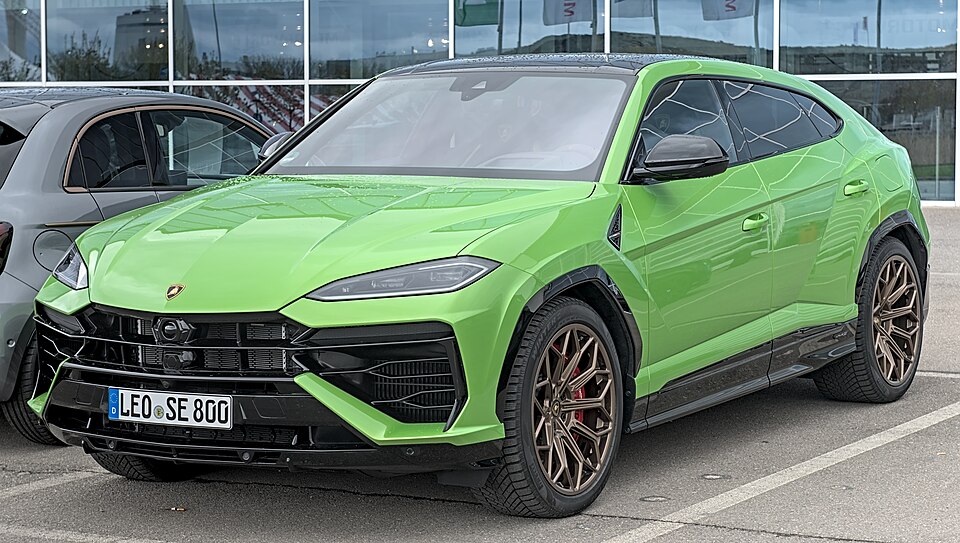
2025 Lamborghini Urus
Trims, performance, features, fuel economy, safety and known problems — with the pros and cons against similar 2025 models.
- Class
- Standard Sport Utility Vehicle 4WD
- Body styles
- 4dr SUV
- Engines
- 4.0L 8-cyl turbo
- Drivetrain
- 4-Wheel Drive
- Fuel
- Plug-in Hybrid
- MPG (best)
- 20 combined · 19 city / 21 hwy
- Length
- 201.2 in
- Curb weight
- 4,850 lb
- NHTSA rating
- Not rated
- Recalls
- 1 campaign
Pros & cons
What's good
- Plug-in hybrid version availableOffered as a plug-in hybrid as well as gas.
Watch out for
- Premium fuel requiredEvery gasoline version is rated for premium, which raises running costs.
Calculated from EPA, NHTSA and vPIC data — not a review. How we calculate this →
Overview
The 2025 Lamborghini Urus is a standard SUV offered with a 4.0L 8-cyl turbo engine, including a hybrid version and 4-wheel drive.
It measures about 201 inches long and 80 inches wide on a 118-inch wheelbase, with a curb weight of roughly 4,850 lb.
EPA rates its most efficient version at 20 MPG combined (19 city / 21 highway), 1% better than the 2025 standard SUV average of 19.8 MPG, for an estimated $4,100 a year in fuel.
NHTSA has not published a 5-Star overall rating for this model year.
It has 1 recall campaign on file.
What changed for 2025
- New plug-in hybrid version
- Best combined MPG up from 16 to 20
Compared with 2024; trim, feature and price changes aren't covered. See the 2024 Urus →
Dimensions & weight
| Body | Length | Width | Height | Wheelbase | Track F / R | Curb weight | Weight F/R |
|---|---|---|---|---|---|---|---|
| 4dr SUV | 201.2 in | 79.5 in | 64.6 in | 118.1 in | 66.9 / 66.9 in | 4,850 lb | 58/42 |
Transport Canada CVS (Open Government Licence – Canada), Canadian-market figures.
Will it fit your garage? Check with your measurements →Engines, MPG & running costs
| Version | Engine | Transmission | Drive | City / Hwy / Comb | vs. class | Fuel / yr | CO₂ g/mi |
|---|---|---|---|---|---|---|---|
| Urus SE Plug-in Hybrid | 4.0L 8-cyl turbo | Automatic (S8) | 4-Wheel Drive | 19 / 21 / 20 | +1% | $4,100 | 166 |
EPA estimates; "vs. class" is combined MPG against the 2025 EPA class average. How we calculate this →
Safety ratings & technology
NHTSA has not published 5-Star ratings for the 2025 Lamborghini Urus.
Similar 2025 standard SUVs
| Model | Best MPG / range | NHTSA overall | Recalls |
|---|---|---|---|
| 2025 Lamborghini Urus (this car) | 20 MPG | Not rated | 1 |
| 2025 Bentley Bentayga | 21 MPG | Not rated | 1 |
| 2025 Aston Martin DBX 707 | 17 MPG | Not rated | 4 |
Recalls (1)
Fuel System, Gasoline › Delivery › Fuel Pump · Sep 23, 2025
NHTSA campaign 25V633000 · 14 vehicles
- Problem
- Lamborghini (Automobili Lamborghini) is recalling certain 2025 Urus vehicles. The fasteners securing the high pressure fuel pump may not be tightened properly, resulting in a fuel leak.
- Risk
- A fuel leak in the presence of an ignition source increases the risk of a fire.
- Fix
- Dealers will inspect the screw connections and replace the high pressure fuel pump and fuel lines as necessary, free of charge. Owner notification letters were mailed October 16, 2025. Owners may contact Lamborghini customer service at 1-866-681-6276. Lamborghini's number for this recall is L636- R.01.25.
Not every 2025 Lamborghini Urus is affected — only a VIN check confirms your car.
Owner-reported problems
No owner complaints for the 2025 Lamborghini Urus in NHTSA's database since 2015.
Used 2025 Lamborghini Urus buyer's checklist
- Run the VIN at nhtsa.gov/recalls. 1 recall this year — ask for proof of repairs.
- Hybrid system. Check for hybrid-system warning lights and ask whether the high-voltage battery has been replaced or is still under warranty.
- Before you pay: service records, a history report and an independent inspection.
Generated by DecodedCars from NHTSA recalls and owner complaints for the 2025 Lamborghini Urus. Not a substitute for a professional inspection.
Other Urus years
Compare all years →Sources: EPA, NHTSA, Transport Canada, Wikimedia Commons. Not affiliated with NHTSA, the EPA or Lamborghini. How we calculate this →