 DecodedCars
Ford Focus
14 model years from 2005 to 2018, compared on size, efficiency, safety and reliability.
- Model years
- 2005–2018
- Class
- Compact Cars
- Latest engines
- 1.0L 3-cyl turbo, 2.0L 4-cyl, 2.0L 4-cyl turbo, 2.3L 4-cyl turbo
- Best MPG
- 26–34 combined, by year
- EV range
- up to 115 mi
- Latest rating
- ★★★★★ (2018)
- Recalls
- 27 campaigns, all years
- Most complaints
- 2012 (3,147)
- Fewest problems
- 2018
- Interest
- 21,550 Wikipedia views / 30 days
The 2018 Focus in brief
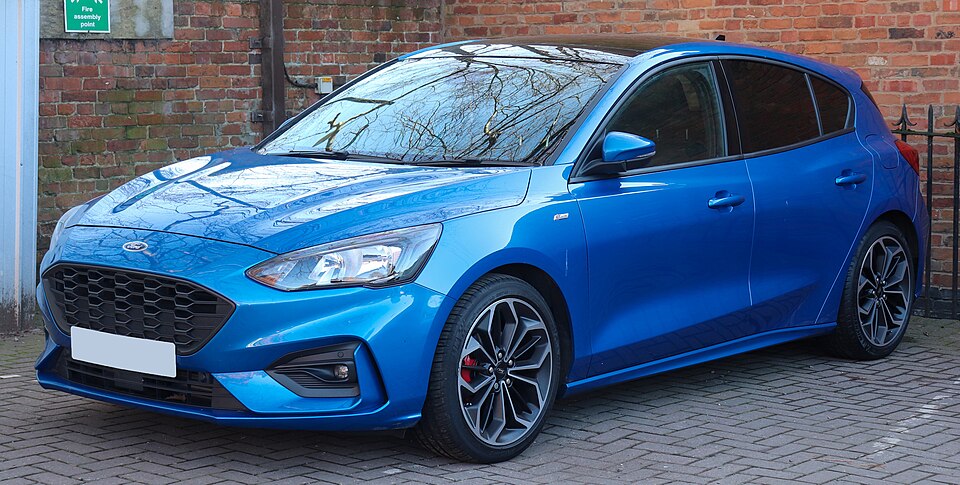
The 2018 Ford Focus is a compact car offered with 4 engines (1.0L 3-cyl turbo, 2.0L 4-cyl, 2.0L 4-cyl turbo and 2.3L 4-cyl turbo) and front-wheel drive and all-wheel drive.
It measures about 172 inches long and 72 inches wide on a 104-inch wheelbase, with a curb weight of roughly 2,926 lb (4dr Hatchback Se/Titanium).
EPA rates its most efficient version at 34 MPG combined (30 city / 40 highway), 26% better than the 2018 compact car average of 27 MPG, for an estimated $700 a year in fuel.
The electric version has an EPA-rated range of up to 115 miles and takes about 5.5 hours to charge on a 240-volt Level 2 charger.
In NHTSA crash testing it earned the top 5-star overall rating.
It has 7 recall campaigns on file and owners have filed 837 complaints with NHTSA since 2015, most often about the power train.
The Ford Focus has 14 model years in our data, from 2005 to 2018.
Its most efficient year was 2018 at 34 MPG combined; across all years the best version ranged from 26 to 34 MPG.
Owners most often report problems with the power train (5,215), engine (1,959), steering (1,469).
Buying used? 2018 has the fewest problems in our data.
2014 has the most recalls (14); all years together count 27 campaigns and 12,013 owner complaints.
How the 2005 Focus compares
The 2005 Ford Focus is a compact car offered with 2 engines (2.0L 4-cyl and 2.3L 4-cyl) and front-wheel drive.
It measures about 175 inches long and 67 inches wide on a 103-inch wheelbase, with a curb weight of roughly 2,564 lb (4dr Sedan LX/Se/Se Sport/Zts).
About the Ford Focus
The Ford Focus is a compact car manufactured by Ford from 1998 until 2025. It was created under Alexander Trotman's Ford 2000 plan, which aimed to globalize model development and sell one compact vehicle worldwide. The original Focus was primarily designed by Ford of Europe's German and British teams. Production of the fourth generation Focus began in 2018 in Germany and China. In 2025, Ford announced that the Focus would no longer be built, in line with an announcement made in 2022.
From the Wikipedia article "Ford Focus", licensed under CC BY-SA 4.0.
2018 Focus pros & cons
Full 2018 details →What's good
- Excellent fuel economyUp to 34 MPG combined — 26% better than the average 2018 compact car (27 MPG).
- Electric version availableOffered as a electric as well as gas.
- AWD / 4WD available
- 5-star NHTSA safety ratingTop overall score in federal crash tests.
Watch out for
- Modest powerUp to 160 hp, versus about 210 hp for similar 2018 models.
- Many owner complaints837 complaints filed with NHTSA versus about 29 for similar models — most often about the power train.
- 7 recallsMore than similar models (about 1). Confirm repairs with the VIN.
Best and worst years to buy used
2018 Focus
837 owner complaints · 7 recalls · 3 fire reports · 15 crash reports
NHTSA overall: ★★★★★
None of the 4 model years we compared stands out for complaints or recalls.
NHTSA recalls and complaints for 4 model years since 2015; use it alongside a pre-purchase inspection. How we calculate this →
Focus changes by model year
- 2017
- Longest EV range up from 76 to 115 miles
- Now crash-tested by NHTSA: 5 stars overall
- 2016
- Engine added: 2.3L 4-cyl turbo
- All-wheel or four-wheel drive now available
- 2015
- Engine added: 1.0L 3-cyl turbo
- Best combined MPG up from 32 to 34
- 2013
- Engine added: 2.0L 4-cyl turbo
- 2012
- New body dimensions: 3.5 in shorter, wheelbase +1.5 in — most likely a redesign or new generation
- New all-electric version
- Best combined MPG up from 29 to 32
- 2008
- New body dimensions: 6.3 in longer — most likely a redesign or new generation
- Engine dropped: 2.3L 4-cyl
- 2006
- New body dimensions: 5.9 in shorter — most likely a redesign or new generation
Years without a measurable change are left out.
Show all 14 model years side by side
| Year | Latest engines | Best MPG / range | Length | Weight | Overall | Recalls | Complaints |
|---|---|---|---|---|---|---|---|
| 2018 | 1.0L 3-cyl turbo, 2.0L 4-cyl, 2.0L 4-cyl turbo | 34 MPG | 171.7 in | 2,926 lb | ★★★★★ | 7 | 837 |
| 2017 | 1.0L 3-cyl turbo, 2.0L 4-cyl, 2.0L 4-cyl turbo | 34 MPG | 171.7 in | 2,926 lb | ★★★★★ | 10 | 907 |
| 2016 | 1.0L 3-cyl turbo, 2.0L 4-cyl, 2.0L 4-cyl turbo | 34 MPG | 171.7 in | 2,926 lb | Not rated | 11 | 1,194 |
| 2015 | 1.0L 3-cyl turbo, 2.0L 4-cyl, 2.0L 4-cyl turbo | 34 MPG | 171.7 in | 2,926 lb | Not rated | 11 | 1,034 |
| 2014 | 2.0L 4-cyl, 2.0L 4-cyl turbo | 32 MPG | 171.7 in | 2,926 lb | Not rated | 14 | 2,496 |
| 2013 | 2.0L 4-cyl, 2.0L 4-cyl turbo | 32 MPG | 171.7 in | 2,926 lb | Not rated | 14 | 1,759 |
| 2012 | 2.0L 4-cyl | 32 MPG | 171.7 in | 2,926 lb | Not rated | 10 | 3,147 |
| 2011 | 2.0L 4-cyl | 29 MPG | 175.2 in | 2,624 lb | Not rated | 0 | 73 |
| 2010 | 2.0L 4-cyl | 28 MPG | 175.2 in | 2,624 lb | Not rated | 0 | 139 |
| 2009 | 2.0L 4-cyl | 28 MPG | 175.2 in | 2,586 lb | Not rated | 0 | 85 |
| 2008 | 2.0L 4-cyl | 28 MPG | 175.2 in | 2,586 lb | Not rated | 0 | 104 |
| 2007 | 2.0L 4-cyl, 2.3L 4-cyl | 27 MPG | 168.9 in | 2,606 lb | Not rated | 0 | 105 |
| 2006 | 2.0L 4-cyl, 2.3L 4-cyl | 26 MPG | 168.9 in | 2,606 lb | Not rated | 0 | 49 |
| 2005 | 2.0L 4-cyl, 2.3L 4-cyl | 26 MPG | 174.8 in | 2,564 lb | Not rated | 0 | 84 |
Alternatives to the 2018 Focus
| Model | Best MPG / range | NHTSA overall | Recalls |
|---|---|---|---|
| 2018 Honda Civic | 36 MPG | ★★★★★ | 6 |
| 2018 Toyota Prius | 56 MPG | ★★★★★ | 1 |
| 2018 Volkswagen Golf/GTI | 29 MPG | ★★★★★ | 6 |
| 2018 Hyundai Elantra | 35 MPG | ★★★★★ | 1 |
| 2018 Subaru WRX | 23 MPG | Not rated | 2 |
| 2018 Nissan Leaf | 151 mi | Not rated | 4 |
Most common owner-reported problems
Sources: EPA, NHTSA, Transport Canada, Wikipedia, Wikimedia Commons. Not affiliated with NHTSA, the EPA or Ford. How we calculate this →