 DecodedCars
Kia Sedona 2012
Versiones, desempeño, equipamiento, consumo, seguridad y problemas conocidos, con sus ventajas y desventajas frente a modelos similares 2012.
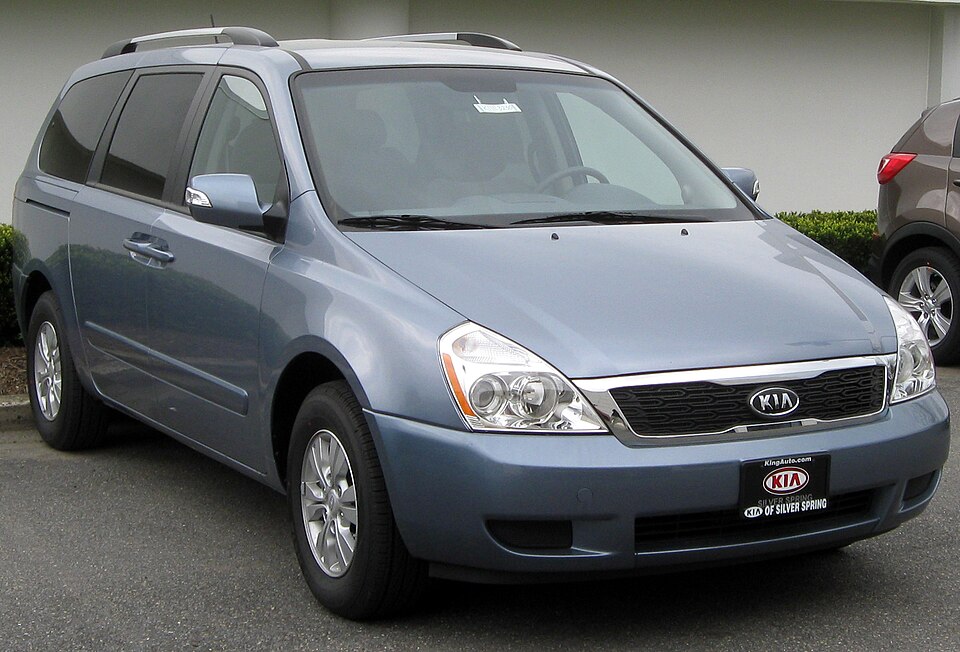
- Clase
- Minivan (2WD)
- Carrocerías
- 5dr Van FWD LX, 5dr Van FWD LX-Convenience/EX
- Motores
- 3.5L 6 cil.
- Tracción
- Tracción delantera
- Combustible
- Gasolina regular
- MPG (mejor)
- 21 combinadas · 18 ciudad / 24 carretera
- Largo
- 202 in
- Peso en vacío
- 4,601 lb
- Calificación NHTSA
- Sin calificar
- Retiros
- 5 campañas
Resumen
El Kia Sedona 2012 es una minivan con motor 3.5L 6 cil., con tracción delantera.
Mide unas 202 pulgadas de largo y 78 de ancho, con una distancia entre ejes de 119 pulgadas, y pesa alrededor de 4,601 lb (5dr Van FWD LX).
La EPA califica su versión más eficiente con 21 MPG combinadas (18 en ciudad / 24 en carretera), un 1 % peor que el promedio de su clase (minivan, 2012: 21.3 MPG), con un gasto estimado de $3,200 al año en combustible.
La NHTSA no ha publicado una calificación general de 5 estrellas para este año modelo.
Tiene 5 campañas de retiro registradas y los propietarios han presentado 86 quejas ante la NHTSA desde 2015, sobre todo por problemas de sistema eléctrico.
Novedades del 2012
Sin cambios en motores, versiones, tracción, tamaño, consumo EPA ni calificación NHTSA respecto al Sedona 2011: un año sin cambios según los datos.
Comparado con 2011; no incluye cambios de versiones, equipamiento ni precio. Ver el Sedona 2011 →
Dimensiones y peso
| Carrocería | Largo | Ancho | Alto | Distancia entre ejes | Vía del. / tras. | Peso en vacío | Peso del./tras. |
|---|---|---|---|---|---|---|---|
| 5dr Van FWD LX | 202 in | 78.3 in | 69.3 in | 118.9 in | 66.5 / 66.5 in | 4,601 lb | 57/43 |
| 5dr Van FWD LX-Convenience/EX | 202 in | 78.3 in | 72 in | 118.9 in | 66.5 / 66.5 in | 4,601 lb | 57/43 |
Transport Canada CVS (Open Government Licence – Canada), medidas del mercado canadiense.
¿Cabe en tu garaje? Compruébalo con tus medidas →Motores, consumo y costo de uso
| Versión | Motor | Transmisión | Tracción | Ciudad / Carr. / Comb. | vs. su clase | Combustible / año | CO₂ g/mi |
|---|---|---|---|---|---|---|---|
| Sedona | 3.5L 6 cil. | Automática 6-spd | Tracción delantera | 18 / 24 / 21 | -1% | $3,200 | 423 |
Estimaciones de la EPA; "vs. su clase" compara las MPG combinadas con el promedio 2012 de su clase EPA. Cómo lo calculamos →
Calificaciones de seguridad y tecnología
La NHTSA no ha publicado calificaciones de 5 estrellas para el Kia Sedona 2012.
Minivan similares 2012
| Modelo | Mejor MPG / autonomía | General NHTSA | Retiros |
|---|---|---|---|
| Kia Sedona 2012 (este auto) | 21 MPG | Sin calificar | 5 |
| Toyota Sienna 2012 | 21 MPG | Sin calificar | 9 |
| Honda Odyssey 2012 | 22 MPG | Sin calificar | 5 |
| Dodge Grand Caravan 2012 | 20 MPG | Sin calificar | 6 |
| Chrysler Town and Country 2012 | 20 MPG | Sin calificar | 5 |
| Nissan Quest 2012 | 21 MPG | Sin calificar | 1 |
| Volkswagen Routan 2012 | 20 MPG | Sin calificar | 1 |
Retiros (5)
Texto oficial de la NHTSA (en inglés).
Combustible (gasolina) › Fuel Injection System › Fuel Rail · 21 feb 2020
Campaña NHTSA 20V101000 · 51,465 vehículos
- Problema
- Kia Motors America (Kia) is recalling certain 2011-2012 Sedona vehicles. The fuel rail may crack from exposure to heat generated within the engine compartment, resulting in a fuel leak.
- Riesgo
- A fuel leak increases the risk of fire.
- Solución
- Kia will notify owners, and dealers will replace the fuel rail, free of charge. The recall began June 16, 2020. Owners may contact Kia customer service at 1-800-333-4542. Kia's number for this recall is SC188.
Bolsas de aire › Air Bag/Restraint Control Module · 1 jun 2018
Campaña NHTSA 18V363000 · 507,587 vehículos
- Problema
- Kia Motors America (Kia) is recalling certain 2010-2013 Kia Forte, Forte Koup, 2011-2013 Kia Optima and 2011-2012 Kia Optima Hybrid and Sedona vehicles. In the event of a crash, the air bag control unit (ACU) may short circuit, preventing the frontal air bags and seat belt pretensioners from deploying.
- Riesgo
- If the frontal air bags and seat belt pretensioners are disabled, there is an increased risk of injury to the vehicle occupants in the event of a vehicle crash that necessitates deployment of these safety systems.
- Solución
- Kia will notify owners. For model year 2011 Sedona vehicles, Kia will instruct dealers to verify the ACU part number and, if necessary, install an extension wire harness kit between the ACU Connector and the Vehicle Harness Connector. For all other affected vehicles, Kia will instruct dealers to install the extension wire harness kit. The recall began September 28, 2018. Owners may contact Kia customer service at 1-800-333-4542. Kia's number for this recall is SC165.
Suspensión › Front › Control Arm › Lower Arm · 1 jun 2016
Campaña NHTSA 16V387000 · 97,884 vehículos
- Problema
- Kia Motors Corporation (Kia) is recalling certain model year 2006-2012 Kia Sedona vehicles manufactured from June 15, 2005, through August 14, 2012 and originally sold in, or currently registered in Alaska, Connecticut, Delaware, Illinois, Indiana, Iowa, Kansas, Kentucky, Maine, Maryland, Massachusetts, Michigan, Minnesota, Missouri, Nebraska, New Hampshire, New Jersey, New York, North Dakota, Ohio, Pennsylvania, Rhode Island, South Dakota, Utah, Vermont, West Virginia, Wisconsin and the District of Columbia. In the affected vehicles, the front lower control arms may break due to corrosion from salt water exposure such as from road salt use.
- Riesgo
- A broken control arm can result in the loss of control of the vehicle, increasing the risk of a crash.
- Solución
- Kia will notify owners and dealers will replace the front lower control arms on 2006-2007 models. 2008-2012 models will either have their front lower control arms replaced or additional anti-corrosion coating will be applied. These repairs will be performed free of charge. The recall began on July 27, 2016. Owners may contact Kia at 1-800-333-4542. Kia's number for this recall is SC133.
Cerraduras y seguros › Hood › Latch · 1 jun 2016
Campaña NHTSA 16V389000 · 219,800 vehículos
- Problema
- Kia Motors Corporation (Kia) is recalling certain model year 2006-2014 Kia Sedona vehicles manufactured from June 15, 2005, through April 04, 2014. In the affected vehicles, the secondary hood latch may bind and remain in the unlatched position when the hood is closed.
- Riesgo
- If the primary latch is inadvertently released and the secondary latch is not engaged, the hood could unexpectedly open while driving, increasing the risk of a vehicle crash.
- Solución
- Kia will notify owners and dealers will replace the secondary hood latch or clean and lubricate the latch, depending on the vehicle's location and the condition of the latch. These repairs will be performed free of charge. The recall began on July 27, 2016. Owners may contact Kia at 1-800-333-4542. Kia's recall number is SC134.
Suspensión › Front › Control Arm › Lower Arm · 5 nov 2013
Campaña NHTSA 13V550000 · 79,867 vehículos
- Problema
- Kia Motors Corporation (Kia) is recalling certain model year 2006-2012 Kia Sedona vehicles manufactured from June 15, 2005, through August 14, 2012 originally sold in, or currently registered in Massachusetts, Maryland, Michigan, New Hampshire, New York, Pennsylvania, Vermont, Wisconsin, Connecticut, Delaware, Iowa, Illinois, Indiana, Maine, Minnesota, Missouri, New Jersey, Ohio, Rhode Island, West Virginia or the District of Columbia. In the affected vehicles, the front lower control arms may break due to corrosion resulting from prolonged exposure to salty environments.
- Riesgo
- A broken control arm can result in the loss of control of the vehicle, increasing the risk of a crash.
- Solución
- Kia will notify owners and dealers will inspect the degree of corrosion of the front lower control arms, and will either rustproof or replace them, free of charge. The recall began on December 20, 2013. Owners may contact Kia at 1-800-333-4542. Kia's recall number is SC100.
No todos los Sedona 2012 están afectados: solo el VIN lo confirma.
Problemas reportados por propietarios
Reportes sin verificar; los más vendidos acumulan más.
Lista para comprar un Kia Sedona 2012 usado
- Consulta el VIN en nhtsa.gov/recalls. 5 retiros en este año: pide comprobantes de reparación.
- Sistema eléctrico — 27 reportes de propietarios. Prueba todas las ventanas, seguros, luces, pantallas y puertos USB; revisa la antigüedad de la batería.
- Motor — 17 reportes de propietarios. Arranca el motor en frío, escucha si golpetea y fíjate en luces de advertencia o titubeos al acelerar.
- Estructura › Carrocería — 13 reportes de propietarios. Abre y cierra todas las puertas, el cofre y la cajuela; busca óxido o paneles desalineados.
- Millaje a vigilar. Los propietarios suelen reportar problemas alrededor de las 80,000 millas; pregunta qué se reparó cerca de ese punto.
- Antes de pagar: historial de servicio, reporte de antecedentes e inspección de un mecánico independiente.
Generado por DecodedCars a partir de retiros y quejas de propietarios ante la NHTSA para el Kia Sedona 2012. No sustituye una inspección profesional.
Otros años del Sedona
Comparar todos los años →| Año | MPG (mejor) | Largo | General | Retiros | Quejas |
|---|---|---|---|---|---|
| Sedona 2021 | 21 | 201.6 in | ★★★★★ | 0 | 10 |
| Sedona 2020 | 21 | 201.6 in | ★★★★★ | 1 | 20 |
| Sedona 2019 | 21 | 201.6 in | ★★★★★ | 2 | 39 |
| Sedona 2018 | 21 | 201.6 in | ★★★★★ | 3 | 49 |
| Sedona 2017 | 21 | 201.6 in | ★★★★★ | 4 | 134 |
| Sedona 2016 | 21 | 201.6 in | Sin calificar | 4 | 297 |
| Sedona 2015 | 21 | 201.6 in | Sin calificar | 3 | 140 |
| Sedona 2014 | 20 | 202 in | Sin calificar | 1 | 37 |
| Sedona 2011 | 21 | 202 in | Sin calificar | 6 | 52 |
| Sedona 2010 | 19 | 202 in | Sin calificar | 5 | 22 |
| Sedona 2009 | 18 | 202 in | Sin calificar | 5 | 19 |
| Sedona 2008 | 18 | 202 in | Sin calificar | 5 | 73 |
Fuentes: EPA, NHTSA, Transport Canada, Wikimedia Commons. Sin afiliación con la NHTSA, la EPA ni Kia. Cómo lo calculamos →