 DecodedCars
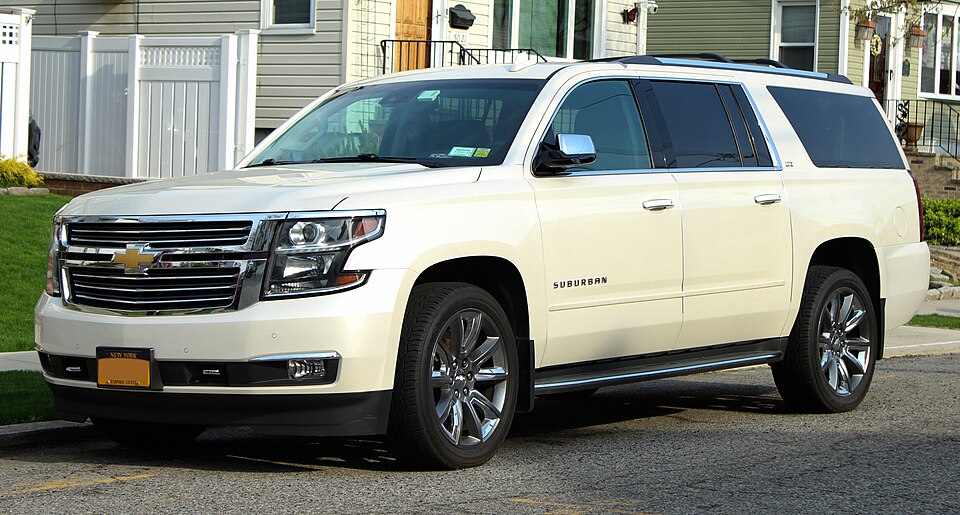
Chevrolet Suburban 2014
Versiones, desempeño, equipamiento, consumo, seguridad y problemas conocidos, con sus ventajas y desventajas frente a modelos similares 2014.
- Clase
- SUV grande (2WD)
- Carrocerías
- 1500 4dr SUV 4WD, 1500 4dr SUV RWD
- Motores
- 5.3L 8 cil.
- Tracción
- Tracción trasera, Tracción 4x4
- Combustible
- FFV
- MPG (mejor)
- 17 combinadas · 15 ciudad / 21 carretera
- Largo
- 222.4 in
- Peso en vacío
- 5,686–5,820 lb
- Calificación NHTSA
- Sin calificar
- Retiros
- 3 campañas
Ventajas y desventajas
Lo bueno
- Tracción total / 4x4 disponible
A tener en cuenta
Sin puntos débiles frente a modelos similares en los datos.
Calculado con datos de la EPA, la NHTSA y vPIC; no es una reseña. Cómo lo calculamos →
Resumen
El Chevrolet Suburban 2014 es un SUV grande con motor 5.3L 8 cil., con tracción trasera y tracción 4x4.
Mide unas 222 pulgadas de largo y 79 de ancho, con una distancia entre ejes de 130 pulgadas, y pesa alrededor de 5,820 lb (1500 4dr SUV 4WD).
La EPA califica su versión más eficiente con 17 MPG combinadas (15 en ciudad / 21 en carretera), un 9 % peor que el promedio de su clase (SUV grande, 2014: 18.6 MPG), con un gasto estimado de $3,950 al año en combustible.
La NHTSA no ha publicado una calificación general de 5 estrellas para este año modelo.
Tiene 3 campañas de retiro registradas y los propietarios han presentado 57 quejas ante la NHTSA desde 2015, sobre todo por problemas de otro o desconocido.
Novedades del 2014
- Motor retirado: 6.0L 8 cil.
Comparado con 2013; no incluye cambios de versiones, equipamiento ni precio. Ver el Suburban 2013 →
Versiones, desempeño y equipamiento
Versiones
Fabricado en: Arlington, Texas
NHTSA vPIC, según el fabricante, para 5 configuraciones del Suburban 2014; puede no incluir todas las versiones. Cómo lo calculamos →
Dimensiones y peso
| Carrocería | Largo | Ancho | Alto | Distancia entre ejes | Vía del. / tras. | Peso en vacío | Peso del./tras. |
|---|---|---|---|---|---|---|---|
| 1500 4dr SUV 4WD | 222.4 in | 79.1 in | 76.8 in | 129.9 in | 68.9 / 67.3 in | 5,820 lb | 51/49 |
| 1500 4dr SUV RWD | 222.4 in | 79.1 in | 76.8 in | 129.9 in | 68.9 / 67.3 in | 5,686 lb | 51/49 |
Transport Canada CVS (Open Government Licence – Canada), medidas del mercado canadiense.
¿Cabe en tu garaje? Compruébalo con tus medidas →Motores, consumo y costo de uso
| Versión | Motor | Transmisión | Tracción | Ciudad / Carr. / Comb. | vs. su clase | Combustible / año | CO₂ g/mi |
|---|---|---|---|---|---|---|---|
| Suburban C10 2WD FFV | 5.3L 8 cil. | Automática 6-spd | Tracción trasera | 15 / 21 / 17 | -9% | $3,950 | 520 |
| Suburban K10 4WD FFV | 5.3L 8 cil. | Automática 6-spd | Tracción 4x4 | 15 / 21 / 17 | -5% | $3,950 | 520 |
Estimaciones de la EPA; "vs. su clase" compara las MPG combinadas con el promedio 2014 de su clase EPA. Cómo lo calculamos →
Calificaciones de seguridad y tecnología
La NHTSA no ha publicado calificaciones de 5 estrellas para el Chevrolet Suburban 2014.
SUV grande similares 2014
| Modelo | Mejor MPG / autonomía | General NHTSA | Retiros |
|---|---|---|---|
| Chevrolet Suburban 2014 (este auto) | 17 MPG | Sin calificar | 3 |
| Toyota Land Cruiser 2014 | 15 MPG | Sin calificar | 4 |
Retiros (3)
Texto oficial de la NHTSA (en inglés).
Bolsas de aire › Frontal › Passenger Side › Inflator Module · 5 feb 2021
Campaña NHTSA 21V054000 · 1,778,128 vehículos
- Problema
- General Motors, LLC (GM) is recalling certain 2014 Cadillac Escalade, Escalade ESV, Chevrolet Silverado 2500, Silverado 3500, Suburban, Tahoe, GMC Sierra 2500, Sierra 3500, Yukon, and Yukon XL vehicles originally sold, or ever registered, in the states of AL, CA, FL, GA, HI, LA, MS, SC, TX, PR, AS, GU, the MP, and VI or "Zone A." Additionally GM is recalling certain 2011-2014 Cadillac Escalade, Escalade ESV, Chevrolet Silverado 2500, Silverado 3500, Suburban, Tahoe, GMC Sierra 2500, Sierra 3500, Yukon, Yukon XL and 2011-2013 Cadillac Escalade EXT, Chevrolet Avalanche, Silverado 1500, and GMC Sierra 1500 vehicles originally sold, or ever registered, in the states of AZ, AR, DE, DC, IL, IN, KS, KY, MD, MO, NE, NV, NJ, NM, NC, OH, OK, PA, TN, VA, and WV or "Zone B." Additionally, GM is recalling certain 2010-2014 Cadillac Escalade, Escalade ESV, Chevrolet Silverado 2500, Silverado 3500, Suburban, Tahoe, GMC Sierra 2500, Sierra 3500, Yukon, and Yukon XL and 2010-2013 Cadillac Escalade EXT, Chevrolet Avalanche, Silverado 1500, and GMC Sierra 1500 vehicles originally sold, or ever registered, in the states of AK, CO, CT, ID, IA, ME, MA, MI, MN, MT, NH, NY, ND, OR, RI, SD, UT, VT, WA, WI, and WY or "Zone C." These vehicles are equipped with non-desiccated passenger frontal inflators containing phase-stabilized ammonium nitrate (PSAN) propellant. These inflators may explode due to propellant degradation occurring after long-term exposure to high absolute humidity, high temperatures, and high temperature cycling.
- Riesgo
- An inflator explosion may result in sharp metal fragments striking the driver or other occupants, resulting in serious injury or death.
- Solución
- GM will notify owners, and dealers will replace the front passenger air bag inflator with an alternate one, free of charge. Interim letters notifying owners of the safety risk were mailed on February 25, 2021. Second notification letters will be mailed once the remedy is available. Owner notification letters were mailed to 40 VIN owners on May 11, 2021. A second owner notification letter was mailed to all other owners on January 24, 2022. Owners may contact Chevrolet customer service at 1-800-222-1020; Cadillac customer service at 1-800-458-8006; and GMC customer service at 1-800-462-8782. GM's number for this recall is N212328800.
Sistema eléctrico · 1 oct 2014
Campaña NHTSA 14V614000 · 106,307 vehículos
- Problema
- General Motors LLC (GM) is recalling certain model year 2013-2014 Cadillac CTS, Escalade, Escalade ESV, Chevrolet Suburban, Tahoe, GMC Yukon, and Yukon XL, and 2014 Buick Enclave, Chevrolet Express, Impala, Silverado HD, Traverse, GMC Acadia, Savana, and Sierra HD vehicles. In the affected vehicles, the chassis electronic module may be internally contaminated, resulting in an electrical short.
- Riesgo
- If the module experiences an electrical short, the vehicle could stall, increasing the risk of a crash.
- Solución
- GM will notify owners, and dealers will replace the chassis electronic module, free of charge. The recall began on December 26, 2014. Owners may contact GM customer service at 1-800-521-7300 (Buick), 1-800-458-006 (Cadillac), 1-800-222-1020 (Chevrolet), and 1-800-462-8782 (GMC). GMÂs number for this recall is 14515.
Frenos hidráulicos · 6 ago 2013
Campaña NHTSA 13V342000 · 10 vehículos
- Problema
- General Motors is recalling certain model year 2014 Chevrolet Suburban vehicles manufactured July 9, 2013, through July 22, 2013; and 2014 Chevrolet Tahoe vehicles manufactured July 16, 2013, through July 23, 2013; and model year 2014 GMC Yukon vehicles manufactured July 13, 2013, through July 18, 2013; and model year 2014 GMC Yukon XL vehicles manufactured on July 22, 2013. The rear brake caliper bolts may not be fully tightened. Thus, these vehicles fail to conform to the requirements of Federal Motor Vehicle Safety Standard (FMVSS) No. 135, "Light Vehicle Brake Systems."
- Riesgo
- Loose caliper bolts may cause reduced braking performance and result in lengthened stopping distances, increasing the risk of a crash.
- Solución
- GM will notify owners, and dealers will inspect the bolts on both rear brake caliper brackets. Any bolts found loose will be replaced and tightened. This service will be performed, at no charge. Owners may contact Chevrolet at 1-800-222-1020 and GMC at 1-800-462-8782. GM's recall number is 13247.
No todos los Suburban 2014 están afectados: solo el VIN lo confirma.
Problemas reportados por propietarios
Reportes sin verificar; los más vendidos acumulan más.
Lista para comprar un Chevrolet Suburban 2014 usado
- Consulta el VIN en nhtsa.gov/recalls. 3 retiros en este año: pide comprobantes de reparación.
- Bolsas de aire — 15 reportes de propietarios. Confirma que la luz de advertencia de las bolsas de aire se apague al arrancar y que cualquier retiro de bolsas de aire esté reparado.
- Sistema eléctrico — 7 reportes de propietarios. Prueba todas las ventanas, seguros, luces, pantallas y puertos USB; revisa la antigüedad de la batería.
- Estructura › Carrocería — 7 reportes de propietarios. Abre y cierra todas las puertas, el cofre y la cajuela; busca óxido o paneles desalineados.
- Millaje a vigilar. Los propietarios suelen reportar problemas alrededor de las 63,000 millas; pregunta qué se reparó cerca de ese punto.
- Antes de pagar: historial de servicio, reporte de antecedentes e inspección de un mecánico independiente.
Generado por DecodedCars a partir de retiros y quejas de propietarios ante la NHTSA para el Chevrolet Suburban 2014. No sustituye una inspección profesional.
Otros años del Suburban
Comparar todos los años →| Año | MPG (mejor) | Largo | General | Retiros | Quejas |
|---|---|---|---|---|---|
| Suburban 2027 | 23 | – | Sin calificar | 0 | 0 |
| Suburban 2026 | 23 | 225.6 in | Sin calificar | 3 | 18 |
| Suburban 2025 | 23 | 225.6 in | ★★★★★ | 1 | 32 |
| Suburban 2024 | 23 | 225.6 in | ★★★★★ | 2 | 45 |
| Suburban 2023 | 23 | 225.6 in | ★★★★★ | 4 | 148 |
| Suburban 2022 | 23 | 225.6 in | ★★★★★ | 4 | 124 |
| Suburban 2021 | 23 | 225.6 in | ★★★★★ | 12 | 204 |
| Suburban 2020 | 18 | 224.4 in | Sin calificar | 4 | 44 |
| Suburban 2019 | 18 | 224.4 in | Sin calificar | 3 | 78 |
| Suburban 2018 | 19 | 224.4 in | Sin calificar | 4 | 84 |
| Suburban 2017 | 19 | 224.4 in | Sin calificar | 5 | 142 |
| Suburban 2016 | 19 | 224.4 in | Sin calificar | 6 | 220 |
Fuentes: EPA, NHTSA, Transport Canada, Wikimedia Commons. Sin afiliación con la NHTSA, la EPA ni Chevrolet. Cómo lo calculamos →