 DecodedCars
Chevrolet Malibu 2010
Versiones, desempeño, equipamiento, consumo, seguridad y problemas conocidos, con sus ventajas y desventajas frente a modelos similares 2010.
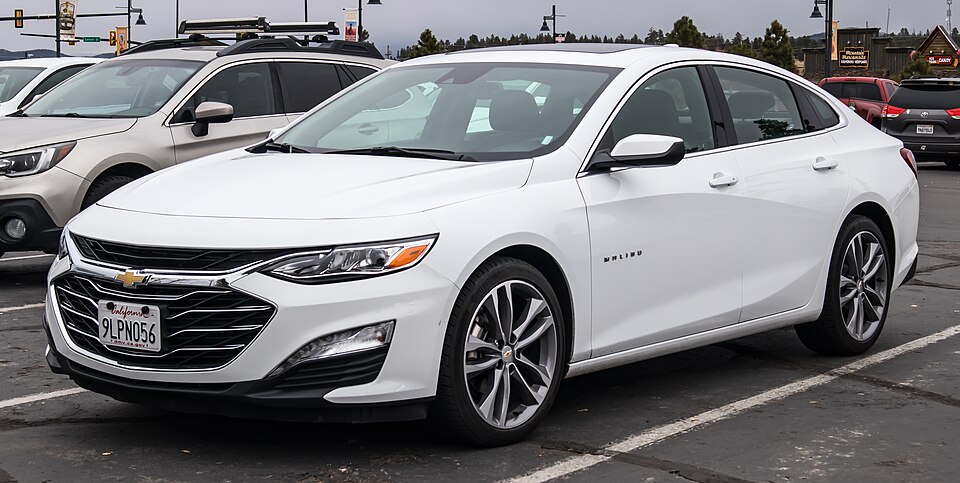
- Clase
- Auto mediano
- Carrocerías
- Ls/Lt 4dr Sedan FWD, Ltz 4dr Sedan FWD
- Motores
- 2.4L 4 cil., 3.5L 6 cil., 3.6L 6 cil.
- Tracción
- Tracción delantera
- Combustible
- Híbrido, Gasolina regular, FFV
- MPG (mejor)
- 29 combinadas · 26 ciudad / 34 carretera
- Largo
- 191.7 in
- Peso en vacío
- 3,415–3,649 lb
- Calificación NHTSA
- Sin calificar
- Retiros
- 3 campañas
Ventajas y desventajas
Lo bueno
- Excelente consumo de combustibleHasta 29 MPG combinadas: un 31 % mejor que el promedio de su clase (auto mediano, 2010: 22.2 MPG).
- Disponible en versión híbridaSe ofrece en versión híbrida además de gasolina.
A tener en cuenta
- Muchas quejas de propietarios974 quejas ante la NHTSA frente a unas 112 de modelos similares; sobre todo por problemas de dirección.
Calculado con datos de la EPA, la NHTSA y vPIC frente a 26 modelos similares 2010; no es una reseña. Cómo lo calculamos →
Resumen
El Chevrolet Malibu 2010 es un auto mediano disponible con 3 motores (2.4L 4 cil., 3.5L 6 cil. y 3.6L 6 cil.), incluida una versión híbrida, con tracción delantera.
Mide unas 192 pulgadas de largo y 71 de ancho, con una distancia entre ejes de 112 pulgadas, y pesa alrededor de 3,415 lb (Ls/Lt 4dr Sedan FWD).
La EPA califica su versión más eficiente con 29 MPG combinadas (26 en ciudad / 34 en carretera), un 31 % mejor que el promedio de su clase (auto mediano, 2010: 22.2 MPG), con un gasto estimado de $2,300 al año en combustible.
Tiene 3 campañas de retiro registradas y los propietarios han presentado 974 quejas ante la NHTSA desde 2015, sobre todo por problemas de dirección.
Novedades del 2010
Sin cambios en motores, versiones, tracción, tamaño, consumo EPA ni calificación NHTSA respecto al Malibu 2009: un año sin cambios según los datos.
Comparado con 2009; no incluye cambios de versiones, equipamiento ni precio. Ver el Malibu 2009 →
Dimensiones y peso
| Carrocería | Largo | Ancho | Alto | Distancia entre ejes | Vía del. / tras. | Peso en vacío | Peso del./tras. |
|---|---|---|---|---|---|---|---|
| Ls/Lt 4dr Sedan FWD | 191.7 in | 70.5 in | 57.1 in | 112.2 in | 59.8 / 60.2 in | 3,415 lb | 59/41 |
| Ltz 4dr Sedan FWD | 191.7 in | 70.5 in | 57.1 in | 112.2 in | 59.8 / 60.2 in | 3,649 lb | 59/41 |
Transport Canada CVS (Open Government Licence – Canada), medidas del mercado canadiense.
¿Cabe en tu garaje? Compruébalo con tus medidas →Motores, consumo y costo de uso
| Versión | Motor | Transmisión | Tracción | Ciudad / Carr. / Comb. | vs. su clase | Combustible / año | CO₂ g/mi |
|---|---|---|---|---|---|---|---|
| Malibu Hybrid Híbrido | 2.4L 4 cil. | Automática 4-spd | Tracción delantera | 26 / 34 / 29 | +31% | $2,300 | 306 |
| Malibu | 2.4L 4 cil. | Automática (S6) | Tracción delantera | 22 / 33 / 26 | +17% | $2,600 | 342 |
| Malibu FFV | 2.4L 4 cil. | Automática (S6) | Tracción delantera | 22 / 33 / 26 | +17% | $2,600 | 342 |
| Malibu | 2.4L 4 cil. | Automática 4-spd | Tracción delantera | 22 / 30 / 25 | +13% | $2,700 | 355 |
| Malibu FFV | 2.4L 4 cil. | Automática 4-spd | Tracción delantera | 22 / 30 / 25 | +13% | $2,700 | 355 |
| Malibu FFV | 3.5L 6 cil. | Automática 4-spd | Tracción delantera | 19 / 29 / 23 | +4% | $2,900 | 386 |
| Malibu | 3.5L 6 cil. | Automática 4-spd | Tracción delantera | 18 / 29 / 22 | -1% | $3,050 | 404 |
| Malibu | 3.6L 6 cil. | Automática (S6) | Tracción delantera | 17 / 26 / 20 | -10% | $3,350 | 444 |
Estimaciones de la EPA; "vs. su clase" compara las MPG combinadas con el promedio 2010 de su clase EPA. Cómo lo calculamos →
Calificaciones de seguridad y tecnología
La NHTSA no ha publicado calificaciones de 5 estrellas para el Chevrolet Malibu 2010 con el programa de pruebas actual (2011+).
Auto mediano similares 2010
| Modelo | Mejor MPG / autonomía | General NHTSA | Retiros |
|---|---|---|---|
| Chevrolet Malibu 2010 (este auto) | 29 MPG | Sin calificar | 3 |
| Ford Mustang 2010 | 21 MPG | Sin calificar | 5 |
| Honda Accord 2010 | 25 MPG | Sin calificar | 13 |
| Chevrolet Impala 2010 | 22 MPG | Sin calificar | 4 |
| Toyota Camry 2010 | 34 MPG | Sin calificar | 8 |
| Chevrolet Camaro 2010 | 22 MPG | Sin calificar | 1 |
| Nissan GT-R 2010 | 17 MPG | Sin calificar | 0 |
Retiros (3)
Texto oficial de la NHTSA (en inglés).
Bolsas de aire › Frontal › Driver Side › Inflator Module · 16 ene 2019
Campaña NHTSA 19V019000 · 1,145 vehículos
- Problema
- General Motors LLC (GM) is recalling certain 2010-2011 Chevrolet Malibu vehicles. In the event of a crash necessitating deployment of the driver frontal air bag, the air bag inflator may explode due to being overpressurized.
- Riesgo
- If the inflator explodes, sharp metal fragments may strike the driver or other occupants resulting in serious injury or death.
- Solución
- GM has notified owners, and dealers will replace the front driver air bag module, free of charge. The recall began February 25, 2019. Owners may contact GM customer service at 1-800-522-9559. GM's number for this recall is N182206630.
Control de estabilidad (ESC) · 14 may 2014
Campaña NHTSA 14V252000 · 2,440,524 vehículos
- Problema
- General Motors LLC (GM) is recalling certain model year 2004-2012 Chevrolet Malibu vehicles manufactured May 16, 2003, through October 11, 2012, 2004-2007 Malibu Maxx vehicles manufactured June 25, 2003, through April 5, 2007, 2005-2010 Pontiac G6 vehicles manufactured May 26, 2004, through January 4, 2010, and 2007-2010 Saturn Aura vehicles manufactured April 24, 2006, through May 26, 2009. In the affected vehicles, increased resistance in the Body Control Module (BCM) connection may result in voltage fluctuations in the Brake Apply Sensor (BAS) circuit. These fluctuations can cause one or more of these conditions: the brake lights to illuminate without the brake pedal being pushed; the brake lights to not illuminate when the pedal is pushed; difficulty disengaging the cruise control; moving the gear shifter out of the 'PARK' position without pushing the brake; and disablement of crash avoidance features such as traction control, electronic stability control, and panic braking assist features.
- Riesgo
- Any of the above failure conditions increases the risk of a crash.
- Solución
- GM will notify owners, and dealers will attach the wiring harness to the BCM with a spacer, apply dielectric lubricant to both the BCM and harness connector and the BAS and harness connector, and will relearn the brake pedal home position, free of charge. The manufacturer distributed an Interim letter to customers on July 14, 2014. The recall began on August 18, 2014. Owners may contact General Motors customer service at 1-800-222-1020 (Chevrolet), 1-800-762-2737 (Pontiac), 1-800-553-6000 (Saturn). GM's number for this recall is 13036.
Tren motriz › Transmisión automática › Gear Position Indication (Prndl) · 18 sept 2012
Campaña NHTSA 12V460000 · 426,240 vehículos
- Problema
- General Motors (GM) is recalling certain model year 2007-2010 Saturn Aura and model year 2008-2010 Chevrolet Malibu and Pontiac G6 vehicles, equipped with a 4-speed automatic transmission. On these vehicles, the tabs on the transmission shift cable end may fracture and separate.
- Riesgo
- If the tabs were to fracture and separate, the shift lever and the actual position of the transmission gear may not match. The driver would be able to move the shifter to 'PARK' and remove the ignition key, but the transmission gear may not be in 'PARK.' The vehicle may not be able to be restarted and the vehicle could roll away after the driver has exited the vehicle, resulting in a possible crash without prior warning.
- Solución
- GM will notify owners, and dealers will install a retainer over the cable end or replace the shift cable as necessary. This service will be performed free of charge. Notification to owners began on on November 9, 2012. Owners were instructed to not bring their vehicles for repair until January 2013. Owners may contact General Motors at 1-800-521-7300.
No todos los Malibu 2010 están afectados: solo el VIN lo confirma.
Problemas reportados por propietarios
Reportes sin verificar; los más vendidos acumulan más.
Lista para comprar un Chevrolet Malibu 2010 usado
- Consulta el VIN en nhtsa.gov/recalls. 3 retiros en este año: pide comprobantes de reparación.
- Dirección — 364 reportes de propietarios. Gira el volante de tope a tope estacionado y en marcha; escucha ruidos y nota si la dirección está dura o suelta.
- Sistema eléctrico — 218 reportes de propietarios. Prueba todas las ventanas, seguros, luces, pantallas y puertos USB; revisa la antigüedad de la batería.
- Control de estabilidad (ESC) — 173 reportes de propietarios. Pregunta al vendedor y al mecánico específicamente por este sistema.
- Millaje a vigilar. Los propietarios suelen reportar problemas alrededor de las 85,000 millas; pregunta qué se reparó cerca de ese punto.
- Sistema híbrido. Busca luces de advertencia del sistema híbrido y pregunta si la batería de alto voltaje se reemplazó o sigue en garantía.
- Antes de pagar: historial de servicio, reporte de antecedentes e inspección de un mecánico independiente.
Generado por DecodedCars a partir de retiros y quejas de propietarios ante la NHTSA para el Chevrolet Malibu 2010. No sustituye una inspección profesional.
Otros años del Malibu
Comparar todos los años →| Año | MPG (mejor) | Largo | General | Retiros | Quejas |
|---|---|---|---|---|---|
| Malibu 2025 | 31 | 193.7 in | ★★★★★ | 1 | 12 |
| Malibu 2024 | 31 | 193.7 in | ★★★★★ | 2 | 44 |
| Malibu 2023 | 30 | 193.7 in | ★★★★★ | 2 | 72 |
| Malibu 2022 | 32 | 193.7 in | ★★★★★ | 1 | 99 |
| Malibu 2021 | 32 | 193.7 in | ★★★★★ | 2 | 90 |
| Malibu 2020 | 32 | 193.7 in | ★★★★★ | 1 | 199 |
| Malibu 2019 | 46 | 193.7 in | ★★★★★ | 1 | 195 |
| Malibu 2018 | 46 | 193.7 in | ★★★★★ | 6 | 711 |
| Malibu 2017 | 46 | 193.7 in | ★★★★★ | 4 | 726 |
| Malibu 2016 | 46 | 193.7 in | Sin calificar | 10 | 865 |
| Malibu 2015 | 29 | 191.7 in | Sin calificar | 3 | 267 |
| Malibu 2014 | 29 | 191.7 in | Sin calificar | 6 | 330 |
Fuentes: EPA, NHTSA, Transport Canada, Wikimedia Commons. Sin afiliación con la NHTSA, la EPA ni Chevrolet. Cómo lo calculamos →