 DecodedCars
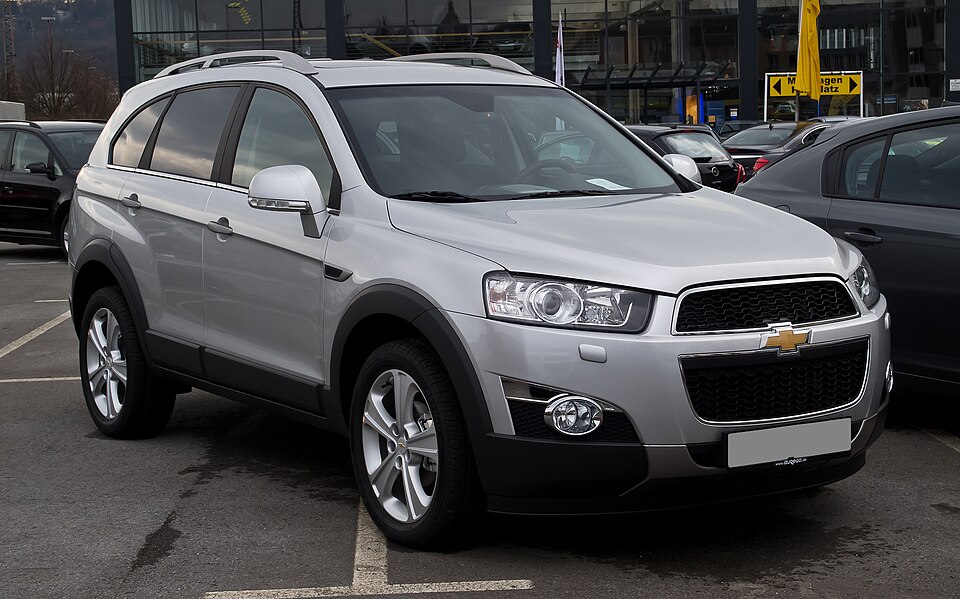
Chevrolet Captiva
4 model years from 2012 to 2015, compared on size, efficiency, safety and reliability.
- Model years
- 2012–2015
- Class
- Small Sport Utility Vehicle 2WD, Sport Utility Vehicle - 2WD
- Latest engines
- 2.4L 4-cyl
- Best MPG
- 23–23 combined, by year
- Latest rating
- Not rated
- Recalls
- 2 campaigns, all years
- Most complaints
- 2014 (141)
- Fewest problems
- 2015
- Interest
- 5,608 Wikipedia views / 30 days
The 2015 Captiva in brief
The 2015 Chevrolet Captiva is a small SUV offered with a 2.4L 4-cyl engine and front-wheel drive.
EPA rates its most efficient version at 23 MPG combined (20 city / 28 highway), 4% worse than the 2015 small SUV average of 24 MPG, for an estimated $2,900 a year in fuel.
NHTSA has not published a 5-Star overall rating for this model year.
It has 0 recall campaigns on file and owners have filed 14 complaints with NHTSA since 2015, most often about the electrical system.
The Chevrolet Captiva has 4 model years in our data, from 2012 to 2015, classed as Small Sport Utility Vehicle 2WD, Sport Utility Vehicle - 2WD.
Its most efficient year was 2015 at 23 MPG combined; across all years the best version ranged from 23 to 23 MPG.
Owners most often report problems with the electrical system (172), engine (129), unknown or other (73).
2012 has the most recalls (2); all years together count 2 campaigns and 399 owner complaints.
How the 2012 Captiva compares
The 2012 Chevrolet Captiva is a SUV - offered with 2 engines (2.4L 4-cyl and 3.0L 6-cyl) and front-wheel drive and all-wheel drive.
EPA rates its most efficient version at 23 MPG combined (20 city / 28 highway), 10% better than the 2012 SUV - average of 20.9 MPG, for an estimated $2,900 a year in fuel.
About the Chevrolet Captiva
The Chevrolet Captiva is a compact crossover SUV marketed by General Motors. The first generation was developed by GM Korea, based on the GM Theta platform and derived from the S3X concept car revealed in 2004. Released in 2006, it was sold internationally as the Chevrolet Captiva, in Australia and New Zealand as the Holden Captiva and in South Korea as the Daewoo Winstorm prior to the adoption of its international name in 2011, when the Daewoo brand was discontinued. The vehicle shares much its underpinnings with the similarly-styled Opel/Vauxhall Antara / second-generation Saturn Vue, with the Captiva offering optional third-row seating.
From the Wikipedia article "Chevrolet Captiva", licensed under CC BY-SA 4.0.
2015 Captiva pros & cons
Full 2015 details →What's good
- Few owner complaints14 complaints filed with NHTSA versus about 299 for similar models.
- No recalls so far
Watch out for
- No AWD or 4WDTwo-wheel drive only, unusual for a small SUV.
Captiva changes by model year
- 2015
- Engine dropped: 3.0L 6-cyl
- All-wheel / four-wheel drive no longer offered
Years without a measurable change are left out.
Show all 4 model years side by side
Alternatives to the 2015 Captiva
| Model | Best MPG / range | NHTSA overall | Recalls |
|---|---|---|---|
| 2015 Toyota RAV4 | 26 MPG | ★★★★★ | 4 |
| 2015 Honda CR-V | 29 MPG | ★★★★★ | 3 |
| 2015 Hyundai Tucson | 25 MPG | ★★★★★ | 2 |
| 2015 Subaru Forester | 27 MPG | ★★★★★ | 3 |
| 2015 Mazda CX-5 | 29 MPG | ★★★★★ | 3 |
| 2015 Jeep Wrangler | 18 MPG | Not rated | 3 |
Most common owner-reported problems
Sources: EPA, NHTSA, Transport Canada, Wikipedia, Wikimedia Commons. Not affiliated with NHTSA, the EPA or Chevrolet. How we calculate this →